The UFO Library: Mass sighting
The Cosford Incident (1993)
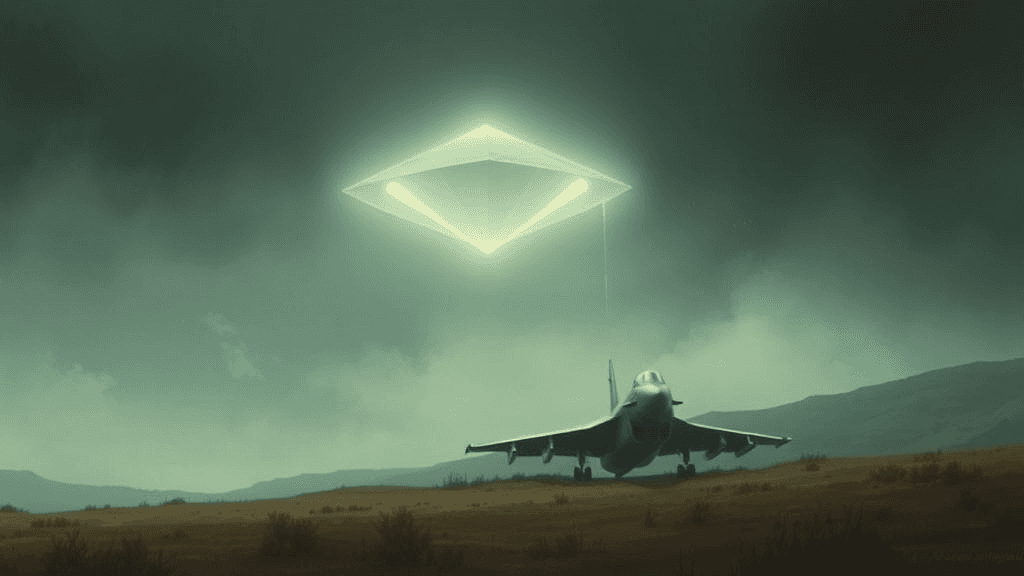
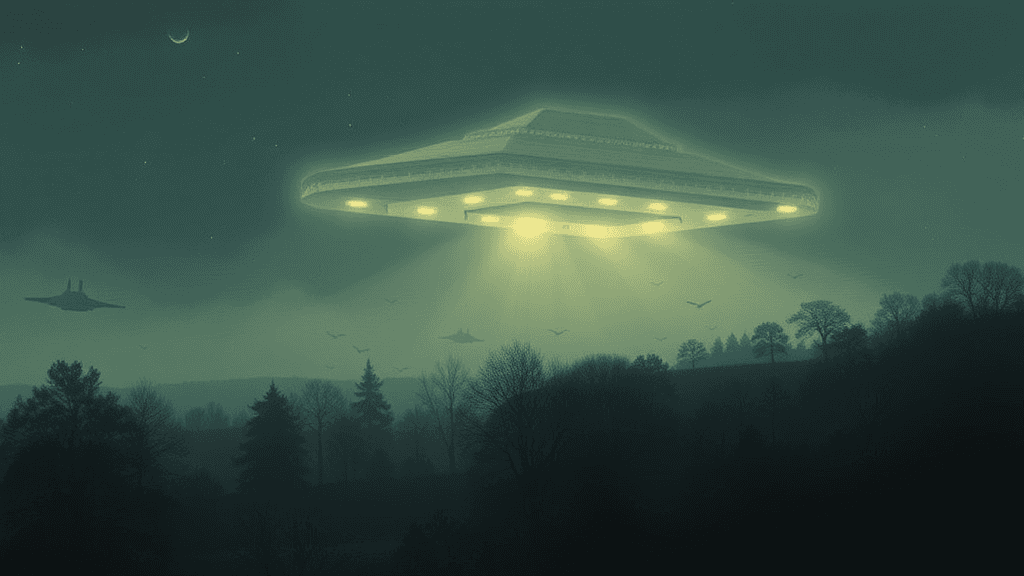
On the night of 30–31 March 1993, more than a hundred witnesses across the British mainland — including MoD police, military staff, and a meteorological officer — reported a massive triangular or delta-shaped craft traversing the UK from west to east; the episode became the most thoroughly documented UFO mass-sighting in British history and triggered a formal MoD defence assessment.
Background
By the early 1990s the British Ministry of Defence maintained a small but active UFO reporting desk — Secretariat (Air Staff) 2a, popularly known as the "UFO desk" — staffed at the time by a junior executive officer named Nick Pope. Pope's brief was to assess whether any reported sighting had defence implications: whether, for instance, a foreign power might be testing a novel reconnaissance vehicle over British soil. Most reports were filed and forgotten. The night of 30–31 March 1993 would prove a conspicuous exception.
The date carried an odd resonance. Exactly three years earlier — on the night of 30–31 March 1990 — the Belgian UFO wave had produced its most dramatic episode: military radar locked onto a slow, low-altitude object over the Ardennes before two F-16 fighters were scrambled in a vain attempt to intercept it. The Belgian object too had been described as triangular, nearly silent, and unaccountably agile. No one in the UK was looking for a repetition, but the similarity of what unfolded would not be lost on later commentators.
That same evening, Russian authorities launched a Zenit-2 rocket from the Baikonur Cosmodrome carrying the Cosmos 2238 military satellite. The rocket's spent upper stage — a Tsyklon 22586U booster — was scheduled to re-enter Earth's atmosphere in the early hours of 31 March, fragmenting in a luminous fireball along a trajectory crossing Ireland, south-west England, and eventually northern France and Spain. Neither British civilian air traffic control nor RAF radar nets were warned in advance.
Events
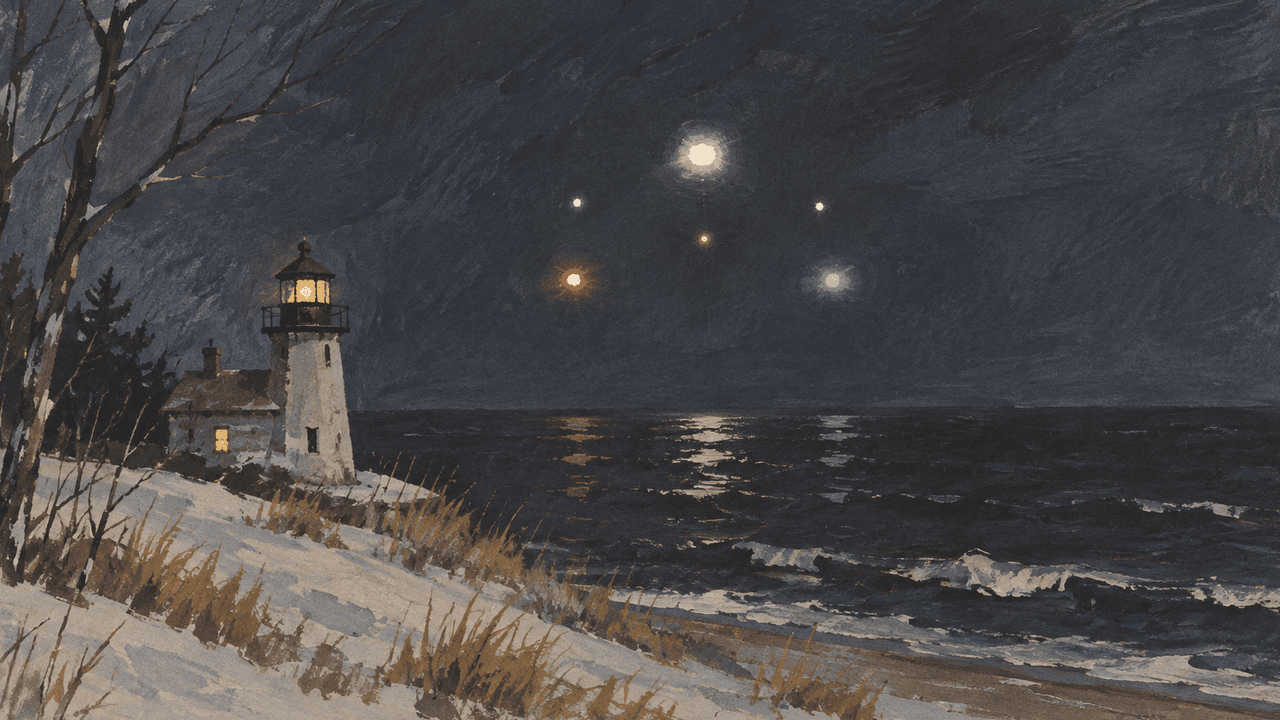
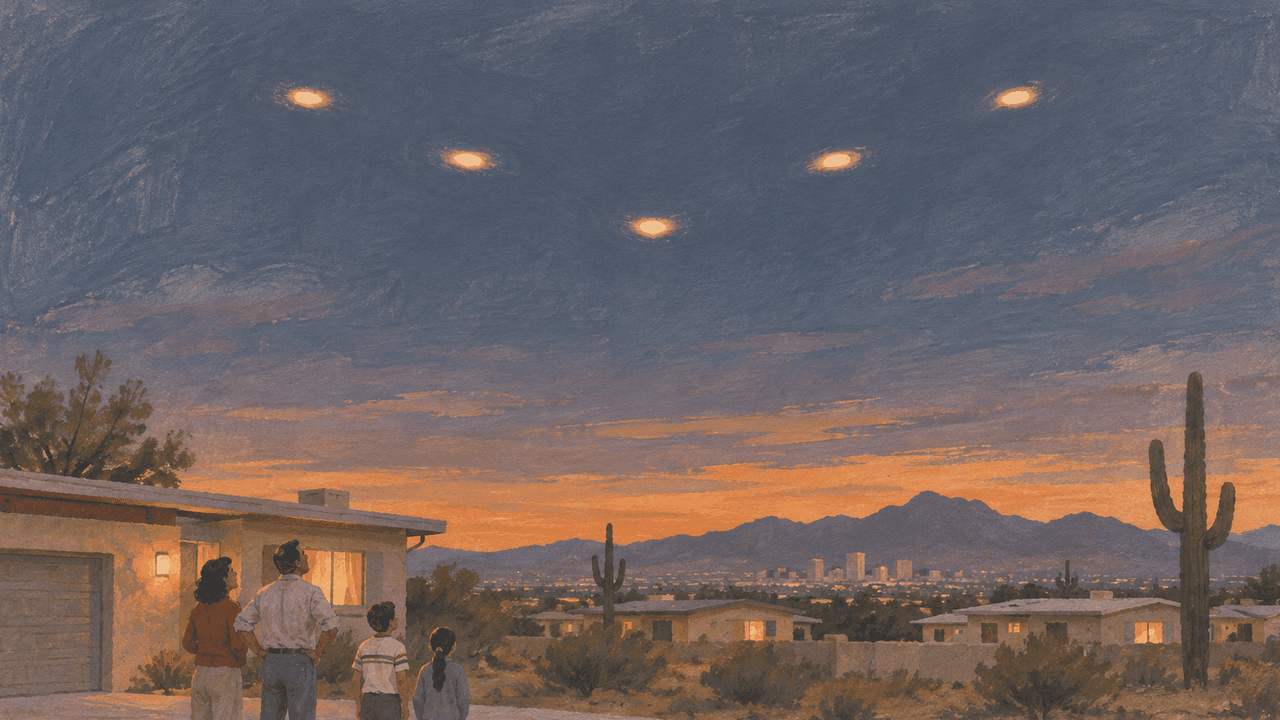
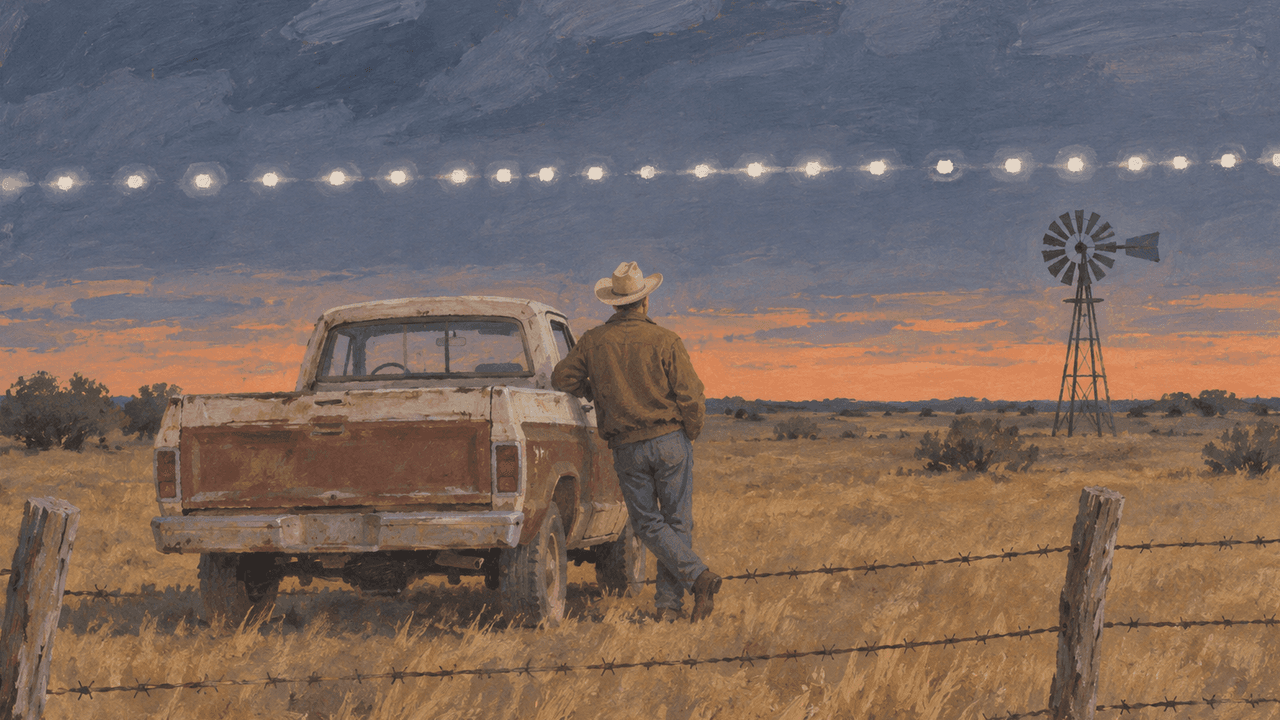
The first wave of reports reached emergency services at approximately 1:10–1:15 AM BST on 31 March. Calls flooded into police stations across Somerset, Devon, and Cornwall describing brilliant white lights moving in close formation at high altitude. A Somerset police officer offered one of the most vivid characterisations on record: the object, he said, resembled "two Concordes flying side by side and joined together" — a large, blunt, delta-wing silhouette lit from beneath. Reports from the Welsh foothills arrived next, with an observer later identified as author Peter Brookesmith among those watching a cluster of lights transit the sky. Civilian witnesses in the English Midlands contacted Shropshire police. Before long, sightings had extended to Ireland and, according to some accounts, northern France and Spain — an arc of observation covering hundreds of miles.
The pattern shifted notably when sightings reached the English Midlands. At approximately 1:10 AM, an MoD police patrol at RAF Cosford in Shropshire — two officers on routine security rounds — spotted two brilliant white lights with short vapour trails moving steadily to the south-east. The object was silent and appeared to be at significant altitude. They filed a formal report and, crucially, telephoned RAF Shawbury — a meteorological training station twenty miles to the north-west — to alert colleagues to watch the sky.
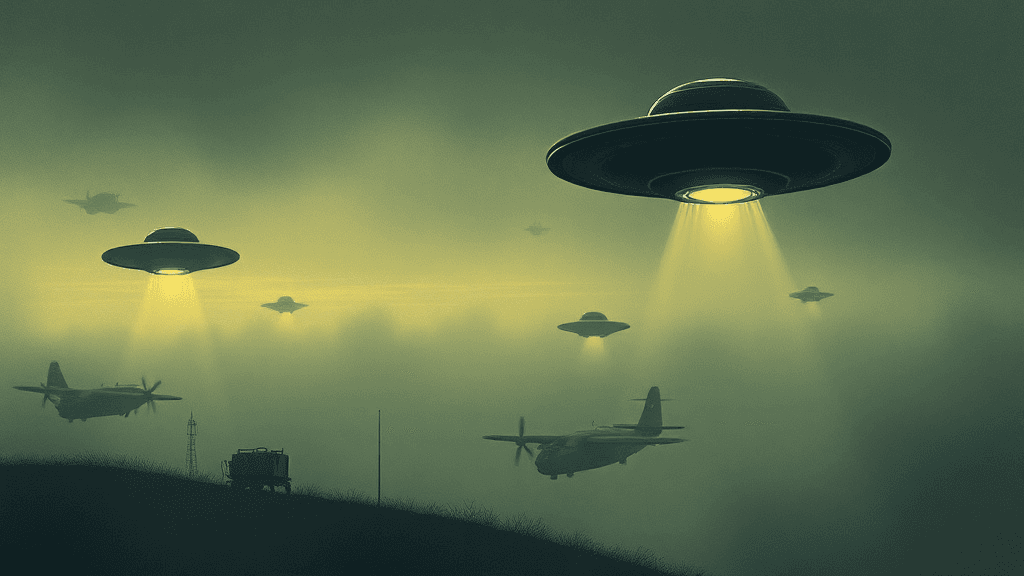
The most consequential single account of the night came from Wayne Elliott, the on-duty meteorological observer at RAF Shawbury. Alerted by the Cosford phone call, Elliott went outside and waited. At approximately 2:40 AM BST — roughly ninety minutes after the first cluster of sightings — he observed something he described as altogether unlike any conventional aircraft. The object was at low altitude, between 400 and 500 feet above the ground. He estimated its size as somewhere between a C-130 Hercules transport and a Boeing 747. Its most striking feature was a narrow beam of light projecting downward, slowly sweeping the terrain below in a methodical pattern he likened to a search operation. Accompanying it was a low-frequency humming sound unlike any aircraft engine he had encountered. He reported three red lights at the rear of the craft and a single brilliant white light at the front. After hovering and scanning, the object accelerated rapidly and disappeared to the south-east.
A civilian family from Rugeley, Staffordshire, independently reported chasing an object by car across open countryside. They estimated the craft at approximately 200 metres in diameter and believed it had landed in a nearby field; when they arrived at the spot seconds later, nothing was present. A crew aboard an Irish Defence Corps helicopter reported two bright, unaccountable lights at altitudes between 500 and 3,000 feet over Ireland during the same window.
In total, across the two-night reporting period, the MoD eventually compiled statements from approximately 70 to over 100 witnesses, making it by any measure one of the most densely witnessed aerial anomalies in British peacetime history.
Investigation
Nick Pope opened a formal file — catalogued as DEFE 24/2086/1 — and began collating witness statements. His analysis, forwarded through the chain of command to Air Marshal Anthony Bagnall, then Assistant Chief of Air Staff (ACAS), contained a striking sentence that would be quoted in UFO literature for decades: an unidentified object of unknown origin operating in the UK Air Defence Region without appearing on radar, he wrote, "would appear to be of considerable defence significance." Pope recommended further investigation and noted that the performance characteristics described — low speed, low altitude, silent or near-silent operation, a downward-searching light beam — did not match any British, American, or allied aircraft on record.
The assessment alarmed senior staff sufficiently that DI55, the defence intelligence branch responsible for evaluating foreign aerospace capabilities, was consulted. There was at the time active speculation — never confirmed — about the existence of a classified American hypersonic reconnaissance aircraft informally nicknamed "Aurora" that some researchers invoked to explain triangular sightings across Western Europe. DI55 found no match in any known programme.
Civilian investigation ran in parallel. Gary Anthony, a consultant to BUFORA (the British UFO Research Association), obtained the re-entry parameters for the Cosmos 2238 rocket booster from NASA and US Space Command data and ran a computer simulation of its decay path. The results were striking: the booster's trajectory matched the geographic and temporal distribution of the first-wave sightings — Somerset, Devon, the Welsh foothills, Ireland — with considerable precision. A fragmenting orbital body re-entering at high altitude would appear as a cluster of bright, slow-moving lights on a steady south-south-easterly bearing, exactly as witnesses had described.
By May 1993, Pope acknowledged in an internal memo that the satellite re-entry theory "might explain some of the high-altitude sightings." By 1994, he stated publicly that "most of the UFO sightings reported on this occasion can be attributed to this event" — while continuing to note that some accounts, particularly Elliott's, remained unaccounted for.
The Case For and Against
The Cosford incident presents a textbook study in how a single night can produce multiple, genuinely distinct phenomena that are then conflated into a single narrative — with important consequences for how credibility is assessed.
The case for prosaic explanations is strong. The first-wave sightings — the Somerset "two Concordes" account, the Welsh foothills lights, reports from Ireland and northern France — align well with the Cosmos 2238 re-entry at 1:15 AM BST. Rocket-body re-entries routinely produce spectacular multi-witness events: fragmenting debris glows in orange, white, and red hues; pieces separate into apparent formations; the event is silent from the ground; it lasts two to five minutes. Witnesses unfamiliar with re-entries reliably describe "structured craft." The cross-border scope of the first-wave sightings — simultaneously reported from Ireland, England, France, and Spain — is itself strong evidence for a high-altitude, single-pass event rather than a low-flying vehicle.
Wayne Elliott's sighting posed the harder problem for years. His observation occurred at 2:40 AM — ninety minutes after the confirmed re-entry window — at low altitude over Shropshire, not along the booster's high-altitude arc. A fragmenting orbital body cannot hover, cannot sweep a searchlight, and cannot be heard. For more than a decade, Elliott's account stood as the strongest evidence that something genuinely anomalous had been in the Midlands sky that night.
Resolution came in 2005, when a former RAF Shawbury airman contacted UFO researcher Dr David Clarke of Sheffield Hallam University. The airman identified the object Elliott had observed as a Dyfed-Powys police helicopter equipped with a NiteSun searchlight, on active pursuit of a stolen vehicle travelling along the A5 near its junction with the A49. The helicopter's spotlight, sweeping the ground in a search pattern at low level, matched Elliott's description point for point. The "low-frequency hum" was consistent with the turbine engine of a helicopter heard at distance through cool night air. Elliott himself, when presented with the explanation, acknowledged it was plausible — he noted that he had been telephoned minutes before his observation and primed to expect a UFO, a documented precondition for perceptual misidentification.
The black triangle shape reported by some witnesses — including the Cosford MoD police patrol — is a persistent pattern across the UFO literature from the late 1980s onward. Some researchers attribute triangular sightings to classified US or NATO aircraft; the B-2 Spirit stealth bomber had been publicly revealed in 1988 and the F-117 Nighthawk acknowledged in 1988 as well, but neither platform matches the described flight characteristics. Others argue that witnesses observing three lights — say, the navigation lights of a conventional aircraft — perceive a solid connecting shape between them, a well-documented perceptual effect.
Cultural Impact
The Cosford incident became a central case in the growing public profile of Nick Pope, who left the MoD in 1994 and published Open Skies, Closed Minds (1996), which devoted substantial attention to the case. Pope's framing — a credentialled government insider, in post at the time, genuinely alarmed by the witness accounts — gave Cosford a legitimacy in the UFO literature that civilian-only sightings rarely achieved. He appeared on numerous television programmes citing the case as evidence that the British government had encountered something it could not explain.
The case also fed the British dimension of the 1990s UFO cultural moment: the era of The X-Files, the renewed public interest in the Rendlesham Forest incident, and a succession of Freedom of Information Act requests that began prising open MoD files. Cosford was cited by researchers as evidence that the British state had encountered a genuine anomaly and had declined to publicise it — a claim that Pope's own published memos appeared to support.
The 2006–2013 MoD UFO files release programme, coordinated by The National Archives, included DEFE 24/2086/1 in its tranches, allowing independent scrutiny of Pope's original assessments and the raw witness statements. Dr David Clarke, who served as academic consultant to the National Archives on the releases, later published his forensic reconstruction of the case — including the police-helicopter identification — as a model of careful prosaic analysis applied without dismissing witnesses.
The case gained unexpected additional attention in 2018 when the Shropshire Star reported that the incident may have been cross-referenced by AATIP researchers during the classified US programme's 2007–2012 run, though supporting documentation for this claim has not been publicly released.
Current Status
The scholarly consensus — represented most clearly by Dr David Clarke's 2023 thirtieth-anniversary analysis — is that the Cosford incident consists of at least two separable events: the Cosmos 2238 booster re-entry, which accounts for the first-wave sightings across south-west England and Wales at approximately 1:10–1:15 AM; and the Elliott/Shawbury sighting at 2:40 AM, most plausibly explained as the Dyfed-Powys police helicopter with its NiteSun searchlight active on an A5 pursuit. Clarke considers the case effectively closed on the available evidence.
Nick Pope, while accepting that those explanations account for the mechanics, has continued to argue in interviews and public appearances that the incident merits attention as a case study in British government UFO management — an example of genuine institutional concern expressed internally and suppressed publicly. He draws a contrast with the dismissive posture that characterised official US handling in the same period, pointing to his own memos as evidence of a more serious internal assessment than any public statement acknowledged.
File DEFE 24/2086/1 remains publicly accessible through The National Archives at Kew and is among the most-requested documents in the British UFO archive. Whatever the objects above RAF Shawbury and the Somerset countryside actually were, the Cosford incident endures as proof that mass aerial anomalies can penetrate military bureaucracy, generate classified assessments of "considerable defence significance," and still yield, upon patient investigation, identifications that no one had thought to check at the time.
Witnesses
- Wayne Elliott (Met Office observer, RAF Shawbury): the most-cited single witness; described a low-altitude, slow-moving object with a downward-searching light beam, low-frequency humming sound, and red/white lights at approximately 2:40 AM; later acknowledged the Dyfed-Powys police helicopter as a plausible explanation.
- MoD police patrol, RAF Cosford: two officers who reported two brilliant white lights with vapour trails moving south-east at approximately 1:10 AM; their call to Shawbury primed Elliott's subsequent observation.
- Somerset police officer: described a craft resembling "two Concordes flying side by side and joined together" — a large delta-wing silhouette with lights.
- Peter Brookesmith (author/researcher): observed the lights from the Welsh foothills during the first-wave event.
- Irish Defence Corps helicopter crew: reported two bright, unaccountable lights at 500–3,000 feet altitude over Ireland during the same window.
- Rugeley family (Staffordshire, civilians): chased an object by car, estimated it at approximately 200 metres in diameter, believed it landed in a field but found nothing at the site.
- Total estimated witness count across the two-night reporting period: 70–100+ across England, Wales, and Ireland.
Evidence
- DEFE 24/2086/1: original MoD file compiled by Nick Pope, held at The National Archives, Kew; includes raw witness statements, internal memos, and Pope's assessment that an unknown object in UK airspace without radar detection constituted a matter of "considerable defence significance."
- Cosmos 2238 re-entry data: NASA and US Space Command confirmed that the Tsyklon 22586U rocket booster re-entered at approximately 1:15 AM BST on 31 March 1993 on a trajectory from Ireland south-eastward across England — matching the first-wave sighting distribution.
- BUFORA computer simulation: Gary Anthony's analysis mapped the booster's decay path against witness locations and reported times, achieving close correspondence for the Somerset/Devon/Wales/Ireland sightings.
- Police helicopter confirmation (2005): former RAF Shawbury airman identified the Dyfed-Powys police helicopter with NiteSun searchlight as the source of Elliott's 2:40 AM observation; information provided to Dr David Clarke.
- No radar contact during event: RAF and civilian ATC found no radar returns matching the reported objects; initially treated as anomalous, later attributed to the re-entering booster being too brief and high for radar, and the helicopter operating below the ground-radar envelope.
- Chain-of-command briefing: Pope's assessment was forwarded to Air Marshal Anthony Bagnall (ACAS) and consulted with DI55 (Defence Intelligence Staff), establishing official acknowledgment at senior level.
Filed under
Watch
The Most Shocking Alien Encounters Ever | Ancient Aliens
Ross Coulthart investigates UK's UFO Phenomenon
3 Eyewitness Accounts of Alien Encounters | Ancient Aliens | History
Cosford UFO Incident & Mike Debardeleben - Creepy Mysteries
The 1993 Cosford Incident: Nick Pope’s Turning Point on UFOs
Where this entry came from
ProvenanceAgent indexedUpdated 5mo ago8 sources
Drafted by the archive's AI research agent from the sources below; corrections from readers are reviewed and folded in.
- First indexed
- 04 JUN 26 // 08:18Z
- Last updated
- 11 JUN 26 // 04:47Z
- Case Closed: 30th Anniversary of the Cosford Incident, David Clarke, Dr David Clarke's Substack
- UFO files — research guide, The National Archives, The National Archives
- The Cosford Incident – The British UFO Mystery, Marcus Lowth, UFO Insight
- Cosford, Shropshire, England, March 1993, Enigma Labs, Enigma Labs Library
- 20 years since Cosford UFO mystery, Shropshire Star, Shropshire Star
- Was Shropshire's most notorious UFO incident secretly investigated by the Pentagon?, Shropshire Star, Shropshire Star
- Cosford UFO Incident — by Nick Pope, Nick Pope (original article), Physics Forums
- The 1993 Cosford Incident, Podcast UFO, Podcast UFO
Notes
- Case Closed: 30th Anniversary of the Cosford Incident, David Clarke, Dr David Clarke's Substack
- UFO files — research guide, The National Archives, The National Archives
- The Cosford Incident – The British UFO Mystery, Marcus Lowth, UFO Insight
- Cosford, Shropshire, England, March 1993, Enigma Labs, Enigma Labs Library
- 20 years since Cosford UFO mystery, Shropshire Star, Shropshire Star
- Was Shropshire's most notorious UFO incident secretly investigated by the Pentagon?, Shropshire Star, Shropshire Star
- Cosford UFO Incident — by Nick Pope, Nick Pope (original article), Physics Forums
- The 1993 Cosford Incident, Podcast UFO, Podcast UFO
Also available
UFOs Declassified
Canadian documentary series investigating declassified government UFO files. The premiere episode covers the Cosford Incident, examining the March 1993 UK military sightings of a triangular craft witnessed by RAF personnel and civilian witnesses over RAF Cosford and surrounding areas.
The British UFO Files
Documentary investigation into Britain's most significant UFO incidents declassified by the Ministry of Defence. Features eyewitness accounts and government documentation from the Cosford 1993 case, examining the triangular craft sighting and official military response.
UFO Files
History Channel documentary series examining declassified government files on UFO incidents. Series episodes investigate the Cosford sightings and other significant UK UFO cases, featuring interviews with witnesses, military officials, and UFO researchers.
Buying through these links supports the library. We may earn a commission.