The UFO Library: Military encounter
Foo Fighters of World War II
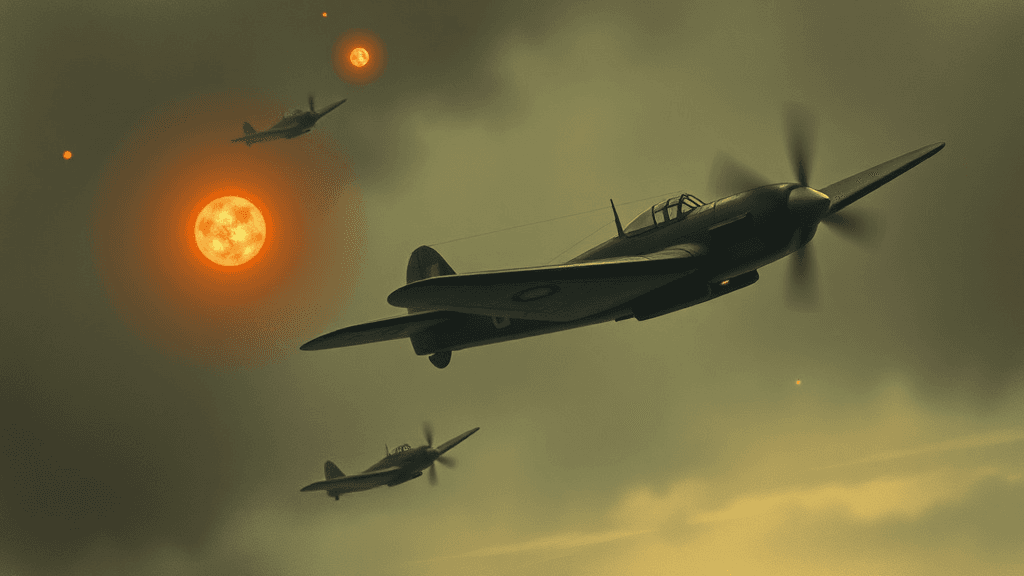
Allied pilots over Europe and the Pacific reported mysterious luminous orbs — red, orange, and white — that paced their aircraft at high speed, defied radar detection, and were never explained.
Background
By late 1944, the Allied air campaign over occupied Europe was at its peak. American and British bomber and night-fighter squadrons flew nightly sorties deep into German-held territory, their crews already contending with flak, Luftwaffe interceptors, and the psychological strain of sustained combat. Into this already harrowing environment arrived something entirely unexpected: glowing, silent objects that seemed to follow aircraft with apparent intelligence and purpose, yet never attacked.
The phenomenon was not limited to a single crew or a single night. Between November 1944 and the end of the war in Europe in May 1945, dozens of independent reports from multiple squadrons described luminous spheres — fiery orange, brilliant white, or pulsing red — that tracked Allied aircraft through evasive maneuvers, maintained formation at high speed, and vanished as mysteriously as they appeared. Similar reports emerged from the Pacific Theater, where B-29 crews over Japan and naval aviators over the Solomon Islands described "balls of fire" that hung in the sky or paced bombers on their runs. The wartime phenomenon came to be known as "foo fighters," a term that entered the English language from a comic strip and endured into the modern UFO lexicon as one of the earliest well-documented waves of military encounters with unidentified aerial phenomena.
Events
The First Encounters — November 1944
The encounter most often cited as the beginning of the foo fighter wave took place on the evening of November 23, 1944, near Strasbourg on the French-German border. Lieutenant Edward Schlueter was piloting a Bristol Beaufighter night fighter of the 415th Night Fighter Squadron, with Lieutenant Donald J. Meiers operating the radar and Lieutenant Fred "Fritz" Ringwald, the squadron's intelligence officer, riding as an observer. Over the Rhine Valley, the crew spotted eight to ten bright orange lights arranged in a row off their left wing, flying through the air at high speed. Schlueter's first instinct was evasive action — the lights could have been a new German weapon. But the objects matched every maneuver: when Schlueter banked to starboard, the lights followed; when he dove, they dove. Neither the aircraft's onboard radar nor Allied ground-control radar registered any targets in the area. After several minutes of pursuit, the lights simply winked out.
Ringwald, as intelligence officer, was especially well positioned to evaluate the encounter. He later reported that he was entirely sober, alert, and certain of what he had seen. In the debriefing that followed, radar operator Meiers — known for his dry humor — reportedly reached for a copy of the Smokey Stover comic strip, whose fireman protagonist used the nonsense catchphrase "where there's foo, there's fire." Meiers declared the objects "foo fighters," and the name stuck.
December 1944 — The Wave Intensifies
Over the following weeks, sightings from the 415th multiplied rapidly. On December 17, 1944, near Breisach, Germany, a pilot reported "five or six flashing red and green lights in a T-shape" that appeared to follow his aircraft before disappearing. On December 22, two additional crews from the squadron independently reported luminous spheres that rose from the ground and trailed their aircraft at altitude.
Lieutenant Wallace Gould provided one of the most vivid accounts. He described a glowing object that followed his wing tip for a time before suddenly ascending at tremendous speed to an altitude he estimated at over 20,000 feet. "We were very close to them," Gould told investigators, "and none of us saw any structure." The objects appeared to be pure light — no wings, no fuselage, no exhaust trail.
Meiers himself classified three distinct types of foo fighter behavior:
- Red fireballs that appeared off the wing tips and flew alongside the aircraft, maintaining pace through all maneuvers.
- Vertical formations of three fireballs that appeared ahead of the aircraft, seemingly positioned to observe the approaching plane.
- Clusters of approximately fifteen lights that Meiers compared to "a Christmas tree up in the air" — formations so bright and dense they were unmistakable.
The aircraft of the 415th were traveling at approximately 260 miles per hour during these encounters. The objects kept pace effortlessly.
The Story Breaks — January 1945
On December 31, 1944, Associated Press correspondent Robert C. Wilson visited the 415th to investigate the reports firsthand. His dispatch, published in the New York Times on January 2, 1945, brought the foo fighter phenomenon to the attention of the American public for the first time. The January 15, 1945, edition of Time magazine carried a story titled "Foo-Fighter," reporting that the balls of fire had been following night fighters for over a month. The articles prompted a wave of corroborating reports from other units.
8th Air Force and Bomber Crews
The sightings were not confined to the 415th or to night fighters. Major William D. Leet, a B-17 Flying Fortress pilot with the 8th Air Force, reported that during a mission from Austria to the Adriatic Sea, his bomber was "kept company" by a small, disc-shaped object that paced the aircraft for an extended period. The intelligence officer who debriefed Leet suggested it might be "a new German fighter," but could offer no explanation for why it never attacked or attempted interception.
The Royal Air Force had its own extensive file. RAF No. 178 Squadron reported "an intermittent red light" following their aircraft over Hungary as early as October 13, 1944, and the squadron logged numerous similar incidents stretching back to April 1944 — predating the 415th's reports by several months. Bomber Command crews across multiple groups reported encounters throughout the final year of the European war.
Researcher Keith Chester, whose 2007 book Strange Company: Military Encounters with UFOs in World War II represents the most thorough study of the wartime sightings, documented cases in which foo fighters were described as ball-shaped, saucer-shaped, and cigar-shaped — some reportedly larger than the bombers they followed. In one striking case, a bomber crew was followed by a luminous object for over fifty minutes, during which crew members reported feeling waves of heat emanating from it.
Pacific Theater — "Balls of Fire"
The Pacific Theater produced its own parallel wave. B-29 Superfortress crews of the 5th Air Force reported encounters with "red balls of fire" that paced their aircraft during bombing runs over Japan in the final months of the war. U.S. Navy and Marine pilots operating over New Guinea, the Solomon Islands, and elsewhere in the western Pacific described similar phenomena.
Career Air Force pilot Duane Adams related two encounters with a bright light that paced his aircraft for approximately thirty minutes each time, both occurring at night over the South Pacific. In both instances, the entire crew witnessed the object, which eventually "rapidly ascended into the sky" and disappeared. The Pacific sightings differed somewhat from the European reports in that the objects tended to be solitary — a single large burning sphere that "just hung in the sky" — rather than the clusters and formations reported over Germany.
Notably, the sightings were not exclusive to Allied forces. Reports eventually surfaced indicating that German and Japanese pilots had encountered similar phenomena, a fact that significantly undermined the hypothesis that the objects were Axis secret weapons.
Investigation
Wartime Intelligence Response
Captain Ringwald filed a formal report listing fourteen separate foo fighter incidents from December 1944 and early January 1945, which he forwarded to the intelligence section at XII Tactical Air Command. XII TAC, unable to explain the phenomenon, escalated the reports to the highest level available: Supreme Headquarters Allied Expeditionary Force (SHAEF) in Paris, under General Eisenhower's command. SHAEF had no knowledge of the phenomenon and relayed the inquiry to the British Air Ministry in London.
The Air Ministry's response, received on March 13, 1945, was underwhelming. It acknowledged that "Bomber Command crews have for some time been reporting similar phenomena" and suggested that "a few of the alleged aircraft may have been Me 262" jet fighters, with "flak rockets" proposed as "the most likely explanation" for the remainder. The Air Ministry conceded that "the whole affair is still something of a mystery."
The members of the 415th rejected these explanations outright. The Me 262 was a tangible aircraft with a visible airframe and engine exhaust — nothing like the structureless globes of light they had observed. Flares and weather balloons could not track aircraft through evasive maneuvers at 260 miles per hour. The crews were experienced combat aviators who were thoroughly familiar with St. Elmo's fire, anti-aircraft flak, and conventional pyrotechnics, and they insisted the foo fighters were none of these.
Postwar Analysis
After the war, examination of captured German records revealed no evidence of a secret weapon matching the foo fighter descriptions. The Germans, it turned out, had been as puzzled by the phenomenon as the Allies. Similarly, Japanese records offered no indication that the "balls of fire" seen in the Pacific were any product of Axis technology.
The Robertson Panel, convened by the CIA in January 1953 to review the U.S. government's UFO evidence, examined wartime foo fighter cases among its broader survey. The panel explored several natural explanations — electrostatic phenomena similar to St. Elmo's fire, electromagnetic effects, and reflections of light from ice crystals — but reached no definitive conclusion. The foo fighters were filed alongside the growing catalog of Cold War-era unidentified aerial phenomena without resolution.
Chester's archival research at the U.S. National Archives uncovered references to a joint U.S.-British foo fighter investigation conducted during the war itself, as well as a direct link between the wartime inquiries and postwar UFO studies by intelligence services — suggesting that the institutional interest in unidentified aerial phenomena predated Project Sign (1947) and Project Blue Book (1952) by several years.
The Case For
The foo fighter reports are among the most credible in the early UFO literature for several reasons. The witnesses were trained military aviators operating under combat conditions — people whose survival depended on accurate observation and rapid threat assessment. The reports came from multiple independent squadrons across two theaters of war, reducing the likelihood of collective delusion or a single unit's idiosyncrasy. The phenomenon persisted over many months and was observed by radar operators, pilots, navigators, gunners, and an intelligence officer. Notably, Senator Ted Stevens — later a powerful U.S. senator from Alaska — was among the pilots who reported a foo fighter encounter during his service in the European Theater, describing an object that "remained visible whether he slowed up, sped up, or dove," with nothing registering on radar.
The objects exhibited behaviors difficult to attribute to natural phenomena: they maintained formation with aircraft traveling at high speed, performed maneuvers that matched or exceeded the performance of the fastest Allied fighters, and appeared to respond to the movements of the aircraft they followed. The fact that both Allied and Axis pilots reported the phenomenon rules out any single nation's secret weapon program.
The Case Against
Skeptics have offered several explanations that, while none individually accounts for all reports, collectively suggest the phenomenon may have been a mixture of mundane causes amplified by the stress and sensory distortion of nighttime combat flying. Pilots flying at high altitude in cold, clear air could have encountered ball lightning, ice crystal reflections, or unusual atmospheric luminescence. St. Elmo's fire, though familiar to the crews, can take unusual forms under extreme conditions. Some sightings may have been misidentified flares, V-2 rocket exhaust plumes visible at great distances, or even the Me 163 Komet rocket interceptor — though the latter did not operate at night. Combat fatigue and the psychological strain of sustained nighttime operations over hostile territory may have made crews more prone to misinterpreting ambiguous visual stimuli.
The absence of any physical evidence — no wreckage, no photographs, no definitive radar tracks — also weakens the case. The reports, however vivid, remain purely testimonial.
Cultural Impact
The foo fighters occupy a foundational position in UFO history. They represent the first sustained wave of unidentified aerial phenomena reported by credible military witnesses and documented through official channels. The wartime sightings predated Kenneth Arnold's 1947 sighting — often cited as the beginning of the modern UFO era — by several years, and they demonstrate that the phenomenon of unexplained objects in military airspace is not a Cold War invention but extends back to the global conflict that preceded it.
The term "foo fighter" itself became embedded in the broader culture. The rock band Foo Fighters, founded by Dave Grohl in 1994, took its name directly from the WWII phenomenon, introducing the term to millions who had never heard of the wartime sightings. The wartime encounters feature prominently in virtually every comprehensive history of the UFO subject, from early works like Edward J. Ruppelt's The Report on Unidentified Flying Objects (1956) to Chester's exhaustive 2007 study.
The foo fighters also set an enduring template for military UFO encounters: objects that display apparent intelligence, outperform known aircraft, register on no instruments, exhibit no hostile intent, and ultimately defy explanation. This pattern would repeat — over Washington, D.C. in 1952, over Tehran in 1976, over the USS Nimitz in 2004 — forming a through-line that contemporary UAP researchers continue to trace.
Current Status
The foo fighters of World War II remain officially unexplained. No single proposed explanation — natural, technological, or psychological — has been accepted as definitive by historians or the intelligence community. The wartime records, scattered across American and British archives, have never been the subject of a comprehensive declassification effort, and Chester's research suggests that significant documentation may still await discovery.
In the context of the post-2017 UAP disclosure movement, the wartime sightings have taken on renewed significance. Advocates for greater government transparency about unidentified aerial phenomena point to the foo fighters as evidence that the phenomenon has a documented history stretching back at least eighty years, involving multiple nations' military forces. Whether the objects were atmospheric anomalies, misidentified technology, or something genuinely unknown, the foo fighters remain one of the most intriguing unsolved mysteries of the Second World War.
Witnesses
- Lt. Edward Schlueter — Pilot, 415th Night Fighter Squadron; piloted the aircraft during the first widely reported encounter on November 23, 1944
- Lt. Donald J. Meiers — Radar operator, 415th NFS; coined the term "foo fighters" from the Smokey Stover comic strip; classified three distinct types of foo fighter behavior
- Lt. Fred "Fritz" Ringwald — Intelligence officer, 415th NFS; observer during the first encounter; filed formal report documenting 14 incidents
- Lt. Wallace Gould — 415th NFS pilot who described a glowing object ascending over 20,000 feet at tremendous speed
- Major William D. Leet — B-17 pilot, 8th Air Force; reported a disc-shaped object pacing his bomber from Austria to the Adriatic
- Senator Ted Stevens — Future U.S. Senator; as an Air Force fighter pilot in Europe, reported an object that matched all maneuvers
- Duane Adams — Career USAF pilot; reported two encounters over the South Pacific witnessed by entire crew
- RAF No. 178 Squadron crews — Reported luminous objects over Hungary from as early as April 1944
- Numerous unnamed crews of the 415th NFS, 8th Air Force bomber groups, 5th Air Force B-29 squadrons, and RAF Bomber Command
Evidence
- Official military reports: Captain Ringwald's report listing 14 incidents forwarded through XII Tactical Air Command to SHAEF
- British Air Ministry response (March 13, 1945): Acknowledged the phenomenon as ongoing among Bomber Command crews; offered Me 262 and flak rockets as partial explanations while conceding the matter remained "a mystery"
- Press coverage: Robert C. Wilson's Associated Press dispatch published in the New York Times (January 2, 1945); Time magazine story "Foo-Fighter" (January 15, 1945)
- Robertson Panel review (January 1953): CIA-convened scientific panel examined foo fighter cases among broader UFO evidence
- Captured Axis records: Postwar examination revealed no German or Japanese weapon matching the descriptions; Axis pilots reported similar encounters
- Archival documentation: Keith Chester's research at the U.S. National Archives uncovered references to a joint U.S.-British wartime foo fighter investigation
- No physical evidence: No wreckage, photographs, or definitive radar tracks were recovered
Filed under
Watch
Project Blue Book: Declassified – The True Story of the Foo Fighters | History
The Mysterious Foo Fighters Of World War II
WWII pilots discuss their "foo fighter" UFO encounters
Foo Fighters - WWII's Mysterious UFOs
UFO Foo Fighters of World War II and the Korean War
Where this entry came from
ProvenanceAgent indexedUpdated 6mo ago8 sources
Drafted by the archive's AI research agent from the sources below; corrections from readers are reviewed and folded in.
- First indexed
- 27 APR 26 // 17:21Z
- Last updated
- 27 APR 26 // 17:21Z
- The story of American pilots encountering UFOs over Europe during WWII, Task & Purpose
- Foo Fighters in WWII, Enigma Labs
- What Were the Mysterious 'Foo Fighters' Sighted by WWII Night Flyers?, Smithsonian Air & Space Magazine
- Strange Company: Military Encounters with UFOs in World War II, Keith Chester, Anomalist Books
- What or Who Were The Foo Fighters? Strange WWII Lights In The Sky, Historic Mysteries
- WWII Foo Fighters: The Strange Lights That Followed Allied Pilots, VeteranLife
- The Story of WWII Foo Fighters and What Pilots Actually Saw in the Skies Over Europe and the Pacific, World War Wings
- Foo fighter, Wikipedia
Notes
- The story of American pilots encountering UFOs over Europe during WWII, Task & Purpose
- Foo Fighters in WWII, Enigma Labs
- What Were the Mysterious 'Foo Fighters' Sighted by WWII Night Flyers?, Smithsonian Air & Space Magazine
- Strange Company: Military Encounters with UFOs in World War II, Keith Chester, Anomalist Books
- What or Who Were The Foo Fighters? Strange WWII Lights In The Sky, Historic Mysteries
- WWII Foo Fighters: The Strange Lights That Followed Allied Pilots, VeteranLife
- The Story of WWII Foo Fighters and What Pilots Actually Saw in the Skies Over Europe and the Pacific, World War Wings
- Foo fighter, Wikipedia
Also available
WW2 Mystery: Foo Fighters
Two-part TV miniseries examining mysterious glowing orbs that appeared in WWII European skies. Allied pilots reported these unexplained aerial phenomena dodged military formations at high speed under apparent intelligent control, sparking decades of speculation about Nazi weapons, Japanese technology, or something else entirely.
Project Blue Book: Foo Fighters
Season 1 Episode 5 of the dramatized historical series following Project Blue Book investigators. A secret group claims to have witnessed mysterious lights during WWII combat called Foo Fighters. The episode draws from declassified 1944 sightings of mysterious orange lights pursued by the 415th Night Fighter Squadron.
History's Greatest Mysteries: Foo Fighters: WWII Edition
Season 7 Episode 14 investigates mysterious fireballs known as "Foo Fighters" that appeared in night skies over Europe during WWII. These strange lights moved at incredible speeds exceeding 200 mph and seemed to defy physics. The episode explores competing theories—advanced enemy technology, atmospheric phenomena, or something more mysterious.
Ancient Aliens: Aliens and the Third Reich
Season 2 Episode 4 examines the phenomenon of "Foo Fighters"—disk-shaped unknown flying objects reported by Allied pilots during WWII. The episode explores whether these sightings represent advanced Nazi weapons, Japanese technology, or extraterrestrial visitors. Series explores pseudoscientific ancient astronaut hypothesis applied to 20th-century encounters.