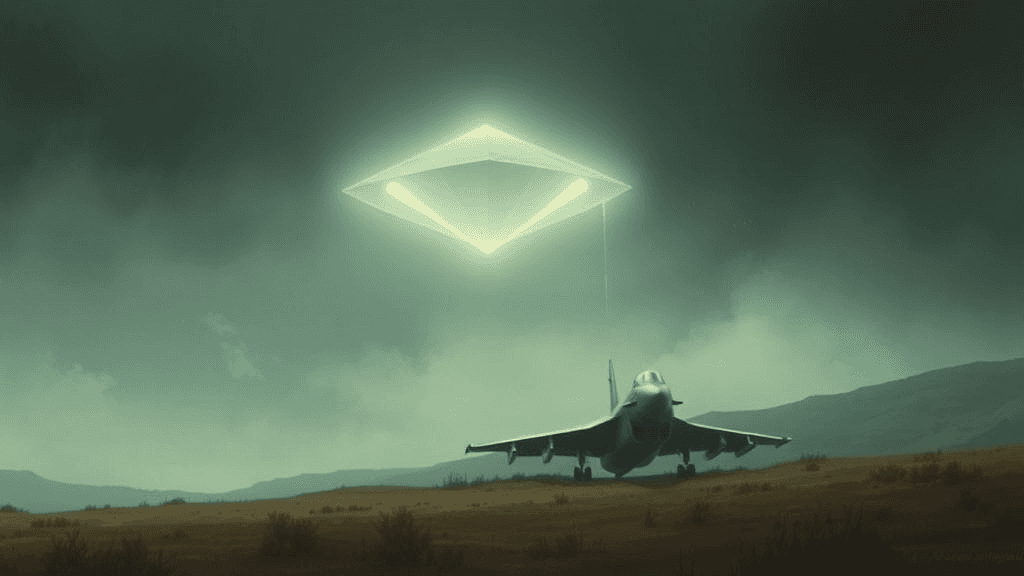
The UFO Library: Military encounter
GIMBAL & GO FAST Encounters
Two declassified U.S. Navy FLIR videos — GIMBAL and GO FAST — captured by F/A-18 Super Hornet crews from the USS Theodore Roosevelt in January 2015, showing objects with anomalous flight characteristics; formally released by the Pentagon in April 2020 and central to the modern UAP disclosure movement.
Background
By 2014 the U.S. Navy had finished installing the Raytheon AN/APG-79 Active Electronically Scanned Array (AESA) radar on its carrier-based F/A-18 Super Hornets. The upgrade was transformative: where the older mechanically scanned radars occasionally missed fast or unconventional targets, the AESA swept the airspace with far greater sensitivity. Almost immediately, aircrew attached to the USS Theodore Roosevelt (CVN-71) carrier strike group began detecting radar contacts that behaved unlike any aircraft in their recognition libraries.
Flight operations during this period were concentrated off the Atlantic seaboard — pre-deployment work-ups in the warning areas east of Virginia Beach and the Florida coast. Lt. Ryan Graves, an F/A-18F pilot with Strike Fighter Squadron VFA-11 "Red Rippers", later testified that his squadron was detecting objects "every day for at least a couple of years." In late 2014 Graves filed a formal hazard report with the Naval Safety Center — a rare step that reflects genuine operational concern rather than curiosity.
The objects were described by multiple pilots as spherical, sometimes as "a partially transparent sphere with a cube inside," roughly 15–20 feet in diameter, carrying no visible wings, exhaust plume, or distinctive tail surfaces. They appeared consistently on the new radar but often couldn't be acquired visually, even when radar geometry suggested they were close. On one documented occasion two F/A-18s were only 100 feet apart at the threshold of Warning Area W-72, east of Virginia Beach, when one crew spotted an object motionless against the wind directly at the entry point; both aircraft broke off and returned to base.
The Videos
Among this wave of encounters, two FLIR recordings made on or around 21 January 2015 would become the most scrutinised military UAP footage in history.
GIMBAL
The GIMBAL video runs 34 seconds. It was recorded using the Raytheon AN/ASQ-228 Advanced Targeting Forward-Looking Infrared (ATFLIR) pod mounted on a F/A-18 Super Hornet operating from Theodore Roosevelt. The clip shows an elongated, roughly disc-shaped white object tracking steadily from right to left against a background of broken cloud, heading into a reported 120-knot westerly wind. What makes it unusual — and what gave the video its name — is the object's apparent rotation: the shape smoothly pivots roughly 180 degrees while its trajectory remains unchanged.
The audio track is at least as striking as the imagery. Off-camera voices, identifying themselves as pilots or weapons systems officers (WSOs), exclaim:
"Look at that thing, dude!" "It's rotating!" "My gosh!" "They're all going against the wind. The wind is 120 knots out of the west."
The phrase "they're all" is significant: pilots reported observing multiple objects on their radar simultaneously, with the GIMBAL object being only one member of a larger formation — the rest invisible on the FLIR footage because they were just off-frame.
GO FAST
The GO FAST video, also from January 2015 and also attributed to Theodore Roosevelt aircrew, is a shorter clip showing a white oval object that appears to skim barely above the ocean surface at tremendous speed while the pilot exclaims, "Oh my gosh, dude!" The object moves across the sensor frame so rapidly that it seems to be outrunning the targeting pod's ability to track it — hence the informal call sign.
Investigation and Analysis
Official pathway to release
The footage was collected and evaluated within the Advanced Aerospace Threat Identification Program (AATIP), the classified Pentagon initiative running from roughly 2007 to 2012 (though its successor activities continued) and associated with intelligence officer Luis Elizondo. Elizondo later stated that the Roosevelt encounters in early 2015 were among the cases that convinced him the UAP phenomenon posed a genuine national-security concern. He resigned from the Pentagon in October 2017 in protest at what he described as excessive internal secrecy.
On 16 December 2017 The New York Times published a landmark front-page investigation co-bylined by Helene Cooper, Ralph Blumenthal, and Leslie Kean, revealing the existence of AATIP and publishing the GIMBAL video for the first time. The article appeared simultaneously with the launch of To The Stars Academy of Arts & Science (TTSA), the organisation co-founded by musician Tom DeLonge and several former government officials including Elizondo, which had obtained the footage.
The GO FAST video followed in March 2018, released by TTSA and covered by The Washington Post and CNN among others.
On 27 April 2020 the Department of Defense officially declassified and released all three videos — FLIR1, GIMBAL, and GOFAST — through the Naval Air Systems Command website. Pentagon spokesperson Sue Gough stated the material "does not reveal any sensitive capabilities or systems, and does not impinge on any subsequent investigations of military air space incursions by unidentified aerial phenomena."
Ryan Graves and congressional testimony
Ryan Graves became the most prominent witness from the Roosevelt encounters. He co-founded Americans for Safe Aerospace, a non-profit advocating for pilots to report UAP without career penalty. On 26 July 2023 he testified before the House Oversight Committee's Subcommittee on National Security, making him among the first active-duty-era military pilots to address Congress directly on UAP. His statement: "Sightings of UAPs in our airspace are not rare, but they are grossly under-reported." Graves described the safety implications — objects sharing restricted military airspace with no transponder, no flight plan, and no means of coordination — as the central concern, separate from any question of origin.
Fellow pilot Danny Accoin was quoted describing the objects as having "no distinct wings, no distinct tail, no distinct exhaust plume" — standard disqualifiers for conventional aircraft, drones, or balloons.
Skeptical analysis: GIMBAL
The most detailed skeptical examination of the GIMBAL video was conducted by Mick West, a science writer and founder of the debunking resource Metabunk.org. West argues that the apparent rotation is not a property of the object itself but an artifact of the ATFLIR pod's own mechanical behaviour. When an ATFLIR tracks a target across a wide angle, its sensor head must perform a compensatory "gimbal roll" to keep the image level; as it approaches certain geometrical limits it executes a rapid counter-rotation. West demonstrates that the background clouds rotate in perfect synchrony with the object — which would only be possible if the rotation were a camera effect rather than real object motion.
Under West's reading, the object itself is likely a distant conventional aircraft (possibly two aircraft flying in close formation) at 20–30 miles range. At that distance the heat bloom from jet engines overwhelms the ATFLIR sensor, producing a glare blob far larger than the physical aircraft — explaining the lack of visible wings or tail. He has stated greater than 99% confidence in this explanation. A 2023 preprint on arXiv by independent researchers attempted to reconstruct possible flight paths for the GIMBAL object and found at least one conventional-aircraft trajectory consistent with the data.
Proponents of the anomalous interpretation, including former TTSA advisor Marik von Rennenkampff, dispute whether the camera-rotation hypothesis fully accounts for the timing and direction of the spin, and note that the pilots — who had the radar picture — were reacting to a genuine formation of contacts, not a single distant plane.
Skeptical analysis: GO FAST
The GO FAST video generated its own parallel debate. Initial impressions suggested the object was travelling at extraordinary low altitude and extraordinary speed. West applied basic trigonometry to the on-screen ATFLIR readout — elevation angle, azimuth, slant range, and the jet's own altitude — and concluded the object was actually at roughly 13,000 feet altitude, not near the ocean surface. The illusion of ocean-skimming speed arises from classic parallax: the jet is moving rapidly, the camera is locked onto a relatively slow target, and the ocean behind (much further away) scrolls past at apparent high speed. West estimated the object's true ground speed at approximately 30–40 knots and noted that an object cold relative to the ocean below it, drifting with the wind at altitude, is consistent with a weather balloon.
The NASA UAP Independent Study Team reviewed GO FAST in 2023 and reached broadly similar conclusions: the altitude and speed, properly calculated from the sensor data, are not anomalous.
The counter-argument from believers is that pilots with years of ATFLIR experience — and with simultaneous radar data — were surprised, filed hazard reports, and described seeing objects that defied explanation. The sensor alone, they argue, does not capture the full operational picture.
The Case For / Against
For anomalous interpretation:
- Multiple trained military aviators independently reported anomalous contacts over an extended period (2014–2015), consistent in appearance and behaviour.
- Contacts appeared on the new AESA radar but predated its installation in terms of the pilots' subjective experience — suggesting the radar revealed objects that had always been there, not a sensor artefact.
- The reported formation behaviour ("they're all going against the wind") implies coherent, intelligent maneuvering.
- Ryan Graves' safety filing and the general culture of under-reporting mean the documented encounters are likely a fraction of actual events.
- Senior intelligence officials within AATIP treated the footage as significant enough to brief Pentagon leadership.
Against (or urging caution):
- Mick West's glare-rotation and parallax analyses are technically rigorous and have not been definitively rebutted on physical grounds.
- The NASA UAP panel and subsequent All-domain Anomaly Resolution Office (AARO) analyses have reached mundane conclusions for GO FAST specifically.
- No corroborating physical evidence — no recovered material, no independent ground or satellite observation — has been made public.
- The videos were routed to public attention partly through TTSA, a commercially motivated entity with an interest in maximising their significance.
- The Navy's acknowledgment that the videos are "real" refers only to their provenance (authentic sensor footage), not to any conclusion about what the objects are.
Cultural Impact
The December 2017 New York Times article is widely regarded as a watershed moment in UAP history — comparable in terms of institutional legitimacy to the Condon Report of 1969, but pointed in the opposite direction. For the first time, a mainstream American newspaper of record reported on military UAP encounters not as curiosities but as a funded, ongoing national-security concern. The story was shared millions of times and triggered bipartisan Congressional interest that had been largely dormant since Project Blue Book closed in 1969.
The GIMBAL and GO FAST videos became staples of news segments, podcasts, and documentary series. They were instrumental in the passage of the UAP Disclosure Act provisions attached to the National Defense Authorization Act, and in the creation of the UAP Task Force (UAPTF) in 2020, later reorganised as AARO in 2022. Senator Marco Rubio and others cited the Roosevelt encounters explicitly when arguing for new reporting mechanisms.
Ryan Graves's 2023 congressional testimony — alongside that of David Grusch and retired Cmdr. David Fravor (the Nimitz/Tic-Tac case) — attracted global media coverage and placed UAP firmly on the mainstream political agenda.
Current Status
As of 2025, neither the GIMBAL nor GO FAST videos have been officially explained by the U.S. government. AARO's public case file system, launched following the 2022 NDAA requirements, has not published a definitive assessment for either recording as of mid-2025, though AARO's general posture has been that most UAP cases reviewed have mundane explanations.
Mick West's glare and parallax interpretations remain the most technically developed conventional explanations in the public domain. They have not been formally adopted or refuted by the DoD. The arXiv preprint on GIMBAL flight paths represents the most rigorous independent academic attempt to bound what the object could or could not have been.
Ryan Graves continues to advocate through Americans for Safe Aerospace for a systematic, safety-focused approach to UAP reporting. The Roosevelt encounters — and the two videos they produced — remain the most consequential pieces of UAP evidence to enter the public record in the post-Roswell era, not because they prove anything conclusive, but because they were the lever that forced official Washington to acknowledge the phenomenon in earnest.
Witnesses
- Lt. Ryan Graves (F/A-18F pilot, VFA-11 "Red Rippers") — primary public witness; filed formal hazard report with Naval Safety Center in late 2014; testified before Congress July 2023; co-founded Americans for Safe Aerospace.
- Lt. Danny Accoin — Navy F/A-18 pilot, quoted describing objects as having "no distinct wings, no distinct tail, no distinct exhaust plume."
- Multiple unnamed pilots and weapons systems officers (WSOs) from the USS Theodore Roosevelt carrier strike group, audible on the GIMBAL audio track reacting to the rotating object and the wider formation.
Evidence
- GIMBAL video (34 seconds, ATFLIR infrared, January 2015) — officially declassified and released by the Pentagon on 27 April 2020; shows an elongated object rotating while maintaining steady trajectory against 120-knot winds.
- GO FAST video (ATFLIR infrared, January 2015) — officially declassified and released 27 April 2020; shows a small white object apparently moving at high speed at low altitude over the ocean.
- AN/APG-79 AESA radar data — pilots reported tracking multiple simultaneous contacts; raw radar files have not been publicly released.
- Naval Safety Center hazard report (late 2014) — filed by Lt. Graves; existence confirmed but full contents not public.
- Audio track of GIMBAL video — voices discussing object rotation and formation behaviour.
- arXiv preprint (2023) on GIMBAL flight-path reconstruction — independent academic analysis attempting to constrain the object's trajectory from available sensor data.
People involved
Filed under
Watch
Extraordinary Until Proven Otherwise
Unedited Navy Gimbal video.mp4
Unedited Navy Go Fastl video.mp4
Explained: New Navy UFO Videos
Gimbal UFO - A New Analysis
Where this entry came from
ProvenanceAgent indexedUpdated 6mo ago10 sources
Drafted by the archive's AI research agent from the sources below; corrections from readers are reviewed and folded in.
- First indexed
- 24 APR 26 // 22:45Z
- Last updated
- 25 APR 26 // 22:04Z
- Glowing Auras and 'Black Money': The Pentagon's Mysterious U.F.O. Program, Helene Cooper, Ralph Blumenthal, Leslie Kean, The New York Times
- Pentagon UFO videos, Wikipedia
- 'Oh my gosh, dude': Video shows Navy pilots' close encounter with UFO, Thomas Gibbons-Neff, The Washington Post
- A Gimbal Glare Explainer, Mick West, Metabunk
- Gimbal Lock and Derotation in FLIR/ATFLIR systems, Mick West, Metabunk
- Reconstruction of Potential Flight Paths for the January 2015 'Gimbal' UAP, arXiv
- Written Testimony of Ryan Graves, House Oversight Committee UAP Hearing, Ryan Graves, U.S. House of Representatives
- Statement by the Department of Defense on the Release of Historical Navy Videos, Sue Gough, U.S. Department of Defense
- USS Theodore Roosevelt UAPs, The UFO Database
- I Testified Before Congress on UFOs. What I Told Them Was the Tip of the Iceberg, Ryan Graves, Newsweek
Notes
- Glowing Auras and 'Black Money': The Pentagon's Mysterious U.F.O. Program, Helene Cooper, Ralph Blumenthal, Leslie Kean, The New York Times
- Pentagon UFO videos, Wikipedia
- 'Oh my gosh, dude': Video shows Navy pilots' close encounter with UFO, Thomas Gibbons-Neff, The Washington Post
- A Gimbal Glare Explainer, Mick West, Metabunk
- Gimbal Lock and Derotation in FLIR/ATFLIR systems, Mick West, Metabunk
- Reconstruction of Potential Flight Paths for the January 2015 'Gimbal' UAP, arXiv
- Written Testimony of Ryan Graves, House Oversight Committee UAP Hearing, Ryan Graves, U.S. House of Representatives
- Statement by the Department of Defense on the Release of Historical Navy Videos, Sue Gough, U.S. Department of Defense
- USS Theodore Roosevelt UAPs, The UFO Database
- I Testified Before Congress on UFOs. What I Told Them Was the Tip of the Iceberg, Ryan Graves, Newsweek
Also available

The Phenomenon
Documentary examining the Pentagon UFO videos, including the Gimbal and Go Fast footage, featuring Navy pilot testimony and government officials discussing UAP encounters.
Unidentified: Inside America's UFO Investigation
History Channel docuseries investigating modern UAP phenomenon, featuring pilot Ryan Graves and investigators Luis Elizondo and Chris Mellon discussing the 2015 USS Theodore Roosevelt incidents.
The Age of Disclosure
Documentary featuring 34 U.S. government and military officials discussing alleged government cover-up of non-human intelligence, including Navy pilots David Fravor and Ryan Graves recounting their UAP encounters.
A Tear in the Sky
Documentary following military experts and scientists, including William Shatner, using advanced equipment to investigate and recreate Navy UAP encounters, including the famous TicTac incident.
Buying through these links supports the library. We may earn a commission.