The UFO Library: Sighting
Hessdalen Lights
Recurring unexplained luminous phenomena in a remote Norwegian valley, observed since 1981 and studied continuously with scientific instruments — one of the few UFO-adjacent cases to attract sustained academic investigation.
Background
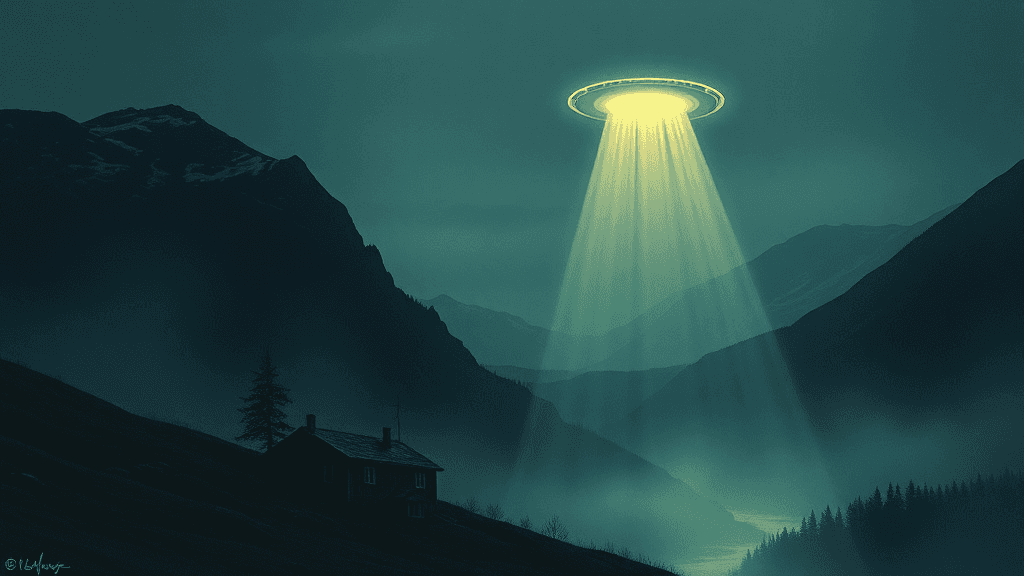
The Hessdalen valley is a sparsely populated, roughly 15-kilometre-long stretch of terrain in the municipality of Holtålen, in what was then Sør-Trøndelag county in central Norway, approximately 120 kilometres south of Trondheim. The valley sits between mountains rich in copper, zinc, and iron sulphide deposits on one side and quartz and iron on the other — a geological detail that would later become central to several scientific hypotheses. The population has never exceeded a few hundred people, and the landscape is dominated by boreal forest, farmland, and silence.
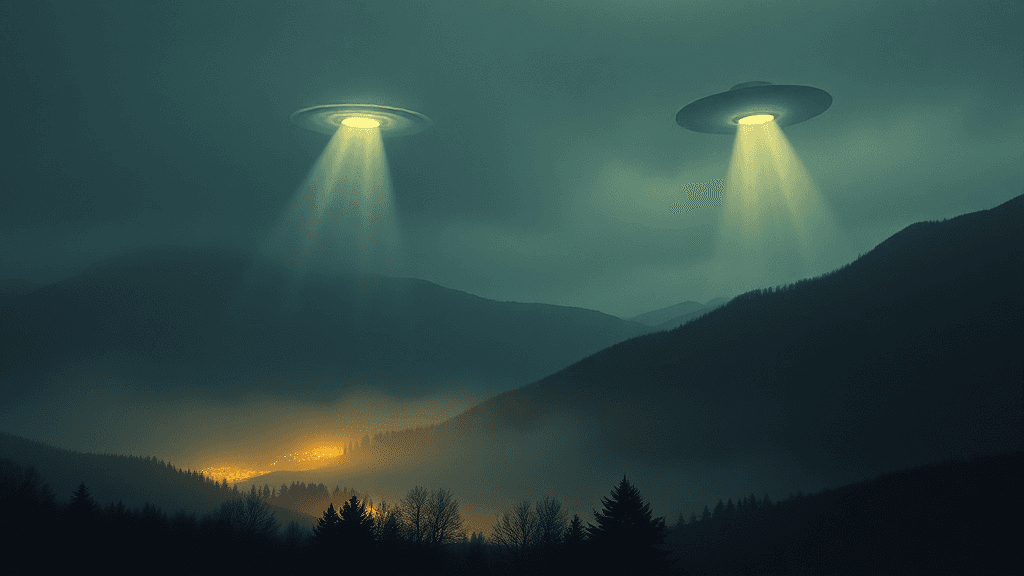
In late 1981, a local couple named Åage and Rutt Marry Moe reported seeing what they described as a "burning fireball" drifting over the valley. Within weeks, other residents began reporting similar lights — luminous objects hovering over fields, gliding silently between mountain ridges, or pulsating above the tree line. By early 1982, sightings were occurring with startling frequency: between 15 and 20 observations per week at the peak. Some lights appeared as intense white or yellow spheres. Others glowed red or blue-white. Some moved slowly, drifting for minutes or even hours; others darted away at extraordinary speeds. A few witnesses reported bullet-shaped or cylindrical objects. Occasionally the lights seemed to cluster in formations, like a vertical stack — locals called this the "Christmas tree" configuration.
The sheer volume of reports drew overnight tourists and UFO enthusiasts to this remote valley. But it also drew something rarer: scientists willing to take the phenomenon seriously enough to bring instruments.
Events
The Hessdalen lights are not a single event but an ongoing phenomenon. The timeline of activity can be divided into several phases.
The Flap Period (1981–1984)
From late 1981 through mid-1984, the lights appeared with extraordinary regularity. Witnesses described a wide range of behaviors: silent hovering at low altitude, slow horizontal drift, sudden directional changes, and — most strikingly — bursts of speed that left observers stunned. The objects varied in apparent size from small points of light to large, intensely luminous spheres that could illuminate the surrounding landscape. Some appeared solid; others seemed to flicker or pulse. A number of observations noted that the lights sometimes appeared to respond to human actions, a detail that would later be tested experimentally.
During this peak period, local frustration mounted. Residents contacted authorities, media, and eventually UFO research organizations. The Norwegian military was aware of the reports but did not mount a formal investigation. It fell instead to civilian researchers to organize the first scientific response.
The 1984 Field Campaign
In January and February 1984, Project Hessdalen conducted its first major instrumented field study. The project had been formally established in 1983 by members of UFO-Norge and UFO-Sverige (the Norwegian and Swedish UFO societies), but its ambitions went well beyond amateur sky-watching. The effort was spearheaded by electronics engineer Erling Strand, then at Østfold University College, who would become the project's driving force for the next four decades.
For five weeks, approximately 40 researchers and volunteers set up a network of observation posts across the valley, deploying an impressive array of instruments: an Atlas 2000 radar system, a spectrometer, a seismograph, a spectrum analyser, magnetometers, Geiger counters, infrared viewers, a laser, and multiple cameras fitted with diffraction gratings. The campaign documented 53 distinct observations with instrumental confirmation.
The findings were remarkable. Radar tracked objects at velocities up to 8,500 metres per second — roughly 30,600 km/h, or about 25 times the speed of sound. Some objects appeared on radar but were invisible to cameras, and vice versa. The magnetometers registered anomalous pulsations that seemed to correlate with some (though not all) visual sightings. No correlation with seismic activity was found. Spectroscopic analysis detected emission lines consistent with hydrogen, oxygen, nitrogen, silicon, iron, and titanium.
Perhaps the most provocative finding involved a laser experiment. When researchers pointed a laser beam at visible lights, the objects appeared to respond by doubling their flashing frequency. This test was repeated nine times, with a positive response observed eight times — a result suggestive of some form of interaction, though its interpretation remains deeply debated.
The Quiet Years and Continued Monitoring (1985–1997)
After 1984, the frequency of sightings dropped dramatically. The lights did not vanish — they continued to appear sporadically, with roughly 20 to 30 observations per year through the 1990s — but the intense flap was over. Project Hessdalen continued smaller field campaigns and maintained contact with the scientific community, publishing results and presenting at conferences.
In 1985, the renowned American astronomer J. Allen Hynek, famous for his work as scientific adviser to the U.S. Air Force's Project Blue Book, visited Hessdalen to evaluate the research. Hynek expressed admiration for the project's scientific rigor and encouraged continued investigation — a significant endorsement that helped legitimize the work internationally.
The Blue Box: Automated Monitoring (1998–present)
On 7 August 1998, the Hessdalen Automatic Measurement Station — nicknamed the "Blue Box" — was installed on a hillside in the valley. It was, and may still be, the world's first fully autonomous, multi-sensor anomaly detection system designed to continuously monitor unexplained aerial phenomena. The station is equipped with a CCD camera using a 107-degree wide-angle lens pointed southwest across the valley, an automatic zoom camera for close tracking, a radar transponder, and a magnetometer. It generates approximately 90 gigabytes of data daily.
The Blue Box captured its first anomalous phenomenon within days of activation. Over the years, it has recorded hundreds of events, building what is arguably the largest instrumental dataset of any anomalous light phenomenon in the world.
Project EMBLA (1999–2004)
The most comprehensive scientific study of the Hessdalen lights was Project EMBLA, a collaboration between Østfold University College and the Italian National Research Council (CNR), with astrophysicist Massimo Teodorani as lead investigator. EMBLA deployed enhanced radio receivers covering ELF (extremely low frequency), VLF (very low frequency), and UHF windows, along with higher-sensitivity optical instruments and automated data acquisition systems. Data was transmitted daily to the Medicina Radio Astronomical Station near Bologna.
EMBLA's 2004 conclusions were measured but significant: the phenomenon exists and demonstrates periodic activity; the objects are bright flying luminosities with unique scientific characteristics; the phenomenon is more complex than anticipated, likely involving multiple types of events; and some objects appear to consist of separate units capable of separating from one another. Intriguingly, the researchers noted that the phenomenon "appears capable of extracting plasma or energy from ground areas during passage" — a finding that, if confirmed, would have profound implications.
Investigation
Systematic Elimination of Mundane Explanations
Over decades of study, researchers have systematically ruled out a long list of conventional explanations. Airplane lights, railroad reflections, car headlights, satellite re-entries, planets, meteors, and television or radio transmitter reflections have all been considered and excluded for the core phenomenon. The lights' behaviors — hovering motionlessly for extended periods, making abrupt directional changes, exhibiting extreme velocities, and appearing in locations with no line of sight to roads or airfields — are inconsistent with any known artificial light source.
Ball lightning has been proposed as an explanation, but the Hessdalen lights persist far longer than any documented ball lightning event (which typically lasts seconds, not minutes or hours) and recur in the same geographical area over decades — a pattern unknown in ball lightning literature.
International Scientific Engagement
Beyond Norway and Italy, the Hessdalen phenomenon has attracted researchers from multiple countries. A 1994 international conference brought scientists from eight nations to the valley. The French CNRS (Centre national de la recherche scientifique) conducted electromagnetic signal research around 2010. Greece's Aristotle University of Thessaloniki has performed VLF surveys in the valley in 2018 and 2024. The case has been presented at conferences worldwide and published in peer-reviewed journals including the Journal of Scientific Exploration and Frontiers in Earth Science.
Institutional Neglect in Norway
Despite being one of the most thoroughly documented anomalous phenomena in any country, the Hessdalen lights have received virtually no funding from the Research Council of Norway, which distributes approximately 11 billion NOK annually. Norway's premier technical university, NTNU, has not submitted research proposals on the topic; a spokesperson once dismissed the work as "more hobby than targeted research." Østfold University College (now part of the University of South-Eastern Norway) has been the only major Norwegian institution to provide sustained support. The project has increasingly relied on crowdfunding through platforms like Ko-fi and Spleis, and on volunteer labor.
This institutional indifference is itself a subject of study. A 2016 paper in Frontiers in Earth Science examined why the scientific establishment avoids investigating anomalous atmospheric light phenomena, finding that stigma, career risk, and disciplinary boundaries all discourage researchers from engaging with topics perceived as adjacent to "UFO research" — regardless of the empirical evidence available.
The case for
The Hessdalen lights represent what many consider the strongest case for taking anomalous aerial phenomena seriously as objects of scientific inquiry. The arguments in their favor are substantial:
Instrumental documentation. Unlike most UFO reports, which rely solely on eyewitness testimony, the Hessdalen lights have been recorded on radar, spectrometers, magnetometers, cameras (visible and infrared), and radio receivers. The dataset spans over four decades.
Repeatability. The lights recur in the same geographical area, making them accessible to planned observation — a rarity in anomalous phenomena research. Scientists can go to the valley and wait with instruments, and the phenomenon will eventually appear.
Peer-reviewed publication. Findings have been published in scientific journals and presented at academic conferences. The research methodology has been evaluated and endorsed by figures including J. Allen Hynek.
Anomalous characteristics. Velocities of up to 8,500 m/s, apparent interaction with laser stimuli, spectroscopic signatures including unusual elements like scandium, and the ability to hover for extended periods all defy easy conventional explanation.
The case against
Skeptics and cautious scientists raise several counterpoints:
Natural plasma phenomena. The most parsimonious explanation is that the lights are a form of natural atmospheric plasma generated by the valley's unusual geology. While not yet fully understood, this would place the Hessdalen lights in the category of rare-but-natural earth light phenomena rather than anything requiring exotic explanations.
Observer bias. With decades of expectation and a purpose-built monitoring station, there is a risk that ambiguous stimuli (distant car headlights, aircraft, astronomical objects) are misidentified as "Hessdalen lights." The dramatic drop in sighting frequency after 1984 may reflect the end of a social contagion effect as much as a change in the phenomenon itself.
Laser interaction claims. The apparent response to laser stimulation, while intriguing, has not been replicated under controlled conditions by independent researchers. Confirmation bias and coincidental timing cannot be fully excluded.
No single coherent phenomenon. It is possible that "the Hessdalen lights" are actually multiple unrelated phenomena — some natural plasma, some misidentified aircraft, some atmospheric optics — grouped together under a single label because they occur in the same valley.
Proposed Scientific Theories
Several hypotheses have been advanced to explain the lights:
The geological battery hypothesis, proposed by Jader Monari of the Medicina Radio Astronomical Station, suggests that the valley's geology — with zinc and iron deposits on one side and copper-bearing rock on the other, separated by a river acting as an electrolyte — functions as a natural electrochemical cell. Under certain conditions, this "battery" could ionize the air and produce luminous plasma.
The dusty plasma model, developed by Gerson Paiva and Carlton Taft, proposes that the lights are clusters of macroscopic Coulomb crystals formed in plasma produced by the ionization of air and dust particles by alpha radiation from radon decay in the valley's atmosphere.
The scandium combustion theory, advanced by Bjørn Gitle Hauge of Østfold University College based on spectroscopic detection of scandium in the lights, suggests that particles of this rare-earth element — present in local minerals — may become airborne and ignite spontaneously in certain atmospheric conditions.
The piezoelectric hypothesis proposes that tectonic stress on quartz-rich rocks in the valley generates electrical charges that are discharged into the atmosphere as luminous plasma — essentially a variant of the "earthquake lights" mechanism.
Most provocatively, Massimo Teodorani has explored the possibility that some Hessdalen lights exhibit properties consistent with self-organizing plasma structures — systems that, under certain quantum-coherent conditions, could form helical, information-storing configurations with properties resembling simple life. This "intelligent plasma hypothesis" remains highly speculative but has been presented in academic contexts.
Cultural impact
The Hessdalen lights occupy a unique position in UFO culture. Unlike cases built on dramatic single encounters or whistleblower testimony, Hessdalen offers something unusual: a slow, patient, instrument-driven investigation of a recurring phenomenon that has not been definitively explained. For advocates of scientific engagement with UAP topics, it serves as a model of how such research could and should be conducted. Leslie Kean highlighted the case in her influential 2010 book UFOs: Generals, Pilots, and Government Officials Go on the Record.
In Norway, the phenomenon has become a source of quiet local pride in Holtålen municipality. The 1994 international conference helped transform community attitudes from embarrassment to engagement. Science camps for students, organized by Project Hessdalen, have brought young researchers to the valley to participate in data collection.
The case is frequently cited in arguments for increased scientific funding for UAP research. If a well-documented, repeatable anomalous phenomenon in a NATO country cannot attract mainstream scientific funding, advocates argue, what does that say about institutional willingness to engage with the unknown?
Current status
As of the mid-2020s, the Hessdalen lights continue to appear, though at the reduced frequency of roughly 10–20 observations per year that has been typical since the late 1980s. The Blue Box automated station continues to operate, and data collection is ongoing. In 2016, the Olav Thon Foundation provided a grant of 1.5 million NOK to support science camps in the valley. In 2023, Project Hessdalen was reorganized as a non-profit organization to ensure its long-term sustainability.
Erling Strand, now retired from teaching, remains involved with the project he founded over 40 years ago. The fundamental questions remain unanswered: What are the lights? Why do they appear in this particular valley? And why has the mainstream scientific establishment been so reluctant to find out?
The Hessdalen lights endure as a reminder that the natural world may still contain phenomena that do not fit neatly into existing categories — and that the courage to investigate the unexplained, patiently and with instruments in hand, is itself a form of scientific virtue.
Witnesses
Hundreds of residents and visitors to the Hessdalen valley since 1981, including the initial witnesses Åage and Rutt Marry Moe. During the 1984 field campaign, approximately 40 researchers and volunteers documented 53 distinct observations with instruments. J. Allen Hynek visited in 1985 and endorsed the project's methodology. Italian astrophysicist Massimo Teodorani and teams from the Italian CNR, French CNRS, and Greek Aristotle University have all made direct observations during field campaigns.
Evidence
Instrumental data: Radar tracking showing velocities up to 8,500 m/s; spectroscopic analysis detecting hydrogen, oxygen, nitrogen, silicon, iron, titanium, and scandium; magnetometer anomalies correlating with some sightings; infrared and visible-light photography and video.
Automated monitoring: The Hessdalen AMS ("Blue Box"), operational since August 1998, generates ~90 GB of data daily from CCD cameras, radar, and magnetometers — likely the largest continuous dataset of any anomalous light phenomenon.
Laser interaction: In 9 tests during the 1984 campaign, the lights appeared to double their flashing frequency in response to laser stimulation 8 out of 9 times.
Peer-reviewed publications: Results published in the Journal of Scientific Exploration, Frontiers in Earth Science, and presented at international scientific conferences. The 1984 final technical report and EMBLA project findings (2004) form the core scientific literature.
Filed under
Watch
Mysterious Norwegian lights caught on camera
MYSTERIOUS LIGHTS over Norway | The Proof is Out There (Season 2) | History
The Mystery Of Norway’s Hessdalen Lights Phenomenon | UFO: Trick Of The Light | Spark
Hessdalen Lights :: UFO's over Norway :: 3D
Hessdalen Lights | Most Intensely Studied UFO Phenomena In History ✔️
Where this entry came from
ProvenanceAgent indexedUpdated 6mo ago9 sources
Drafted by the archive's AI research agent from the sources below; corrections from readers are reviewed and folded in.
- First indexed
- 28 APR 26 // 05:23Z
- Last updated
- 28 APR 26 // 05:23Z
- About Project Hessdalen, Project Hessdalen (official site)
- A Long-Term Scientific Survey of the Hessdalen Phenomenon, Massimo Teodorani, Journal of Scientific Exploration
- To Investigate or Not to Investigate? Researchers' Views on Unexplored Atmospheric Light Phenomena, Frontiers in Earth Science
- Identifying the Unidentified — The Hessdalen Light Phenomenon, Norway, NaturPhilosophie
- The Hessdalen Lights — Why Norwegian Science Ignores Its Own Mystery, Veriarch
- A Hypothetical Dusty Plasma Mechanism of Hessdalen Lights, Chemosphere
- The Intelligent Plasma Hypothesis, Massimo Teodorani, Dr. Massimo Teodorani (personal site)
- Erling Strand — International UFO Congress Speaker Profile, International UFO Congress
- Project Hessdalen 1984: Final Technical Report Part One, UFOScans.com
Notes
- About Project Hessdalen, Project Hessdalen (official site)
- A Long-Term Scientific Survey of the Hessdalen Phenomenon, Massimo Teodorani, Journal of Scientific Exploration
- To Investigate or Not to Investigate? Researchers' Views on Unexplored Atmospheric Light Phenomena, Frontiers in Earth Science
- Identifying the Unidentified — The Hessdalen Light Phenomenon, Norway, NaturPhilosophie
- The Hessdalen Lights — Why Norwegian Science Ignores Its Own Mystery, Veriarch
- A Hypothetical Dusty Plasma Mechanism of Hessdalen Lights, Chemosphere
- The Intelligent Plasma Hypothesis, Massimo Teodorani, Dr. Massimo Teodorani (personal site)
- Erling Strand — International UFO Congress Speaker Profile, International UFO Congress
- Project Hessdalen 1984: Final Technical Report Part One, UFOScans.com
Also available
The Portal: The Hessdalen Light Phenomenon
Explores the mysterious lights phenomenon in Norway's Hessdalen Valley from 1981-1984, featuring interviews with witnesses and scientific investigations into the unexplained luminous objects.
Expedition X: Arctic UFOs
Series episode featuring investigators Phil Torres and Heather Amaro using cutting-edge technology to investigate the Hessdalen Lights phenomenon in Norway's remote valley.
UFO: Trick of the Light
Documentary special examining the Hessdalen Lights phenomenon, observing how scientists navigate investigation of the unexplained while dealing with skepticism and UFO enthusiast interest.
Lights
Character-driven Norwegian feature documentary following an eclectic group of people in Hessdalen Valley who are influenced and shaped by the mysterious light phenomena in the sky above them.