The UFO Library: Mass sighting
Yukon Mothership Incident (1996)
On the night of December 11, 1996, more than thirty witnesses spread across 200 miles of remote Yukon highway independently reported a massive, silent craft with rows of rectangular lights — one of the most thoroughly documented mass-sighting cases in Canadian UFO history.
Background
The Yukon Territory is, by most measures, as remote as North America gets. In December 1996 its interior highway corridor — the Klondike Highway, threading north from Whitehorse through Carmacks and Pelly Crossing toward Dawson City — carried only a trickle of late-evening traffic in the grip of a polar winter. Temperatures were well below freezing, the sky deeply dark, and the highway lonely enough that motorists typically knew other drivers by sight. That geographic isolation turned out to be evidentiary gold: when something extraordinary appeared in the sky on the night of December 11, the witnesses were separated from one another by scores of miles, with no realistic means of coordinating their accounts before investigators arrived.
The Yukon had a modest history of UFO reports before 1996. Local indigenous communities held traditional accounts of strange lights in the north, and occasional sightings had filtered into regional newspapers across the 1970s and 1980s. But nothing on record approached the scale — in witness numbers, geographic spread, and consistency of descriptions — of what unfolded that Wednesday evening. It would take almost three years before a comprehensive investigation was assembled and published, but when it was, the case attracted international attention as a potential benchmark in mass-sighting research.
By late 1996 Canada's federal UFO reporting infrastructure had effectively vanished. The National Research Council had wound down its informal system for receiving pilot and public reports in 1995. The Department of National Defence maintained no equivalent. When something crossed the Yukon sky that night, there was no government antenna tuned to receive it.
Events
The earliest confirmed sightings occurred near the village of Carmacks, roughly 180 kilometres north of Whitehorse, at approximately 7:00 PM local time. A group of four men (designated CRM1–CRM4 in the subsequent investigation) observed a large, silent object moving northeast along the ridgeline, its underside illuminated by multiple rows of rectangular lights. They pulled over to watch as it curved slowly southward and disappeared behind a hill. Separately that same evening, a family of four (CRM6–CRM9) watched what the children initially described as Santa Claus — a slow-moving shape, brilliantly lit, crossing the tree line without any sound.
By approximately 8:00 PM, an object matching the same description was visible near Fox Lake, some 70 kilometres south of Carmacks, tracking broadly northward. Six witnesses at Fox Lake (FOX1–FOX6) reported it over a window stretching from roughly 8:00 to 8:30 PM. FOX1 observed light illuminating what appeared to be a smooth, curved surface above the rows of rectangular lights. FOX2 and FOX3, parked beside the frozen lake, watched a huge form drift east before disappearing behind hills. FOX4 and FOX5 — travelling with a young child — saw the rows of lights crossing slowly overhead and pulled over to watch; their child asked calmly what it was.
Most physically striking was FOX6, who noticed that the vehicle's dashboard illumination dimmed inexplicably as the object passed overhead. This witness also described multi-coloured lights and a phosphorescent green beam projecting horizontally from the craft's side — characteristics consistent with electromagnetic interference reports documented in other close-approach cases. No mechanical failure followed, but the anomaly was noted.
The most dramatic episode occurred around 8:30–9:00 PM at Pelly Crossing, approximately 130 kilometres north of Carmacks. Witness PEL1 — identified in some accounts as Don Trudeau — was standing outside when he spotted the craft and, on impulse, shone his flashlight directly at it. According to his testimony, the object immediately accelerated toward him. He covered the flashlight beam with his hand; the craft halted approximately 300 metres away. He uncovered the beam; it advanced again. He covered it; it stopped. This apparent call-and-response sequence was repeated several times before the object resumed its broader northward movement. A ground-sweeping beam from beneath the craft's centre became visible during this exchange, and ice crystals suspended in the bitter air made secondary beams at the craft's rear glow as distinct luminous shafts.
Six additional Pelly Crossing witnesses (PEL2–PEL7), including four college-aged women, corroborated the object's presence. PEL2 and PEL3 independently compared the angular width of the light row to the span of the Big Dipper constellation — an observation that later proved useful for triangulation calculations.
Additional reports emerged from Mayo further north and as far south as Watson Lake, called in to CBC North Radio after the station aired a public segment about the sightings in the days that followed. The 22 formally interviewed and coded witnesses (FOX1–6, PEL1–7, CRM1–9) represent a subset of the 31 or more individuals eventually associated with the event.
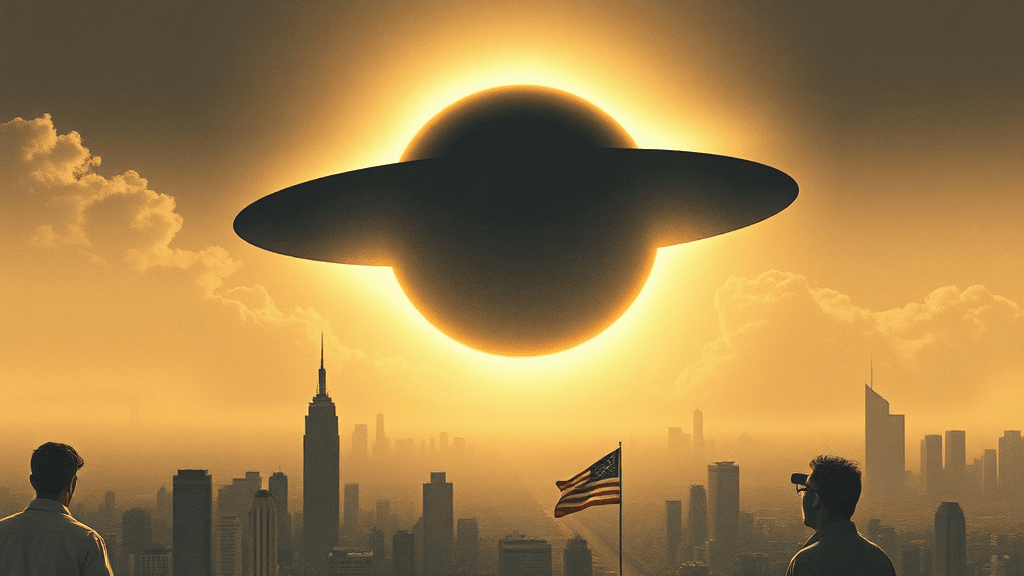
Across all accounts, the object shared consistent defining characteristics: complete silence at no point did any witness report engine noise, rotor wash, or sonic disturbance; slow and deliberate movement generally tracking north-northeast over several hours; a semi-spherical or dome-shaped profile when silhouetted against the sky; multiple rows of rectangular lights on its underside; and an estimated size that dwarfed any known aircraft. Using the Big Dipper as an angular reference and triangulating from multiple vantage points, investigator Martin Jasek calculated the object's diameter at somewhere between 0.5 and 2 kilometres — a figure that, if correct, places it in a category entirely unlike any acknowledged human-built craft.
Investigation
Martin Jasek, an engineer resident in the Yukon and a member of UFO*BC (UFOBC), became the primary investigator after learning of the sightings through local channels. He spent roughly three years tracking down witnesses, many of whom had never filed any official report and several of whom requested anonymity or declined to participate at all. His methodology stood apart from much civilian UFO investigation of the era: he gathered signed, witnessed statements accompanied by individual sketches, cross-referenced sighting times against the object's apparent movement, plotted trajectories on topographic maps, and used known landmarks — hill profiles, lake shores, tree lines — as geometric reference points.
The investigation was posted online in October 1999, hosted at ufobc.ca under Case 22, where individual witness testimony pages remain accessible. Jasek also presented the case at the 2000 MUFON Symposium, giving it broader circulation in the North American UFO research community. The public archive was unusual for its era and became a reference model for how mass-sighting events should be documented when no official body will do so.
No Canadian government agency ever opened a formal inquiry. The RCMP in affected communities logged no reports. Transport Canada received no pilot observations from the corridor. The silence of official channels was partly structural — by 1996, Canada simply had no active UFO reporting mechanism — and partly a function of the event's location: a mid-week winter evening on a remote highway sees few aircraft and no radar coverage dense enough to capture low-altitude returns.
The Case For / Against
Arguments for credibility: The case rests on an unusually robust evidential foundation. Witnesses were distributed across more than 200 kilometres of highway, making mass hallucination or social contagion implausible. Many did not know one another, had no prior interest in UFOs, and reported the experience reluctantly or only after CBC Radio's public call-in segment gave them a forum. The consistency of core descriptors — rows of rectangular lights, total silence, enormous apparent size — across geographically separated groups is difficult to attribute to suggestion or misidentification of a shared distant stimulus. The FOX6 vehicle electrical anomaly and the PEL1 flashlight interaction introduce physical dimensions that go beyond a simple bright-light misidentification. Jasek's engineering-grade triangulation, while dependent on angular estimates that carry inherent uncertainty, pointed toward an object of genuinely anomalous scale.
Arguments against / skeptical analysis: The Skeptical Inquirer published a direct challenge to the case, arguing that it had been prematurely elevated to "top ten" UFO status on insufficient grounds. Proposed mundane explanations included: a temperature inversion or mirage refracting distant ground lights upward into the sky; the planet Jupiter, exceptionally bright in December 1996, observed through ice-crystal haze that can generate halos and apparent structure; or a rare magnetospheric phenomenon. No experimental blimp operation in the region was identified, but the absence of evidence is not evidence of absence.
Critics specifically challenged the flashlight interaction at Pelly Crossing. The apparent physics — a structure kilometres in diameter decelerating and accelerating in response to a hand-held flashlight — strain any conventional model of propulsion or sensor response, and the observation lacks independent corroboration. Size estimates extrapolated from angular measurements are also highly sensitive to assumed distance: if witnesses overestimated how far away the object was, the calculated diameter shrinks correspondingly.
No physical trace evidence — ground impressions, scorching, radiation readings, electromagnetic disturbance records — was ever collected from any of the sighting locations. The case rests entirely on witness testimony, however internally consistent.
Jasek himself was careful in his published conclusions, acknowledging the limits of civilian investigation and stopping short of claiming proof of extraterrestrial origin. He argued, more modestly, that the case represented a genuine unknown that deserved serious scientific attention — a position the Skeptical Inquirer disputed on the grounds that the unknowness of the cause does not imply the cause is extraordinary.
Cultural Impact
The Yukon 1996 case became one of the most cited examples in arguments for mass-witness credibility within the UFO research community through the 2000s. It appeared in documentary segments on Canadian and international television, was referenced in Leslie Kean's 2010 book UFOs: Generals, Pilots, and Government Officials Go On the Record as an example of high-quality civilian investigation, and circulated widely in online UFO literature as a canonical credible mass sighting.
The case also contributed to a broader Canadian discussion about the absence of any functioning official UFO investigation body. The Yukon incident illustrated the gap vividly: in a country with vast, radar-sparse territory and a history of credible reports, no institutional mechanism existed for receiving, vetting, or analysing them. Advocates for a Canadian equivalent to Project Blue Book periodically cited the December 1996 event as Exhibit A.
Within the Yukon itself, the event left a lasting cultural impression. CBC North's call-in response was larger than any UFO-related programme the station had previously aired. Local newspapers revisited the anniversary through the 2000s. For residents of communities like Carmacks and Pelly Crossing — small, First Nations–majority villages — the sighting intersected with existing oral traditions about unusual phenomena in the northern sky, lending it a resonance that external analytical frameworks can easily underestimate.
Current Status
The case remains officially unresolved and almost certainly will stay that way. No government agency has ever assessed it, no physical evidence was preserved, and the witness pool has aged across three decades — some individuals are deceased, others maintain their anonymity. Jasek's archive at ufobc.ca remains the definitive primary source, with individual testimony pages still accessible.
In the disclosure era of the 2020s, characterised by renewed institutional attention through bodies like the All-domain Anomaly Resolution Office (AARO), the Yukon incident is occasionally cited by advocates as precisely the kind of historical mass-witness case deserving retrospective analysis. Whether AARO or any equivalent body will review a 1996 Canadian civilian event with no recovered radar data or physical traces seems unlikely.
What the case unambiguously demonstrates is the potential rigour of civilian investigation when led by a methodical researcher willing to spend years doing the work without institutional support. Martin Jasek's Case 22 archive stands as a model — not proof of anything extraterrestrial, but a documented record of something extraordinary that the witnesses along the Klondike Highway on the night of December 11, 1996 could not explain, and that no official body has ever seriously tried to.
Witnesses
FOX1–FOX6 — Six witnesses near Fox Lake (~70 km north of Whitehorse), observing between approximately 8:00–8:30 PM. FOX6 reported vehicle electrical anomalies (dashboard dimming) coincident with the object's passage, and a phosphorescent horizontal beam.
PEL1–PEL7 — Seven witnesses at Pelly Crossing (~130 km north of Carmacks). PEL1 (identified in some accounts as Don Trudeau) conducted the widely-cited flashlight interaction, apparently triggering repeated advances and halts by the craft. PEL2/PEL3 compared the object's angular width to the Big Dipper constellation. PEL4–7, four college-aged women, described a long row of lights moving toward them.
CRM1–CRM9 — Nine witnesses at Carmacks (earliest sightings, ~7:00 PM). A group of four men and a separate family, the latter including children who described the object as resembling Santa Claus.
Additional unverified witnesses from Mayo and Dawson City to the north called in to CBC North Radio following media coverage. Total associated witness count: 31 or more.
Evidence
- Witness sketches and signed statements gathered by Martin Jasek (UFOBC) over approximately three years of investigation, publicly archived at ufobc.ca as Case 22.
- Angular size triangulation: multiple witnesses used the Big Dipper as a reference, enabling geometric estimates of apparent diameter; Jasek's calculation suggested 0.5–2 km.
- Vehicle electrical anomaly (FOX6): dashboard dimming during close approach, consistent with electromagnetic-interference reports in other close-encounter cases, though not independently verified.
- Flashlight interaction (PEL1): apparent responsive behaviour of a large object to a hand-held light source; no physical corroboration exists beyond the witness's account.
- No radar data, no physical trace evidence (ground impressions, radiation readings, electromagnetic records) was preserved; no official Canadian government assessment was ever undertaken.
Filed under
Watch
A UFO sighting and the creatures seen by one man in the summer of 1945: "They walk like us"
The Most Mind-Boggling UFO Events That Will Leave You Speechless | NASA’s Unexplained Files
UFO sightings in Canada increasing
Yukon Paranormal, Episode 2- Fox Lake- UFOs in the Yukon
IN FULL: Canadian defence minister gives briefing after US shoots UFO down | ABC News
Where this entry came from
ProvenanceAgent indexedUpdated 5mo ago8 sources
Drafted by the archive's AI research agent from the sources below; corrections from readers are reviewed and folded in.
- First indexed
- 02 JUN 26 // 21:18Z
- Last updated
- 13 JUN 26 // 04:47Z
- Case 22: Event Summary — Yukon UFO Sighting December 1996, Martin Jasek, UFOBC
- Case 22: Witness Testimony FOX 1, Martin Jasek, UFOBC
- Case 22: Witness Testimony FOX 2 and 3, Martin Jasek, UFOBC
- Yukon UFO Sightings Archive, Martin Jasek, UFOBC
- 'Top Ten' UFO Case: Yukon, Canada, 1996—Busted!, Skeptical Inquirer
- The 1996 Yukon UFO Sighting: Massive UFO Witnessed by 30+ Eyewitnesses in Canada, TVI Show / Skywatch Files
- UFO Encounters Over the Yukon, UFO Insight
- Yukon UFO Mothership Incident: December 11th, 1996, The Living Moon
Notes
- Case 22: Event Summary — Yukon UFO Sighting December 1996, Martin Jasek, UFOBC
- Case 22: Witness Testimony FOX 1, Martin Jasek, UFOBC
- Case 22: Witness Testimony FOX 2 and 3, Martin Jasek, UFOBC
- Yukon UFO Sightings Archive, Martin Jasek, UFOBC
- 'Top Ten' UFO Case: Yukon, Canada, 1996—Busted!, Skeptical Inquirer
- The 1996 Yukon UFO Sighting: Massive UFO Witnessed by 30+ Eyewitnesses in Canada, TVI Show / Skywatch Files
- UFO Encounters Over the Yukon, UFO Insight
- Yukon UFO Mothership Incident: December 11th, 1996, The Living Moon
Also available
Best Evidence: Top 10 UFO Sightings
Documentary compilation featuring the 10 most significant UFO sightings in history. The December 1996 Yukon incident—witnessed by 30+ people—is ranked as case #8. Features detailed witness testimony and analysis of the massive UFO sighting over Canada's Yukon Territory.
Close Encounters
Series. Discovery Channel documentary series investigating unexplained UFO encounters. Episodes feature eyewitness accounts and analysis of major sightings including the 1996 Yukon incident where 30+ witnesses reported a massive UFO larger than a football stadium.
Giant UFO in the Yukon Territory
Documentary investigation by UFO researcher Martin Jasek into the December 11, 1996 Yukon UFO sighting. Uses triangulation from 30+ eyewitness accounts to determine the craft was 0.75–1 mile in diameter. Originally broadcast on APTN (Aboriginal Peoples Television Network).
Buying through these links supports the library. We may earn a commission.