The UFO Library: Humanoid encounter
Ariel School UFO Incident
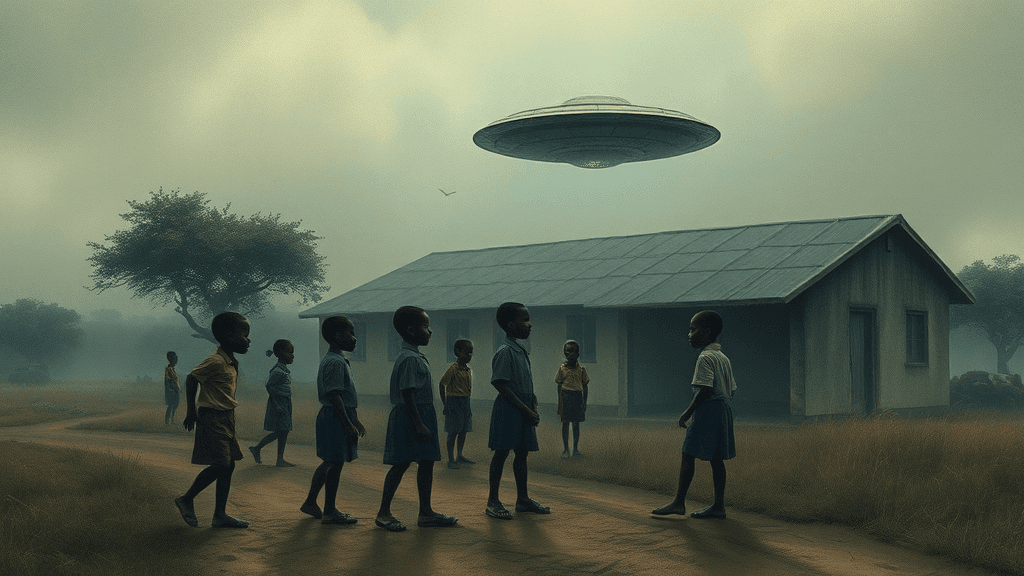
On the morning of September 16, 1994, some sixty schoolchildren at a private primary school outside Harare reported watching a silver disc land in a nearby field and one or more black-clad, large-eyed beings deliver a wordless warning about environmental destruction.
Background
Ruwa is a small town roughly 22 kilometers southeast of Harare, Zimbabwe's capital, and in 1994 it was home to the Ariel School, a private primary school serving a mostly affluent, mixed-race student body aged six to twelve. Zimbabwe in the mid-1990s was not an obvious setting for a landmark UFO case — the country had no significant prior tradition of flying-saucer reports comparable to the United States or United Kingdom — but the region had recently experienced a burst of aerial excitement. In the weeks before the incident, the re-entry of a spent Zenit-2 rocket stage over southern Africa produced a spectacular fireball visible across several countries, generating local news coverage and, some skeptics argue, primed the public imagination for stories of strange things falling from the sky.
Zimbabwe also had an existing, if modest, UFO research infrastructure in the person of Cynthia Hind, the Mutual UFO Network's regional representative for Africa and one of the continent's most active civilian investigators. It was Hind, rather than any government body, who would become the first trained investigator to reach the school after the sighting broke.
Events
At approximately 10:15 a.m. on Friday, September 16, 1994, during the mid-morning break, children at Ariel School reported seeing one or more silver, disc-shaped objects descending toward a rough, brush-covered field just beyond the school fence. Estimates among the children varied — some described a single large craft, others multiple smaller ones — but many converged on a metallic, saucer-like shape that appeared to land or hover low over the ground.
According to the most consistent accounts, one to four humanoid beings emerged from or approached the vicinity of the craft. Witnesses described them as dressed entirely in tight black clothing — some children likened it to a diver's wetsuit — with pale or dark skin, thin limbs roughly proportioned like a small human's, and strikingly large, dark eyes that dominated their faces. Several children said the beings' eyes were the first and most vivid thing they noticed, and many froze or fled in fear at the sight of them; a handful of older students, curious rather than frightened, moved closer to get a better look.
The encounter lasted, by most estimates, ten to fifteen minutes before the object and beings departed and the children returned, badly shaken, to their classrooms. Teachers, who had largely been indoors and did not witness the landing directly, described a schoolyard in an uproar — children crying, arguing about what they had seen, and comparing notes with unusual intensity for a playground rumor. In the days that followed, staff had many of the children independently draw what they had witnessed; the drawings showed a notable consistency in the shape of the craft and the appearance of the beings, a detail investigators and proponents would later cite as evidence against simple invention or copying.
It was only in later interviews — conducted weeks and months afterward — that a further claim surfaced: some children said the beings had communicated with them silently, telepathically, conveying distress about the state of the planet. Reported paraphrases included warnings that humans were "making harm on this world," that "pollution mustn't be," and broader anxieties about technology and possibly nuclear danger. This environmental-warning element would become the case's most quoted and most contested feature.
Investigation
The first outside investigator on the scene was Cynthia Hind, who arrived within days, on September 20, 1994. Hind interviewed the children individually and in small groups and had many of them draw pictures of what they had seen. Her early reports documented a broadly consistent description of the craft and the beings' clothing and eyes — but, notably, did not record any mention of a telepathic environmental message. That detail is largely absent from the earliest documentation.
Around the same time, BBC correspondent and cameraman Tim Leach visited the school on September 19 and filmed a series of on-camera interviews with pupils and staff for international broadcast. Leach, a veteran of conflict reporting, later remarked that he found the children's affect more unsettling than anything he had encountered in a war zone — a line, "I could handle war zones, but I could not handle this," that would be widely quoted in subsequent coverage of the case.
The investigation that would define the case's later reputation, however, came almost two and a half months after the event, in November 1994, when Harvard Medical School psychiatry professor John E. Mack traveled to Zimbabwe with a documentary filmmaker to interview the children himself. Mack, a Pulitzer Prize-winning biographer of T. E. Lawrence who had by then become the most academically credentialed proponent of the reality of alien abduction experiences, filmed on-camera sessions with roughly twelve children, in some cases using guided "relaxation" techniques that critics have characterized as effectively hypnotic. It is Mack's interviews — of which only seven of the twelve have ever been made public, and of which roughly three feature the environmental-message claim explicitly — that produced the vivid, detailed telepathic-warning testimony that later became central to popular retellings of the case. Mack went on to make Ariel a centerpiece of his 1999 book Passport to the Cosmos: Human Transformation and Alien Encounters, linking the children's reported message to similar ecological-warning themes he had documented among adult American abductees, and arguing the case pointed toward a real, if non-physical, contact phenomenon with a conservationist agenda.
Mack's broader abduction research had already drawn scrutiny at Harvard, and in 1994–95 the medical school convened an internal committee to review his research methods. The inquiry, which concluded in August 1995, issued no formal censure and publicly reaffirmed Mack's academic freedom, while nonetheless registering concern about his methodology — a mixed verdict that neither validated nor debunked his work.
The case for and against
Proponents point to several features that make Ariel unusually strong as UFO cases go: a very large number of independent child witnesses (on the order of sixty), broadly consistent descriptions and drawings produced without apparent opportunity for collusion, on-record interviews conducted by a respected international broadcaster within days of the event, and — for those persuaded by Mack's later work — a coherent and thematically resonant message. Fortean writer and encyclopedist Jerome Clark called it among the most remarkable close encounters of the 1990s, and the case remains a touchstone in ufological literature for the scale of its child testimony.
Skeptics, however, note a cluster of serious problems. The most quoted element of the story — the telepathic environmental message — is essentially absent from the earliest, least-contaminated interviews (Hind's) and emerges mainly in Mack's much later, hypnosis-adjacent sessions, a pattern consistent with memory drift, suggestion, or unconscious embellishment rather than a stable, contemporaneous perception. Hind's own interview notes describe children characterizing the beings' clothing as resembling a "diving suit," a description that closely tracks pre-existing UFO folklore rather than an unprompted observation, raising the possibility of contamination through group interviews and adult suggestion. Mack's selective release of only seven of twelve recorded interviews, and his documented prior research interest in children's nuclear anxieties and transpersonal beliefs, have led critics to argue his interview framing may have shaped, rather than merely recorded, what the children reported.
A 2024–2025 investigation by researcher Gideon Reid, published in the November/December 2025 issue of Skeptical Inquirer, proposed that the visual stimulus behind the sighting may have been an itinerant puppet or costumed-actor troupe of the kind then touring Zimbabwean schools to deliver HIV/AIDS-awareness performances — figures that, glimpsed at a distance against scrubland, could plausibly be reinterpreted by frightened children as black-clad, large-eyed beings. Reid also stresses a frequently omitted fact: of the roughly two hundred children present at the school that day, only about sixty reported seeing anything unusual at all, meaning a substantial majority of witnesses experienced nothing extraordinary — a detail that complicates simple appeals to "sixty independent witnesses" as proof of an objective external event. Other proposed mundane explanations include a dust devil or unusual atmospheric phenomenon, and broader mass hysteria fueled by regional excitement over the recent Zenit-2 rocket re-entry.
Cultural impact
Ariel became, alongside cases like the Roswell incident and Betty and Barney Hill abduction, one of the most frequently cited UFO events involving children, and it fed directly into wider 1990s debates over recovered-memory therapy, the reliability of hypnotically-assisted testimony, and the ethics of interviewing minors about traumatic or fantastical experiences. Mack's involvement tied the case into the broader controversy then surrounding his abduction research and his standing at Harvard. The case has since been revisited by two very different documentary treatments: Randall Nickerson's sympathetic, 141-minute Ariel Phenomenon (2022), which interviews the witnesses as adults — including former student Emily Trim and Zimbabwean journalist Francis Chirimuuta — and treats their recollections with considerable weight; and Netflix's docuseries Encounters (2023), whose second episode, "Believers," revisits the case for a mass streaming audience.
The Netflix treatment introduced a new controversy of its own: former student Dallyn Vico appeared to suggest that he and a friend had fabricated the entire sighting, pointing at a distant "shiny rock" that classmates then mistook for a spacecraft. Critics, including Reid's Skeptical Inquirer piece, note that this account directly contradicts Vico's own earlier on-camera testimony in Ariel Phenomenon a year earlier, where he described himself as a "witness to an event that I cannot fully explain" — leaving Vico's true position, and the reliability of either account, unresolved. Reid also observes that Encounters omits both Cynthia Hind and Tim Leach entirely from its retelling, despite their being the earliest investigators on record, which he argues distorts the case's evidentiary timeline in favor of a more dramatic, Mack-centered narrative.
Current status
No physical trace evidence, photograph, or radar data from the Ariel School encounter has ever surfaced; the entire case rests on witness testimony, most of it collected well after the fact and some of it produced under interview conditions modern researchers would regard as methodologically compromised. John Mack died in 2004, and Cynthia Hind died in 2000, leaving neither original investigator available to reconcile the discrepancies between their respective accounts. The children themselves, now adults in their thirties and forties, remain divided: some maintain the encounter was real and profoundly shaped their lives, at least one (Vico) has offered contradictory public statements, and the broader group has never produced a single unified account of what, if anything, occurred beyond a shared, vivid memory of fear. The case is best regarded today as contested: a genuine, sociologically remarkable mass event whose most extraordinary claimed element — the telepathic environmental warning — rests on the least reliable layer of evidence, collected latest and under the most suggestive interview conditions.
Witnesses
Approximately 60 of the roughly 200 children present at Ariel School on September 16, 1994, ranging in age from six to twelve, reported seeing the object and/or beings; the remaining children present reported nothing unusual. School staff were largely indoors and did not witness the landing directly, though several later gave interviews describing the children's reactions. Named adult witnesses/investigators include Cynthia Hind (MUFON regional representative, first investigator on scene, September 20, 1994), BBC correspondent Tim Leach (on-site September 19, 1994), and Harvard psychiatrist John E. Mack (interviewed roughly 12 children in November 1994). Former students who later spoke publicly as adults include Emily Trim and Dallyn Vico, both featured in the 2022 documentary Ariel Phenomenon; Vico also appeared in Netflix's 2023 Encounters series with a contradictory account.
Evidence
No physical trace, photographic, or radar evidence exists. The primary evidentiary record consists of: (1) contemporaneous children's drawings of the craft and beings, collected by Cynthia Hind within days of the event and cited by proponents for their mutual consistency; (2) filmed on-camera interviews conducted by BBC correspondent Tim Leach on September 19, 1994; (3) filmed interviews conducted by John Mack roughly 2.5 months later, in November 1994, of which only 7 of 12 have been publicly released; and (4) retrospective adult testimony collected decades later for the documentaries Ariel Phenomenon (2022) and Netflix's Encounters (2023). Notably, the case's signature claim — a telepathic environmental warning — is absent from the earliest (Hind) interviews and appears only in Mack's later sessions, a discrepancy central to skeptical analysis of the case.
Filed under
Watch
The Story of Children in Zimbabwe Encountering a UFO
The UFO Incident That Shocked Ariel School: Telepathic Extraterrestrials (Re-Edit)
Close Encounters: - The Ariel School UFO Incident // 3D CGI Animation
The Ariel School Encounter
Inside The Alien Sighting That Scarred An Entire School
Where this entry came from
ProvenanceAgent indexedUpdated 2mo ago8 sources
Drafted by the archive's AI research agent from the sources below; corrections from readers are reviewed and folded in.
- First indexed
- 17 JUL 26 // 20:18Z
- Last updated
- 09 SEP 26 // 04:45Z
- Ariel School UFO incident, Wikipedia
- A 1994 UFO Sighting by Children Changed Lives. What If This Guy Made It Up?, VICE
- Documentary explores the UFO sighting that changed the course of 62 children's lives, WHYY
- The Ariel School Phenomenon: What Really Happened When 68 Children Witnessed A UFO?, IFLScience
- A Closer Look at Encounters and the Ariel School Sighting, Gideon Reid, Skeptical Inquirer
- Ariel Phenomenon (2022), Letterboxd
- UFO Documentary 'Encounters' Shares Firsthand Accounts of Alien Presence on Earth, Netflix Tudum
- The Mysterious Events at Ariel School, Zimbabwe - 16 Sept 1994, Gideon Reid, Gideon Reid
Notes
- Ariel School UFO incident, Wikipedia
- A 1994 UFO Sighting by Children Changed Lives. What If This Guy Made It Up?, VICE
- Documentary explores the UFO sighting that changed the course of 62 children's lives, WHYY
- The Ariel School Phenomenon: What Really Happened When 68 Children Witnessed A UFO?, IFLScience
- A Closer Look at Encounters and the Ariel School Sighting, Gideon Reid, Skeptical Inquirer
- Ariel Phenomenon (2022), Letterboxd
- UFO Documentary 'Encounters' Shares Firsthand Accounts of Alien Presence on Earth, Netflix Tudum
- The Mysterious Events at Ariel School, Zimbabwe - 16 Sept 1994, Gideon Reid, Gideon Reid
Also available
Ariel Phenomenon
Filmmaker Randall Nickerson's definitive documentary of the September 1994 UFO sighting at Ariel School in Zimbabwe, where 62 schoolchildren witnessed an extraterrestrial encounter. Features archival interviews with witnesses and investigator John Mack.
Encounters
Four-part Netflix documentary series produced by Steven Spielberg's Amblin Television. Episode 2 "Believers" features the Ariel School incident, examining how 62 students witnessed a close encounter with humanoid figures that profoundly changed their lives.
The Phenomenon
Comprehensive UFO documentary examining sightings since World War II, featuring testimony from government officials, military personnel, and NASA astronauts. The final 12 minutes focus on the Ariel School incident with interviews from the witnesses decades later.
Buying through these links supports the library. We may earn a commission.