The UFO Library: Abduction
Betty and Barney Hill Abduction
An interracial couple returning from a Canadian vacation reported a close encounter on a deserted New Hampshire highway that produced two hours of missing time — and, under hypnosis eighteen months later, a detailed account of medical examination aboard a craft that became the template for all subsequent alien-abduction narratives.
Background
In the autumn of 1961, Betty Hill was a 41-year-old social worker handling child-welfare cases for the state of New Hampshire; her husband Barney was a 39-year-old postal clerk who commuted 60 miles each way to Boston and moonlighted on his church's human-rights committee. They were also, in the parlance of early-1960s America, an interracial couple — Betty was white, Barney was Black — at a moment when Loving v. Virginia was still six years away and their marriage drew looks on the streets of Portsmouth. Both were active in the local NAACP branch and carried themselves as respectable, civic-minded New Englanders who had no particular interest in flying saucers before the night of September 19.
They had taken a belated honeymoon trip to Niagara Falls and Montreal, and were driving home through the White Mountains on U.S. Route 3 — a two-lane road that winds through steep forest and passes the granite walls of Franconia Notch — when their lives changed.
Events
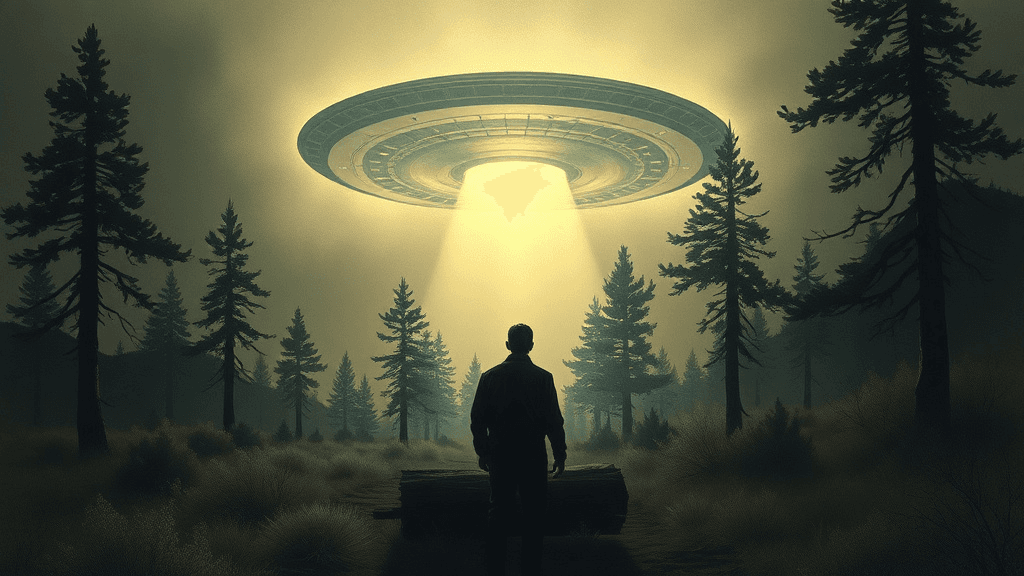
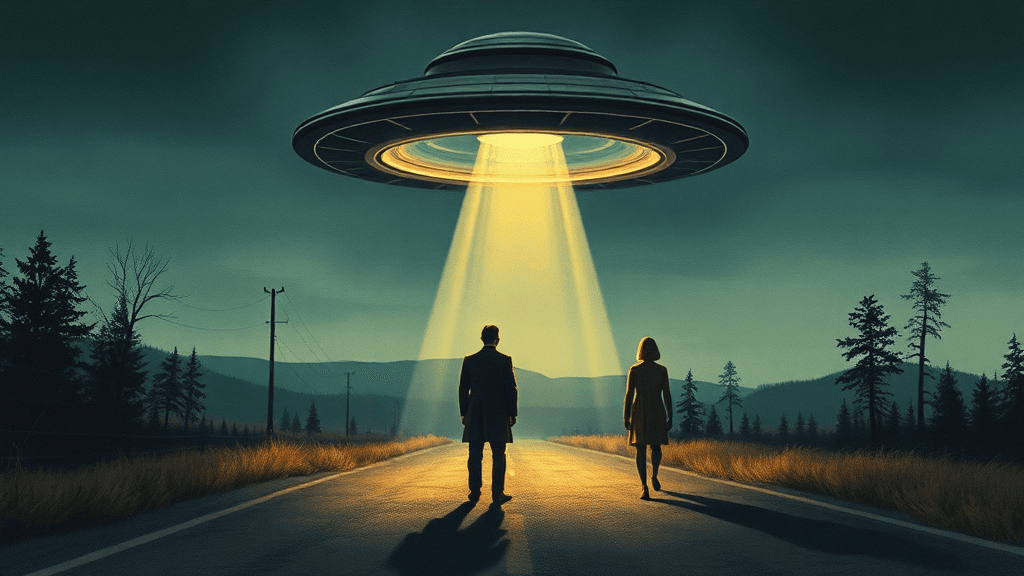
The Hills left a Vermont diner around 10:00 p.m., hoping to reach Portsmouth by 2 a.m. South of Lancaster, New Hampshire, Betty noticed a bright point of light that seemed to move against the stars — westward, then upward — in a way planets and aircraft do not. She borrowed Barney's 7×50 binoculars. The object appeared to be pacing them.
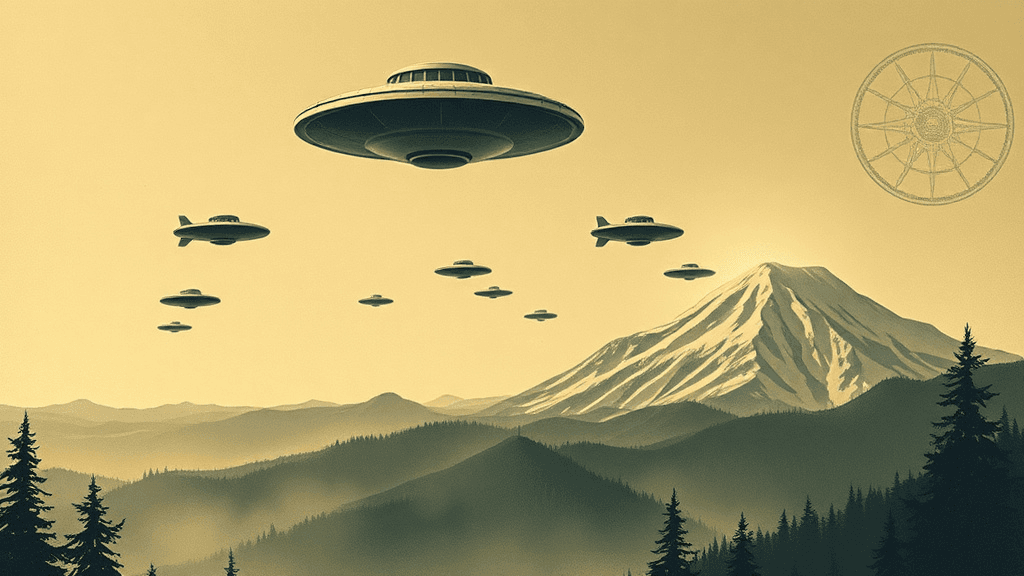
Barney was skeptical at first, attributing it to a commercial airliner. But near Indian Head, just north of Lincoln, the object swung directly across the road and descended to treetop level. Barney pulled the car onto the shoulder and walked into a field, binoculars raised. Through the lenses he saw a large, pancake-shaped craft with a double row of windows and, inside, a row of figures standing at the glass watching him. He later described the leading figure as wearing a black uniform and a shiny cap, with eyes that seemed to reach around the sides of his head — eyes he could not look away from. Panicked, he ran back to the car shouting that they were going to be captured.
They sped south. Shortly afterward — the Hills agreed it was almost immediate — they heard a rhythmic buzzing or beeping sound that seemed to come from the rear of the car and made the chassis vibrate. Betty felt drowsy. A second series of beeping sounds followed, and the Hills found themselves driving through Ashland, New Hampshire, roughly 35 miles further south, with no memory of how they got there. Their watches had stopped. They arrived in Portsmouth around 5 a.m., nearly three hours behind schedule.
The physical anomalies they noticed the next morning: Betty's dress was torn at the hem and stained with a powdery pink residue that could not be identified or removed. Barney's leather shoe tops were scraped flat, as if he had been dragged with his feet trailing. The binocular strap was broken. Shiny, concentric circular patches had appeared on the trunk lid of their car — and when a compass was moved over these spots, the needle spun erratically rather than pointing north.
Investigation
Betty phoned Pease Air Force Base on September 21, 1961. Major Paul W. Henderson took a brief report and filed an Air Intelligence Information Report; the case was eventually forwarded to Project Blue Book, which listed it as "unidentified" in one summary before quietly reclassifying it as having "insufficient data for evaluation." The file was later archived with the National Archives.
The Hills also contacted NICAP — the National Investigations Committee on Aerial Phenomena, then the most serious civilian UFO research organization in the United States. Investigator Walter N. Webb, a professional astronomer, drove to Portsmouth in October 1961 and spent six hours interviewing the couple separately and together. His written assessment described it as "an honest, straightforward account of a frightening experience" and noted a strong degree of internal consistency.
Beginning in late 1961, Betty experienced a series of vivid nightmares in which she and Barney were escorted aboard the craft by the same beings Barney had described. She wrote the dreams down in detail. The Hills discussed them with each other — a fact that would later become central to the skeptical case. Barney, who was exhibiting symptoms of anxiety and stress-related illness, sought treatment from a general practitioner, who referred him to a Boston psychiatrist.
In December 1963, the Hills began sessions with Dr. Benjamin Simon, a highly regarded Boston neurologist and psychiatrist who had used hypnosis to treat combat trauma during World War II. Simon was not a believer in UFOs. He conducted separate, weekly hypnotic regression sessions with Betty and Barney from January through June 1964, recording every session on reel-to-reel tape. He instructed each subject, under post-hypnotic suggestion, to forget what they had said until he chose to play it back — an attempt to prevent cross-contamination.
Under hypnosis, both described similar, though not identical, versions of an abduction. Barney recalled being walked, eyes closed, up a ramp into the craft, placed on a table, and subjected to what he perceived as a genital examination. He spoke of the beings communicating not through spoken words but through a form of direct mental impression. Betty described being separated from Barney, placed on an examining table, and subjected to a battery of procedures — skin scraping, hair sampling, clipping of nails — before a long needle was inserted into her navel in what she was told was a "pregnancy test." At one point, she said, the "leader" showed her a three-dimensional star map displayed as a holographic projection, with solid lines denoting established routes and dashed lines showing exploratory ones. When she asked where they were from, he indicated the map; when she said she didn't know where Earth was on it, he seemed exasperated and closed the session.
The Star Map Controversy
Betty Hill drew the star map from memory after the hypnosis sessions. In 1968, a Ohio schoolteacher and amateur astronomer named Marjorie Fish became intrigued by the drawing and spent years building a three-dimensional wire-and-bead model of nearby solar-type stars using the 1969 Gliese Star Catalogue. Examining thousands of viewing angles, she believed she had found a near-perfect match: viewed from a position near Zeta 2 Reticuli, 39 light-years from Earth, the arrangement of prominent stars corresponded closely to Betty's sketch. Fish's analysis was published in a 1974 issue of Astronomy magazine under the headline "The Zeta Reticuli Incident" and generated substantial public excitement.
The response from the scientific community was sceptical. Astronomers Carl Sagan and Steven Soter pointed out that with roughly fifteen data points arranged on a flat sketch — and with complete freedom to choose the viewing angle, decide which points to connect with lines, and exclude stars that didn't fit — a sufficiently motivated analyst could find apparent order in almost any collection of star positions. They framed it as a straightforward problem of pattern recognition and confirmation bias. Later data from the Hipparcos satellite, which provided stellar distances far more accurate than 1960s catalogue values, undermined several of Fish's key identifications: two of her fifteen chosen stars turned out to be variable stars or close binaries that her own habitability criteria should have excluded. Writer Brett Holman summarised the demolition in a 2008 Fortean Times article titled "Goodbye, Zeta Reticuli." In a rare display of intellectual honesty unusual in UFO circles, Fish herself eventually acknowledged that the improved stellar data made her original conclusion untenable.
The Case For and Against
For: The Hills' core sighting — a brightly lit, structured object that descended to near-treetop level before multiple witnesses — occurred before any hypnotic suggestion and is the least disputed part of the story. The circular marks on the car trunk were independently noted. Major Henderson's Air Force report, while terse, recorded the sighting as unexplained. Walter Webb, a credentialed astronomer, judged the couple reliable. The internal consistency between Barney's and Betty's separate hypnotic accounts — despite being told not to discuss the content — is cited by proponents as difficult to explain by simple confabulation. The Hills were not seeking fame; Betty resisted John Fuller's Interrupted Journey project for months before agreeing, and both declined most commercial opportunities.
Against: Dr. Simon's own professional verdict was unambiguous: he believed the abduction experience originated in Betty's vivid nightmares, which she had recounted to Barney over more than a year before hypnosis began. Hypnotic regression, far from unlocking buried truth, is now known to be highly unreliable; it can produce confident, vivid, emotionally charged false memories, particularly when the subject expects to recall something. The couple had extensive conversations about the dreams before the sessions, creating exactly the conditions for unconscious cross-contamination. Several elements of the beings' description — large, dark, wrap-around eyes; the leader's gleaming black uniform — match alien characters in an Outer Limits episode titled "The Bellero Shield" that aired just twelve days before Barney first described the beings in detail under hypnosis, though Barney insisted he had not seen it. Betty's later public accounts became increasingly embellished and inconsistent, undermining the precision claimed for the hypnotic recall.
Cultural Impact
The Hills' account did not become nationally known until October 1965, when a Boston Traveler reporter broke the story based on a leaked summary of the hypnosis tapes. Wire services picked it up; within days it had run in hundreds of papers across the country. John G. Fuller, an author and journalist, spent two years with the Hills and published The Interrupted Journey in 1966. Look magazine ran an illustrated excerpt that reached millions of readers. A 1975 NBC television film, The UFO Incident, starring James Earl Jones as Barney and Estelle Parsons as Betty, introduced the story to an even wider audience.
The consequences for UFO culture were enormous and, arguably, irreversible. Before the Hills, abduction reports were rare and disorganized; afterward, they multiplied rapidly, and nearly every subsequent case reproduced the same template: missing time, medical examination, large dark-eyed beings, star-map communication, and recovery through hypnotic regression. Researchers Budd Hopkins, David Jacobs, and others built entire careers on this framework. The "gray alien" as a cultural icon — small, smooth-skinned, large-headed, with enormous black eyes — derives almost entirely from Barney Hill's hypnotic descriptions and his subsequent sketches, which were circulated widely before the 1975 film cemented the image. The case also established hypnotic regression as the standard investigative technique for abduction claims, despite its profound epistemological problems.
As an interracial couple navigating a deeply divided society, the Hills also brought a dimension to the story that was rarely discussed at the time but has attracted increasing scholarly attention. Some analysts have suggested that the powerlessness, bodily violation, and coerced submission described in the abduction narrative resonated with the specific vulnerabilities of a Black man in 1960s America, making the case rich material for psychoanalytic and cultural readings that go well beyond ufology.
Current Status
Barney Hill died on February 25, 1969, at the age of 46, from a cerebral hemorrhage. Betty Hill survived him by more than three decades, becoming an increasingly prominent — and by the end somewhat controversial — figure in UFO circles. She died on October 17, 2004, in Portsmouth, at the age of 83. In July 2011, the state of New Hampshire erected a historical marker near Lincoln on Route 3 at the approximate location of the encounter — a rare official acknowledgement of a UFO incident by any government body.
The original case files, hypnosis tapes, Betty's dress, and correspondence are preserved in the Milne Special Collections and Archives at the University of New Hampshire Library, where researchers can examine them directly.
The Hill case occupies a peculiar position in UFO discourse: too well-documented to dismiss outright, too dependent on contested hypnotic recall to accept at face value. What is beyond dispute is its cultural power. No single event did more to shape how Americans imagined — and continued to imagine — the experience of alien contact.
Witnesses
Betty Hill (1919–2004), social worker, Portsmouth NH. Barney Hill (1922–1969), postal clerk, Portsmouth NH. No independent human witnesses to the main encounter; the road through Franconia Notch was effectively empty at midnight.
Evidence
- Shiny circular marks on the car's trunk lid causing compass deflection, noted the morning after the event
- Betty's dress, torn at the hem and stained with an unidentified pink powder; dress preserved in the UNH archives
- Barney's leather shoes with tops scraped smooth in a manner inconsistent with normal wear
- Broken binocular strap
- Both subjects' wristwatches had stopped
- Barney Hill developed an unusual ring of warts around his groin in the period following the incident
- Tape-recorded hypnosis sessions (January–June 1964, Dr. Benjamin Simon) — original reels archived at the University of New Hampshire
- Air Intelligence Information Report filed by Major Paul W. Henderson, Pease AFB, September 21, 1961
- NICAP investigator Walter N. Webb's written assessment (October 1961), describing account as honest and internally consistent
- Betty Hill's hand-drawn star map, produced from memory after hypnosis, archived at UNH
People involved
Entities
Filed under
Watch
An Alien Abducted My Family and I Can Prove It! | This Morning
The Abduction of Betty & Barney Hill - The Full Story | Documentary
Barney & Betty Hill: An Alien Abduction Story - Lights Out Podcast #8
The Truth Behind Betty & Barney Hill's Haunting Experience - DEBRIEFED ep. 56
"Lost" 108-minute interview with alien abductee Betty Hill, Portsmouth, 1999
Where this entry came from
ProvenanceAgent indexedUpdated 6mo ago9 sources
Drafted by the archive's AI research agent from the sources below; corrections from readers are reviewed and folded in.
- First indexed
- 24 APR 26 // 22:45Z
- Last updated
- 25 APR 26 // 22:01Z
- Barney and Betty Hill incident, Wikipedia
- Betty and Barney Hill Papers, 1961–2006, University of New Hampshire Milne Special Collections
- Betty Hill's UFO Star Map: The Truth, Armagh Planet (Armagh Observatory)
- Alien Abduction in the White Mountains, Appalachian Mountain Club
- 'This Can't Be Real': Inside the Alleged Alien Abduction of Betty and Barney Hill in 1961, All That's Interesting
- An Alien Abduction? Hardly a Convincing One., McGill University Office for Science and Society
- The Abduction of Betty and Barney Hill, Boston Public Library
- Goodbye, Zeta Reticuli, Brett Holman, Airminded (Brett Holman)
- The Betty and Barney Hill Abduction: The Case That Defined a Phenomenon, UFOUAP
Notes
- Barney and Betty Hill incident, Wikipedia
- Betty and Barney Hill Papers, 1961–2006, University of New Hampshire Milne Special Collections
- Betty Hill's UFO Star Map: The Truth, Armagh Planet (Armagh Observatory)
- Alien Abduction in the White Mountains, Appalachian Mountain Club
- 'This Can't Be Real': Inside the Alleged Alien Abduction of Betty and Barney Hill in 1961, All That's Interesting
- An Alien Abduction? Hardly a Convincing One., McGill University Office for Science and Society
- The Abduction of Betty and Barney Hill, Boston Public Library
- Goodbye, Zeta Reticuli, Brett Holman, Airminded (Brett Holman)
- The Betty and Barney Hill Abduction: The Case That Defined a Phenomenon, UFOUAP
Also available
Alien Abduction: The Odyssey of Betty and Barney Hill
Documentary revealing new information about Betty and Barney Hill's lives before and after Barney's death in 1969, their celebrity status, and Betty's work as a UFO investigator. Features interviews with Stanton Friedman and Kathleen Marden (Betty's niece).
Alien Abduction: Betty and Barney Hill
Part of the Shock Docs series. Documentary examining new evidence and investigative material related to the 1961 Betty and Barney Hill UFO encounter in the White Mountains of New Hampshire, exploring whether their close encounter was real.
The UFO Incident
Made-for-television biographical film starring James Earl Jones and Estelle Parsons as Barney and Betty Hill. Dramatizes the alleged 1961 alien abduction case, using hypnotic regression to explore their encounter in the White Mountains of New Hampshire.
Buying through these links supports the library. We may earn a commission.