The UFO Library: Crash and retrieval
Corona Debris Field and the 'Crash at Corona' Claim (1947)
The debris that rancher W. W. 'Mac' Brazel found near Corona, New Mexico, in June–July 1947 is the same material that sparked the Roswell story; the 1994 Air Force review tied it to a classified Project Mogul balloon, but Stanton Friedman and Don Berliner later argued in Crash at Corona (1992) that it marked a separate alien craft crash.
Background
"Corona" is shorthand for one of the two physical sites in the Roswell incident: the scatter of wreckage that rancher W. W. "Mac" Brazel found on the sheep ranch he managed in Lincoln County, New Mexico, in the summer of 1947. The village of Corona, the nearest settlement, gave the site its name, and the label stuck largely because of Stanton Friedman and Don Berliner's 1992 book Crash at Corona, which argued that the debris came from a crashed non-human craft rather than from any earthly device. The fuller Roswell narrative, with its base, press release and later body claims, is covered in the site's Roswell crash entry; this entry concentrates on the ranch, the debris, and the argument over what it was.
The context matters. Summer 1947 was the first great American "flying saucer" wave. Kenneth Arnold's Mount Rainier sighting of June 24 had produced the phrase "flying saucer," and newspapers across the country were primed to print any story of a recovered disc. Meanwhile, the Army Air Forces at Alamogordo Army Air Field were conducting a classified program that happened to put large amounts of strange-looking material into the New Mexico sky. Project Mogul was the secret arm of an otherwise unclassified New York University atmospheric research effort. It flew long trains of balloons carrying acoustic sensors in the hope of detecting Soviet nuclear tests at great distance. According to the Roswell incident article, Mogul Flight No. 4 was launched from Alamogordo on June 4, 1947, and its tracking was lost while it drifted toward the Corona area, within about 17 miles of Brazel's property.
Events
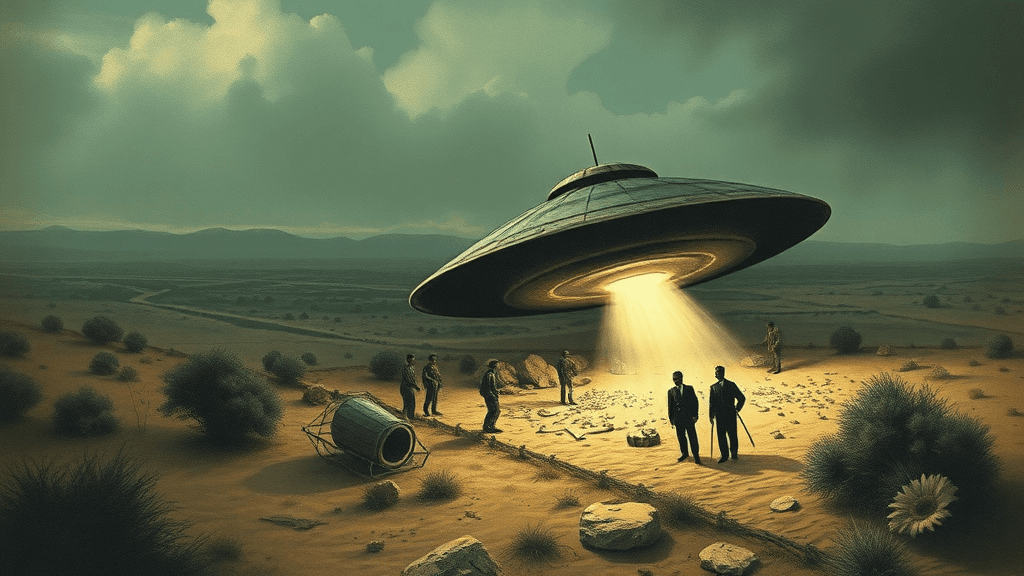
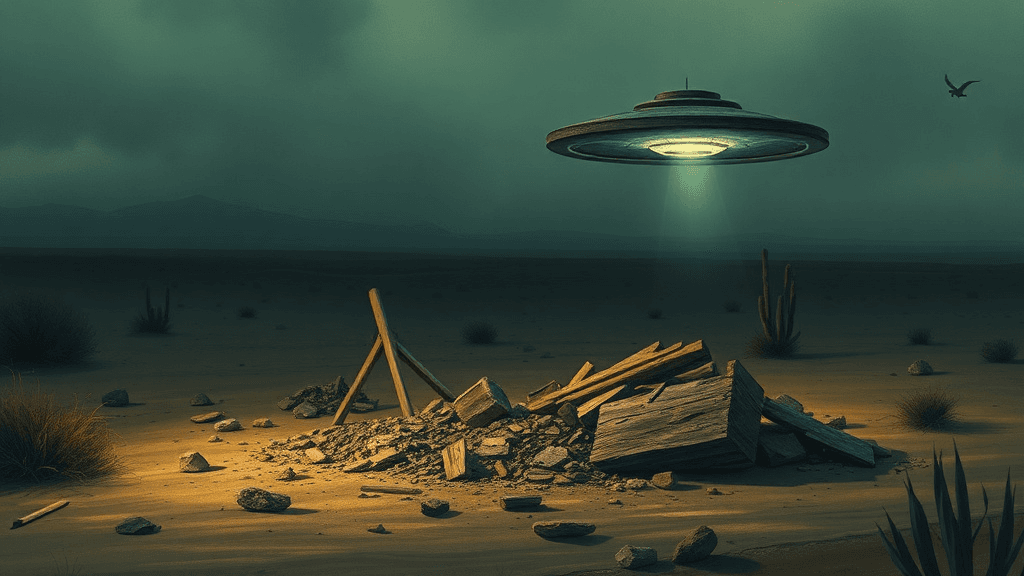
The find. Brazel told the press that he came across the debris while riding out to check on his sheep, sometime in June 1947. He described tinfoil, rubber strips, tape and thin wooden beams or sticks spread across an area of several acres. For a time he paid it little attention; ranchers in that country regularly found the remains of weather equipment. What changed matters was the saucer wave. On July 5 Brazel went into Corona, where, per the Roswell incident account, his uncle Hollis Wilson suggested the material might be a "flying disk," and the possibility of a reward or at least public interest seems to have occurred to him.
The report. On July 6 Brazel drove to Roswell and told Sheriff George Wilcox, who telephoned the Roswell Army Air Field (RAAF), home of the 509th Bomb Group. Intelligence officer Maj. Jesse Marcel and Counter Intelligence Corps officer Capt. Sheridan Cavitt were sent to the ranch with Brazel and collected material. The base commander, Col. William Blanchard, informed the Eighth Air Force commander, Brig. Gen. Roger Ramey, at Fort Worth.
The press release. On July 8 the RAAF public information officer, Lt. Walter Haut, issued a release stating that the military had recovered a "flying disc." Radio station manager George Walsh relayed the story to the Associated Press, and it was in newspapers nationwide within hours. That afternoon the account was reversed. At Fort Worth, Ramey, Col. Thomas DuBose and weather officer Irving Newton displayed fragments to reporters and identified them as the remains of a weather balloon and its radar target; Newton said such targets were in use at some eighty weather stations. Marcel was photographed with the debris at Fort Worth the same day, kneeling over a display that by then carried a mundane explanation.
Brazel's own words. The Roswell Daily Record of July 9 carried Brazel's account. He described "tinfoil, paper, tape, and sticks," and said, "I am sure that what I found was not any weather observation balloon." That sentence is the foundation of the Corona claim: a man who had seen weather balloons on his ranch said this was something different. Later accounts that Brazel was held by the military and coached into silence are disputed; Brazel died in 1963, and his children's later recollections, as summarized in the Roswell incident article, include Bessie Brazel Schreiber's description of materials consistent with Mogul.
Investigation
Forgotten, then revived. The story effectively vanished for thirty years. In 1978 Friedman interviewed the retired Marcel, who said the weather-balloon explanation had been a cover story and that he believed the debris was extraterrestrial. Marcel's account reached the National Enquirer in December 1979, ran on In Search of... in September 1980, and appeared in Charles Berlitz and William Moore's The Roswell Incident (1980), which also added second-hand claims about bodies on the Plains of San Agustin from the testimony of Grady "Barney" Barnett. Marcel's son, Jesse Marcel Jr., later recalled being shown debris as a ten-year-old, including a beam bearing purple-hued "hieroglyphics," a detail that skeptics link to floral-patterned adhesive tape that Mogul's contractor reportedly bought from a toy manufacturer.
Crash at Corona. In 1992 Stanton Friedman and Don Berliner published Crash at Corona, the book that hardened the "Corona" label. It assembled additional witnesses and argued that two craft had come down, one near Brazel's ranch and a second, more intact wreck about two miles to the southeast, with eight occupants, two of them said to have survived. A central supporting witness was teletype operator Lydia Sleppy, who said she was transcribing a report of wreckage from a reporter when a message ordered her to stop. According to the Roswell incident article, Friedman's version of that interruption was later found to be technically impossible for the teletype model Sleppy would have used in 1947.
Rival investigators. The Corona narrative did not go unchallenged within ufology. Kevin Randle and Don Schmitt argued in 1994 for a single crash site and rejected several of Friedman and Berliner's witnesses, notably Gerald Anderson, whose claimed boyhood encounter with a crash site they concluded was unreliable. Skeptical ufologist Karl Pflock, who had begun as an open-minded investigator, concluded by 1994 that the Brazel debris derived from Mogul.
The government reviews. Congressman Steven Schiff of New Mexico requested a General Accounting Office inquiry in 1993; the GAO reported it could find no relevant records in the CIA and nothing on the alleged MJ-12 group. The Air Force produced two studies. The first, Report of Air Force Research Regarding the Roswell Incident (July 1994, followed by The Roswell Report: Fact vs. Fiction in the New Mexico Desert), concluded that the debris was most likely from a Mogul balloon train, and conceded that the 1947 "weather balloon" statement had itself been a cover story, though for a classified balloon project rather than an alien craft. It included Cavitt's sworn statement: "I thought at the time and think so now, that this debris was from a crashed balloon." The Roswell Report: Case Closed (June 24, 1997, by Capt. James McAndrew) argued that later "alien body" accounts were conflations of Air Force parachute tests using instrumented dummies. Critics point out that the dummy tests of the 1950s postdate the 1947 event by years, so the argument concerns memory, not the debris.
The case for / against
For a non-balloon origin. Proponents rest on four pillars. First, Brazel's July 9 statement that this was not a weather balloon. Second, Marcel's long-delayed testimony: a career intelligence officer who had handled the debris himself and insisted it was not of known manufacture. Third, the abrupt reversal in the Army's public account within a single day, which looks like a cover-up to anyone who considers the 1947 release authentic. Fourth, the Air Force's own admission in 1994 that the first official explanation was untrue; for Friedman, this showed that the government had lied once and might be lying again.
Against. The case against is that every physical description matches Mogul: foil, rubber, tape, wooden struts, string. Carl Sagan and Philip Klass both noted this, and Klass argued that the "hieroglyph" tape and sticky foil were consistent with the program's hardware. The mismatch of dates is also notable: the claims of bodies, a second site, and sealed hangars emerged decades afterward from witnesses whose accounts often changed, were second-hand, or could not be confirmed. Sleppy's teletype story fails a technical check; Anderson was abandoned by the very researchers who first used him. Even Randle, one of the most prolific pro-crash investigators, told Skeptical Inquirer in the 2010s that the extraterrestrial evidence was no longer robust, and the 2015 "Roswell slides" he correctly predicted would not show an alien were identified within days as a mummified child displayed at a Colorado museum. Mogul does not settle every detail, since proponents note that no document places a specific balloon train on Brazel's ranch, but it explains the material evidence far better than anything proposed in its place.
A fair reading: the strongest claim that survives is not that aliens crashed at Corona but that the Army misled the public in 1947 about what it had found. A cover story for a classified balloon program is a cover story all the same.
Cultural impact
Corona is where the modern crash-retrieval genre begins. The word "Roswell" is the brand, but the ranch is the physical evidence. Almost every later claim, from alien autopsy footage to the Roswell festival on the town's main street and a place in popular film and television, descends from the idea that something unusual was found on a New Mexico ranch in 1947. The Brazel debris also gave ufology its first template for the long dispute between testimony and documents. It encouraged a market in books by competing investigators who accused each other of fabrication, a pattern that has repeated through later crash-retrieval stories. The Air Force's 1994 and 1997 reports, intended to close the matter, did more to sustain interest than to end it: by admitting a past cover story they confirmed the premise that the military had once misled the public.
Current status
The debris itself is gone: no verified fragment of the Corona material has ever been produced, tested, and shown to be non-terrestrial. The mainstream scientific and historical consensus is that Brazel found Mogul equipment, probably from a train launched in June 1947, and that the Army's cover story reflected the secrecy of that program. A dedicated minority of researchers, including the legacy of Friedman (who died in 2019) and the continuing work of others, maintains that the Corona wreckage represents a recovered craft, and Roswell remains a centre of UFO tourism. Credibility is rated contested here: the existence of the debris and the cover story is well documented, while the extraterrestrial interpretation is not supported by any physical evidence in the public record.
Witnesses
Rancher W. W. "Mac" Brazel; Hollis Wilson (uncle); Sheriff George Wilcox; Maj. Jesse Marcel; Capt. Sheridan Cavitt; teletype operator Lydia Sleppy (as cited by Friedman and Berliner); Gerald Anderson (disputed by Randle and Schmitt). Col. William Blanchard; Lt. Walter Haut (press release); Brig. Gen. Roger Ramey, Col. Thomas DuBose and Irving Newton (Fort Worth); Bessie Brazel Schreiber and William Brazel Jr. (children); Jesse Marcel Jr.
Evidence
Physical debris (tinfoil, rubber, tape, wooden sticks) recorded in the 1947 press; the 1994 Air Force report linking the material to Project Mogul; the 1994 Cavitt statement. No verified alien material has been produced.
Filed under
Watch
UFO Roswell Incident (Full Episode) | Undercover History Updates | National Geographic
The Proof Is Out There: UFO Crash Spotted in NASA Photo (Season 3) | History
The Mysterious Roswell UFO Incident of 1947
70 Years After Famed Crash at Roswell, the Truth Is Still Out There
Roswell Crash Sites Exposed
Where this entry came from
ProvenanceAgent indexedUpdated 2w ago8 sources
Drafted by the archive's AI research agent from the sources below; corrections from readers are reviewed and folded in.
- First indexed
- 24 OCT 26 // 02:18Z
- Last updated
- 24 OCT 26 // 04:44Z
- Roswell incident, Wikipedia
- Crash at Corona: The U.S. Military Retrieval and Cover-Up of a UFO, Publishers Weekly
- Stanton T. Friedman, scientist who tracked UFOs, dies, The Boston Globe
- Crash at Corona, Open Library
- The Roswell Report: Case Closed, James McAndrew, U.S. Air Force / Project Gutenberg
- Roswell Reports (Air Force library archive), U.S. Air Force via webharvest.gov
- The Space Review article on Roswell, The Space Review
- Yetis and Extraterrestrials?, GPO Government Book Talk
Notes
- Roswell incident, Wikipedia
- Crash at Corona: The U.S. Military Retrieval and Cover-Up of a UFO, Publishers Weekly
- Stanton T. Friedman, scientist who tracked UFOs, dies, The Boston Globe
- Crash at Corona, Open Library
- The Roswell Report: Case Closed, James McAndrew, U.S. Air Force / Project Gutenberg
- Roswell Reports (Air Force library archive), U.S. Air Force via webharvest.gov
- The Space Review article on Roswell, The Space Review
- Yetis and Extraterrestrials?, GPO Government Book Talk
Further reading

Crash at Corona
Friedman and Berliner's investigation of the 1947 Corona debris recovery and the claimed military cover-up.
Buying through these links supports the library. We may earn a commission.
Also available
Aliens, Abductions, and UFOs: Roswell at 75
Two-hour Tubi original special marking the 75th anniversary of the 1947 New Mexico debris events, covering the Roswell story and the rancher reports that began it (Corona's William 'Mack' Brazel is part of that chain). Not specific to Corona; runtime is approximate.
Alien Desert Legend
45-minute documentary on the 1947 New Mexico desert event, following the military's initial 'flying disc' announcement and its retraction in favor of a weather balloon explanation. Roswell-focused rather than Corona-specific.
Alien Landing in New Mexico
45-minute documentary about the Roswell incident and the 1947 New Mexico debris reports. Listed on IMDb Pro; Roswell-focused rather than Corona-specific.