The UFO Library: Photograph or film
The Bonilla Observation (1883)
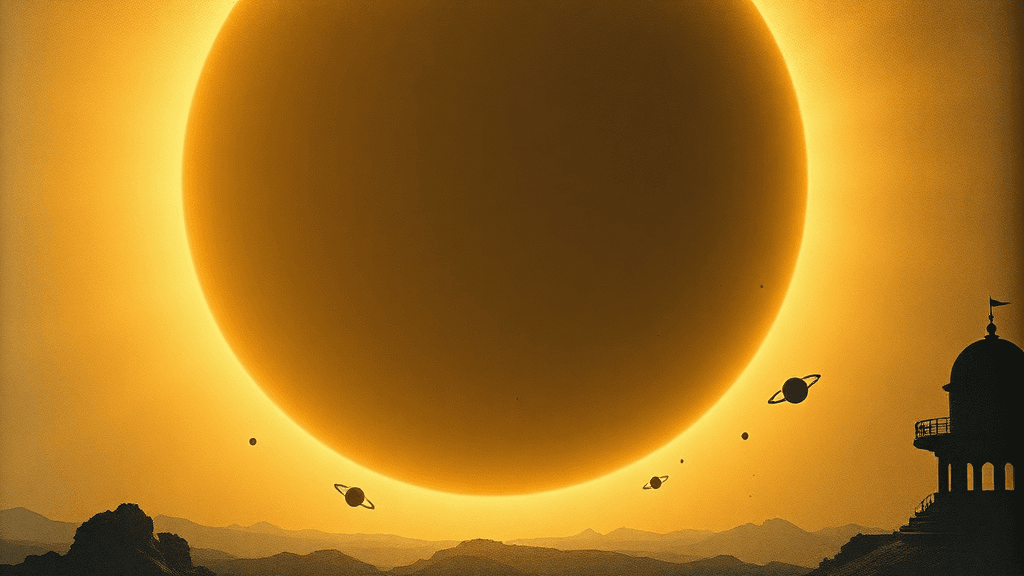
On 12–13 August 1883, Mexican astronomer José Bonilla photographed more than 300 dark, fuzzy objects transiting the solar disk from the newly opened Zacatecas Observatory — producing what are widely regarded as the earliest known photographs of an unidentified aerial phenomenon.
Background
The summer of 1883 found Mexican astronomy at an ambitious turning point. In December 1882, the state of Zacatecas had inaugurated a new research facility — the Observatorio Astronómico del Estado de Zacatecas — perched on the Mexican altiplano at roughly 2,500 metres above sea level. Zacatecas city sits on the central highland plateau, and its thin, stable atmosphere had made it an attractive site for systematic solar and meteorological observation. The observatory's founding director was José A. y Bonilla, a Mexican astronomer charged with conducting rigorous photographic solar studies for the new institution.
By August 1883, Bonilla had spent nearly eight months familiarising himself with the observatory's instruments and establishing observational routines. His work centred on solar photography — a discipline that had grown rapidly since the development of the collodion wet-plate process in the 1850s. The technique allowed astronomers to capture detailed images of the Sun's disk, documenting sunspot cycles, solar prominences, and the periodic transits of Mercury and Venus. On the morning of 12 August, Bonilla directed his telescope toward the Sun for what he expected to be an ordinary session. It was anything but ordinary.
Events
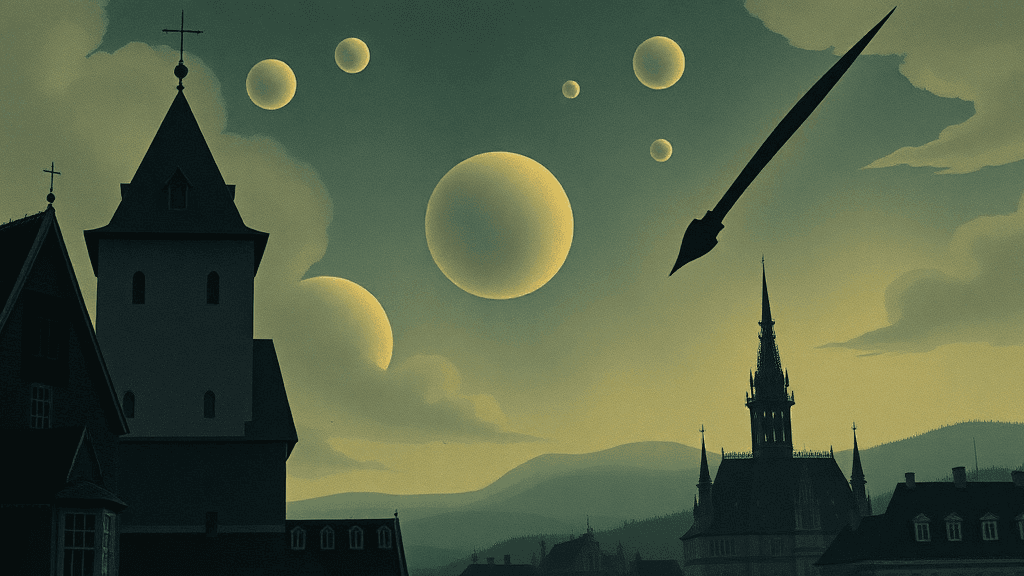
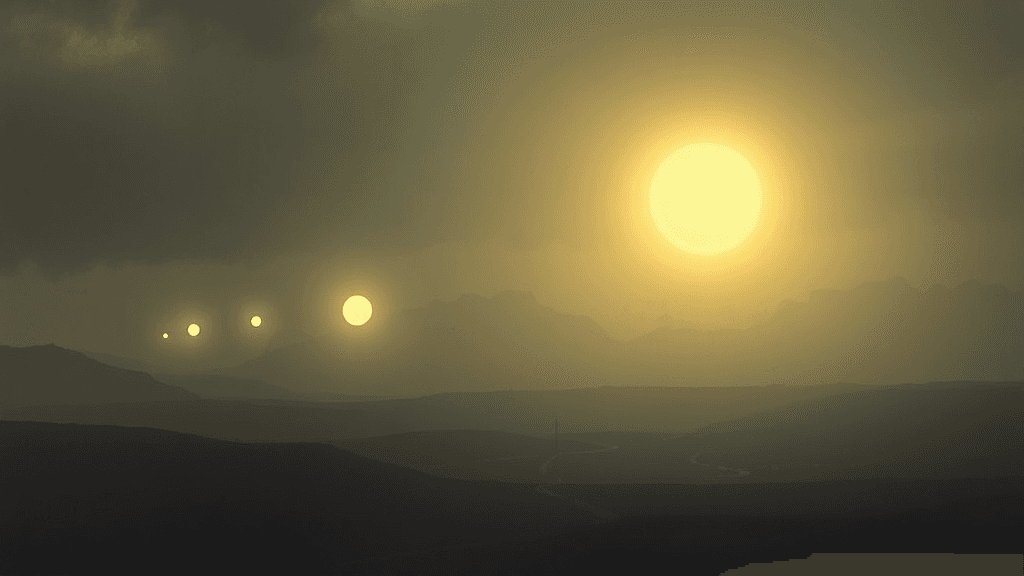
At approximately 8:00 a.m. on 12 August 1883, while examining the solar disk, Bonilla noticed dark objects crossing the bright face of the Sun. Each object transited the disk in under one second — fast enough to be startling but slow enough to observe with care. The objects were not clean geometric silhouettes. Bonilla described them consistently as "fuzzy" or "misty" in character, and noted that many appeared to trail dark appendages he called "dark tails." They arrived in groups, sometimes ten to twenty objects at regular intervals, sweeping across the disk in loose convoy formations before the sky cleared again.
Rather than dismiss the phenomenon, Bonilla reached for his photographic apparatus. Using the collodion wet-plate process — the standard method for astrophotography at the time, requiring each glass plate to be coated with light-sensitive silver salts suspended in collodion, exposed while still wet, and developed immediately — he began capturing images. The process was technically demanding: every exposure required a fresh plate, immediate chemistry, and close attention to the fleeting transits.
The observation did not end that afternoon. The objects continued to appear on 13 August, and Bonilla maintained his photographic vigil through both days. Over the course of the two-day event he produced 447 photographic plates documenting at least 283 distinct transiting objects, though some accounts place the total object count higher. The objects appeared in waves — intense bursts of multiple transits within short windows, interspersed with quieter intervals — suggesting a stream structure rather than random, isolated events.
The timing carries a resonance that would not escape later analysts: 12 August is the traditional peak of the annual Perseid meteor shower, produced by the debris trail of comet 109P/Swift-Tuttle. The Perseids were well known to nineteenth-century astronomers, and Bonilla would have been aware of them. Whether the coincidence of date was meaningful or incidental became one of the interpretive fault lines in subsequent analysis.
Investigation
Bonilla submitted his photographs and written observations to the French astronomy journal L'Astronomie, then the leading popular-scientific astronomy publication in Europe. The article was not published until 1 January 1886 — more than two and a half years after the observations. The journal's founder and editor was Camille Flammarion, France's most celebrated popular astronomer, a figure whose career encompassed rigorous solar observation, studies of Mars, and wide-ranging investigation of unusual natural phenomena.
Flammarion's editorial response was brief and dismissive. He proposed that the most probable explanation was birds, insects, or airborne dust particles passing directly in front of Bonilla's telescope objective — not objects in space at all. His key argument was epidemiological: if the objects had truly been at interplanetary or even high-altitude distances, they would have been visible from other observatories across the hemisphere on the same dates. No other observatory reported anything unusual on 12–13 August 1883. This argument from negative evidence — the absence of corroborating sightings — became the cornerstone of the skeptical position and was not seriously revisited for nearly 130 years.
After 1886 the Bonilla observation vanished from scientific discourse. L'Astronomie had a wide readership among French-speaking scientists but the case attracted no published follow-up, no correspondence from observers elsewhere, and no systematic study of the surviving plates. The collodion glass negatives, if they survived, appear to have entered obscurity along with the observatory's early records.
The case resurfaced in the twentieth century as researchers began combing historical archives for documented anomalous aerial observations predating the modern UFO era. Jacques Vallée, the French-American astrophysicist and author who became one of the most rigorous voices in UFO research, included the Bonilla photographs in his 1965 survey Anatomy of a Phenomenon. Vallée observed that the objects Bonilla described — moving in ordered groups of fifteen to twenty units at regular intervals — showed a pattern difficult to attribute to random biological material drifting past a lens, and he considered the structured formation behaviour suggestive of coherent, possibly organised objects. The case entered UFOlogical literature as one of the oldest alleged photographic records of anomalous aerial phenomena, reproduced from the 1886 L'Astronomie engravings in books, documentaries, and encyclopedias.
In October 2011, three astronomers at the Universidad Nacional Autónoma de México (UNAM) published a preprint on arXiv that returned the observation to mainstream scientific attention. The paper — "Interpretation of the observations made in 1883 in Zacatecas (Mexico): A fragmented Comet that nearly hits the Earth", by Héctor Javier Durand Manterola, María de la Paz Ramos Lara, and Guadalupe Cordero — proposed that Bonilla had observed the fragment train of a disintegrating comet passing at extraordinary proximity to Earth's surface.
The UNAM team's calculations were striking. Working backward from Bonilla's recorded transit durations (each object crossing the solar disk in under one second) and assuming typical cometary velocities, they estimated the fragment train's distance from Earth at between 538 kilometres and 8,062 kilometres above the surface — a range spanning from the upper thermosphere to roughly one-fifth of the lunar distance. Individual fragment sizes were estimated at 68 to 795 metres in length. The total mass of the progenitor comet was placed between 2 × 10¹² and 8 × 10¹⁵ kilograms — consistent with known cometary bodies. The authors drew explicit comparisons to Comet 73P/Schwassmann-Wachmann 3, which was observed fragmenting into hundreds of identifiable pieces during its 2006 apparition.
The case for / against
The comet hypothesis is the most scientifically credible modern interpretation. A fragmented comet at close range explains virtually everything in Bonilla's account: the fuzzy, tail-bearing appearance of the objects (consistent with cometary coma and dust tails at short range), their large number, their grouping into stream-like clusters, and their presence across two consecutive days. Critically, extreme proximity also resolves Flammarion's negative-evidence problem. At a distance of only a few thousand kilometres, strong geometric parallax would restrict the visibility window to a narrow arc of Earth's surface. Zacatecas may simply have been the only observatory properly positioned to see the train — which is why no other institution reported it.
However, the comet hypothesis carries a serious unresolved problem: a fragment train penetrating to such close proximity should have generated a spectacular meteor storm as debris entered the atmosphere. Astronomical records from August 1883 contain no such report. The Perseid records from that year are routine, with no mention of an extraordinary surge. The UNAM authors acknowledged this tension directly, suggesting either the fragment density was insufficient to produce a visible storm or that atmospheric geometry reduced the observable rate — neither solution is fully satisfying.
Flammarion's bird-and-insect hypothesis is less credible than it first appears. At a telescope trained on the Sun, objects immediately in front of the objective lens at very short distance would appear blurred and diffuse — which is consistent with Bonilla's "fuzzy" description — but a two-day procession of nearly 300 individually photographable, distinctly-shaped objects strains this explanation considerably. Birds do not pass in coherent stream formations over 48-hour windows. Moreover, Bonilla was a trained observational astronomer, thoroughly familiar with the artefacts produced by dust, insects, and optical irregularities that are routine hazards of solar telescope work. His decision to document the phenomenon so systematically — nearly 450 separate exposures — suggests he had already considered and rejected the mundane explanations available to him.
The structured craft interpretation advanced in UFOlogical literature, particularly through Vallée's analysis, rests on the formation structure of the objects and their anomalous appearance. Vallée found the regular groupings of 15–20 units at consistent intervals suggestive of intentional arrangement rather than natural dispersion. This reading is not inherently absurd given the historical context — 1883 offered no cultural template of extraterrestrial spacecraft, meaning Bonilla had no motive for fabrication or embellishment. But formation patterns are not diagnostic: cometary fragment trains produced by rotational splitting also exhibit clustering patterns determined by breakup mechanics. Without higher-resolution images or spectroscopic data from the original plates, no interpretation can be conclusively established.
The root difficulty is archival. The original collodion glass plates have not been located and subjected to modern densitometric or spectroscopic analysis. The images published in L'Astronomie in 1886 were printed reproductions — degraded from the originals — and lack the resolution needed to determine whether the objects possess internal structure inconsistent with cometary or biological material.
Cultural impact
The Bonilla observation holds a unique position in the history of anomalous aerial phenomena documentation. It predates Kenneth Arnold's 1947 sighting — conventionally cited as the beginning of the modern UFO era — by 64 years. It involves a trained professional astronomer, an institutional scientific setting, photographic evidence produced with the accepted methods of the period, and formal publication in a respected journal. For researchers who argue that the UFO phenomenon has pre-modern roots independent of Cold War culture, Bonilla's photographs are a key exhibit.
Vallée's treatment in Anatomy of a Phenomenon (1965) was particularly influential. The book was part of a deliberate effort — shared by Vallée, Aimé Michel, and a small circle of scientifically trained researchers — to build a rigorous corpus of anomalous aerial observations spanning centuries. The inclusion of Bonilla's photographs, alongside medieval European woodcuts and early modern reports, helped establish the idea that the phenomenon had a documented history too deep to be explained by 1940s American popular culture.
The 2011 UNAM paper brought the observation a new kind of mainstream visibility. Covered by Phys.org, Gizmodo, the American Association for the Advancement of Science, and dozens of science-news outlets, the story was reframed: not as a UFO sighting but as a near-extinction event. Headlines asking whether a fragmented comet had "almost annihilated humanity in 1883" proved irresistible to science journalists. This reframing stripped the case of its UFOlogical associations while simultaneously amplifying its strangeness — a remarkable inversion of the usual relationship between scientific reinterpretation and popular interest.
Current status
The Bonilla observation remains interpretively unresolved. The UNAM comet hypothesis is the dominant scientific explanation but has not been conclusively accepted, and the meteor-storm problem stands as an open challenge. The original collodion plates have not been publicly located or subjected to modern analysis. The Observatorio Meteorológico Zacatecas — the successor institution to Bonilla's observatory — does not appear to maintain a publicly accessible archive of the original photographic materials.
Within contemporary UFO and UAP research the case is widely cited in historical surveys but rarely occupies a position of active investigation, partly because the comet interpretation provides a plausible naturalistic explanation and partly because the photographs are too low in resolution to support detailed analysis. The observation receives renewed popular attention whenever near-Earth comet events occur — the 2006 fragmentation of Schwassmann-Wachmann 3, the 2013 Chelyabinsk meteor, and the 2017 passage of ʻOumuamua all prompted fresh consideration of what a fragmented comet at near-Earth distances would have looked like to a nineteenth-century solar observer.
What is beyond dispute is the historical record itself: on 12–13 August 1883, at a recently opened scientific observatory on the Mexican altiplano, a professionally trained astronomer spent two days photographing nearly 450 images of objects he could not identify, produced written descriptions specific enough to support quantitative scientific modelling 128 years later, and published his findings in a peer-reviewed international journal. The photographs exist. Whether they depict the debris train of a near-Earth comet, common biological material drifting past the telescope objective, or something else entirely, the Bonilla observation stands as one of the most carefully documented pre-modern encounters with an unidentified aerial phenomenon.
Witnesses
José A. y Bonilla — director of the Observatorio Astronómico del Estado de Zacatecas; the sole documented observer. Bonilla was a professionally trained astronomer conducting systematic solar observations. No corroborating observations were reported from any other observatory on 12–13 August 1883.
Evidence
- 447 collodion wet-plate photographs produced over 48 hours on 12–13 August 1883, documenting at least 283 distinct transiting objects
- Published reproductions of selected plates in L'Astronomie, 1 January 1886
- Bonilla's written descriptions characterising objects as fuzzy and misty, often trailing dark appendages
- The absence of corroborating observations from other observatories is itself evidentially significant, consistent with the close-proximity comet hypothesis (extreme parallax restricts visibility to a narrow surface arc)
- No independent physical evidence; original collodion glass plates have not been publicly located or subjected to modern spectroscopic analysis
Filed under
Watch
Interstellar Secrets of Ancient Civilizations | Ancient Aliens | History
Moon Crash - Something hit the moon
Ancient UFO Sightings and Impossible Artifacts Buried in Coal Millions of Years Ago
Olhar Espacial: A intrigante observação solar de José Bonilla de 1883
UFO in 140 Years old 3D Stereoscopic Images Appeared 2011
Where this entry came from
ProvenanceAgent indexedUpdated 5mo ago8 sources
Drafted by the archive's AI research agent from the sources below; corrections from readers are reviewed and folded in.
- First indexed
- 06 JUN 26 // 13:18Z
- Last updated
- 06 JUN 26 // 16:49Z
- Interpretation of the observations made in 1883 in Zacatecas (Mexico): A fragmented Comet that nearly hits the Earth, Héctor Javier Durand Manterola, María de la Paz Ramos Lara, Guadalupe Cordero, arXiv preprint (arXiv:1110.2798)
- Bonilla observation, Wikipedia
- Mexican astronomers suggest Bonilla sighting might have been a very close comet breaking up, Phys.org
- Was the First Photographed UFO a Comet?, Nancy Atkinson, Universe Today
- Was the 'First Photographed UFO' a Comet?, Gizmodo
- Did a comet almost cause Doomsday in 1883?, American Association for the Advancement of Science
- Interpretation of the observations made in 1883 in Zacatecas (Mexico): A fragmented Comet that nearly hits the Earth, Durand Manterola, Ramos Lara, Cordero, ResearchGate
- 1883.0812 Bonilla Photos, Isaac Koi, Isaac Koi UFO History Archive
Notes
- Interpretation of the observations made in 1883 in Zacatecas (Mexico): A fragmented Comet that nearly hits the Earth, Héctor Javier Durand Manterola, María de la Paz Ramos Lara, Guadalupe Cordero, arXiv preprint (arXiv:1110.2798)
- Bonilla observation, Wikipedia
- Mexican astronomers suggest Bonilla sighting might have been a very close comet breaking up, Phys.org
- Was the First Photographed UFO a Comet?, Nancy Atkinson, Universe Today
- Was the 'First Photographed UFO' a Comet?, Gizmodo
- Did a comet almost cause Doomsday in 1883?, American Association for the Advancement of Science
- Interpretation of the observations made in 1883 in Zacatecas (Mexico): A fragmented Comet that nearly hits the Earth, Durand Manterola, Ramos Lara, Cordero, ResearchGate
- 1883.0812 Bonilla Photos, Isaac Koi, Isaac Koi UFO History Archive
Also available
Ancient Aliens
Long-running docuseries exploring the ancient astronaut hypothesis across history, covering UFO sightings and phenomena throughout the centuries including the Bonilla 1883 observation of unexplained objects over Mexico's Zacatecas Observatory.
UFOs: The Secret History
Comprehensive documentary tracing UFO reports from the 19th century to present day, examining historical astronomical observations and mysterious aerial phenomena with expert analysis and historical documentation.
UFOs: Past, Present, and Future
Classic documentary examining prominent UFO sightings spanning from the 19th century through contemporary times, including early astronomical observations and the development of the modern UFO phenomenon. Narrated by Rod Serling.
In Search of Aliens
TV series hosted by Giorgio Tsoukalos exploring historical UFO sightings and alleged extraterrestrial evidence worldwide, investigating ancient mysteries and documented aerial phenomena throughout human history.
The Phenomenon
Feature-length documentary examining UFO sightings and aerial phenomena throughout history, featuring expert testimony and investigation into documented cases of unexplained aerial objects. Narrated by Peter Coyote.
Buying through these links supports the library. We may earn a commission.