The UFO Library: Crash and retrieval
Roswell Incident
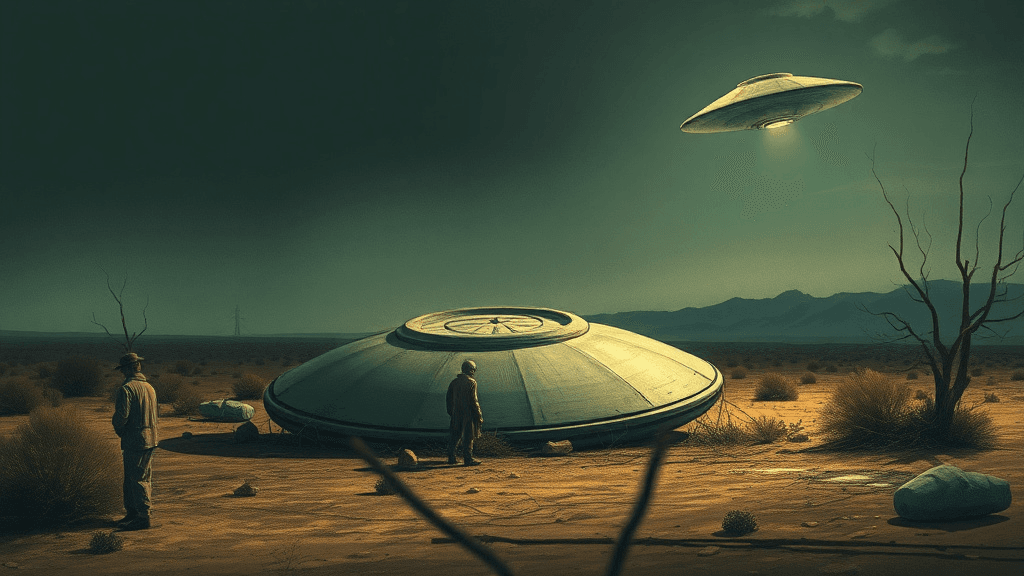
In July 1947, debris from an unidentified object was recovered from a ranch near Roswell, New Mexico; the U.S. Army initially announced the capture of a 'flying disc' before retracting the claim, launching the most enduring and consequential UFO controversy in history.
Background
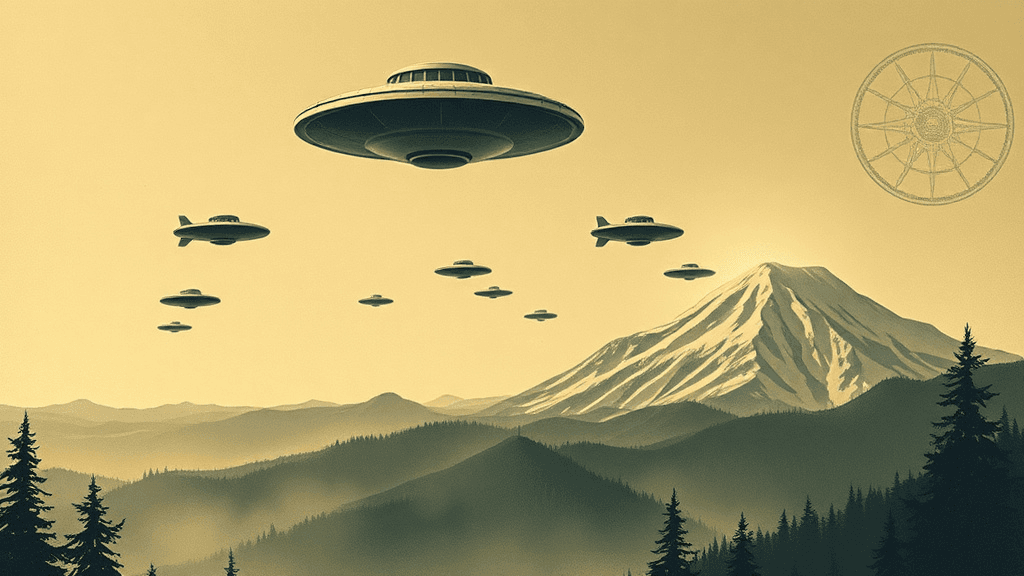
The summer of 1947 was the birth season of the modern UFO era. On 24 June, private pilot Kenneth Arnold reported nine crescent-shaped objects travelling at extraordinary speed near Mount Rainier, Washington, coining the phrase "flying saucers" through a journalistic misquotation. In the two weeks that followed, a wave of sighting reports swept the United States — hundreds of civilians and military personnel reported unusual aerial objects. Newspapers ran daily tallies. The American public was simultaneously fascinated and anxious: the Cold War was crystallising, the Soviet Union was racing toward its own atomic bomb, and the skies suddenly seemed full of unknowns.
In southeastern New Mexico, the Roswell Army Air Field (RAAF) was home to the 509th Bomb Group — the only nuclear-armed military unit in the world, the same outfit that had dropped the atomic bombs on Hiroshima and Nagasaki two years earlier. The base and its surrounding desert communities existed at the sharp edge of American military secrecy. Seventy-five miles northwest of Roswell, the J.B. Foster Ranch sprawled across the arid rangeland near the small town of Corona. Its foreman was W.W. "Mack" Brazel, a taciturn rancher in his mid-forties who spent most of his days tending sheep in relative solitude.
Events
The Debris Discovery
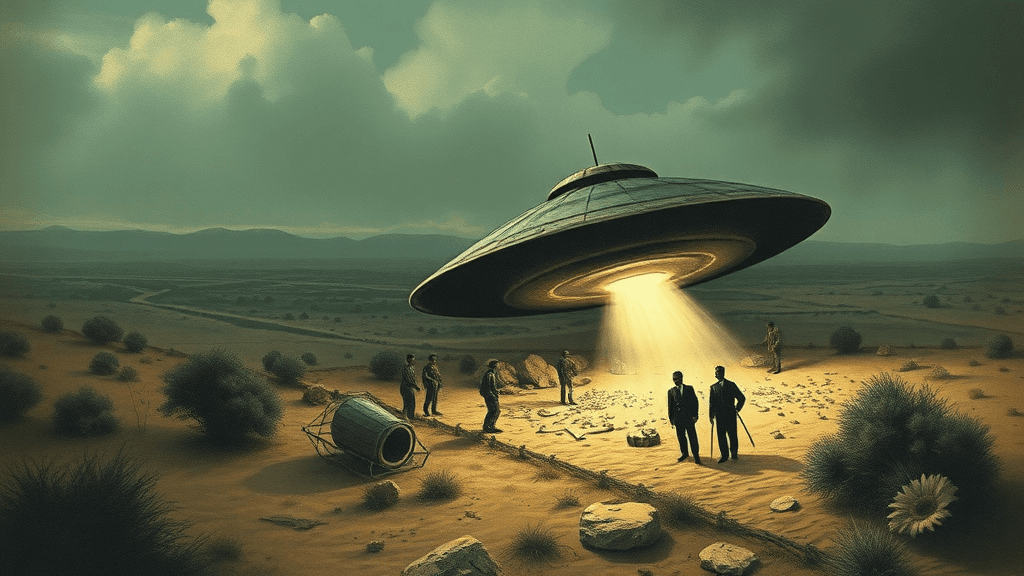
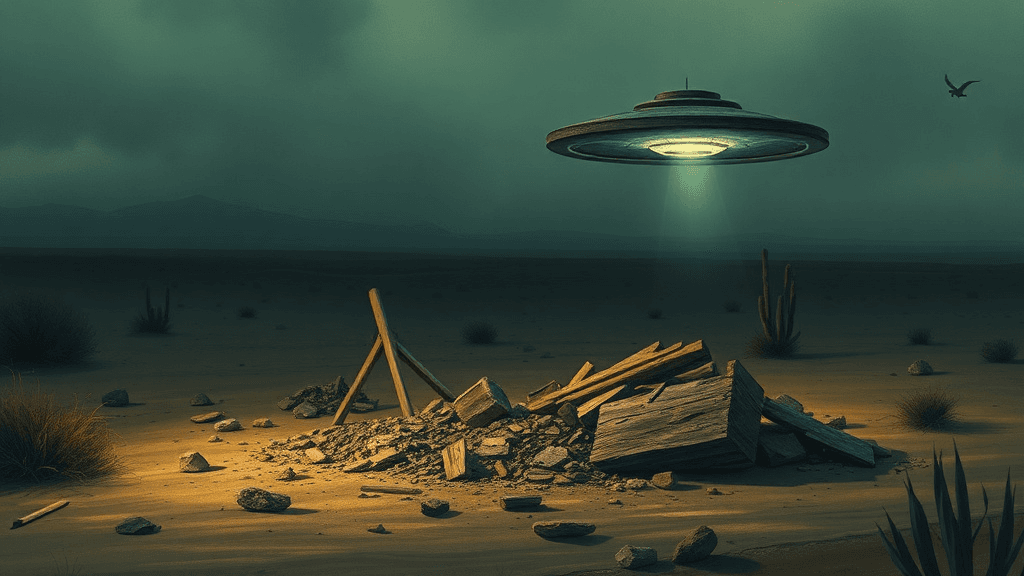
Sometime in mid-June 1947 — the precise date has been debated, with estimates ranging from 14 June to early July — Mack Brazel rode out across the Foster Ranch and discovered a wide field of unusual debris scattered across the pastureland. The wreckage covered an area roughly a quarter-mile long and several hundred feet wide, stretching from one hilltop, down an arroyo, and up over another rise. Brazel described finding sticks, metallic foil, tough paper-like material, and tape bearing small flower-like designs in pastel colours. The debris was lightweight but, Brazel noted, quite unlike anything he had encountered before — and as a rancher in New Mexico, he was thoroughly familiar with the detritus of weather balloons, which regularly came down in the desert.
Brazel gathered some of the material and stored it in a shed. He mentioned the find to neighbours Floyd and Loretta Proctor, who encouraged him to report it to the authorities. On 6 July, Brazel drove into Roswell and brought samples of the debris to Sheriff George Wilcox. The sheriff, uncertain what to make of the material, telephoned the Roswell Army Air Field.
The Military Response
The base intelligence officer, Major Jesse Marcel, was dispatched along with Counter-Intelligence Corps (CIC) officer Captain Sheridan Cavitt to accompany Brazel back to the ranch. Marcel and Cavitt spent much of 7 July examining and collecting the debris. Marcel would later recall loading his car so full of material that he stopped at his home on the way back to the base to show pieces to his wife and eleven-year-old son, Jesse Marcel Jr. The younger Marcel would spend the rest of his life describing what he handled that night: thin, remarkably light metallic fragments that could not be bent, dented, or burned; small I-beam-like structural pieces with strange purple-hued symbols along their inner surfaces; and a parchment-like material of unusual toughness.
On the morning of 8 July 1947, Colonel William Blanchard — commander of the 509th Bomb Group — authorised the base public information officer, Lieutenant Walter Haut, to issue a press release. The statement, which Haut distributed to local media, announced that the RAAF had "come into possession of a flying disc" recovered from a ranch in the Roswell vicinity. The Roswell Daily Record ran the story under the headline: "RAAF Captures Flying Saucer On Ranch in Roswell Region." The story was picked up immediately by wire services and broadcast around the world.
The Retraction
The sensation lasted barely a day. That same afternoon, Brigadier General Roger Ramey, commander of the Eighth Air Force at Fort Worth Army Air Field in Texas, summoned Marcel and the debris to Fort Worth. At a hastily arranged press conference, Ramey displayed the wreckage spread across his office floor and announced that the "flying disc" was nothing more than a standard Rawin weather balloon with a radar reflector. Photographs taken at the press conference showed Marcel and Ramey's chief of staff, Colonel Thomas DuBose, posing with flimsy-looking foil and balsa-wood sticks — material consistent with a weather instrument.
The story died almost overnight. The press accepted the explanation, the public moved on, and the Roswell incident slipped into obscurity for more than three decades.
The Roswell Revival: 1978–1995
The incident would have remained a footnote had it not been for nuclear physicist and UFO researcher Stanton Friedman. In 1978, Friedman was introduced to Jesse Marcel, who was by then retired and living in Houma, Louisiana. Marcel told Friedman that the material he had recovered was not from any weather balloon — that it was, in his judgement, "not of this Earth" — and that he had been ordered to participate in a cover-up. Friedman recognised the potential significance and began tracking down other witnesses.
In 1980, Friedman collaborated with journalist Charles Berlitz and researcher William L. Moore to publish The Roswell Incident, the first book to argue that an extraterrestrial craft had crashed in New Mexico and that the U.S. government had concealed the truth. The book drew on Marcel's testimony and interviews with other military and civilian witnesses, and it reintroduced Roswell to the public imagination.
Through the 1980s and early 1990s, a growing community of researchers — most prominently Kevin Randle and Donald Schmitt, working through the J. Allen Hynek Center for UFO Studies — conducted extensive interviews with hundreds of individuals who claimed direct or indirect knowledge of the events. Their 1991 book UFO Crash at Roswell and 1994 follow-up The Truth About the UFO Crash at Roswell presented testimony suggesting not only anomalous debris but the recovery of non-human bodies from a second crash site.
The Alien Bodies Claims
The most controversial dimension of the Roswell narrative concerns alleged extraterrestrial corpses. Several witnesses came forward in the late 1980s and 1990s with claims of small humanoid bodies recovered by the military. Among the most prominent was Glenn Dennis, a mortician at the Ballard Funeral Home in Roswell, who claimed that on 7 July 1947 he received multiple calls from the RAAF mortuary officer asking about child-sized hermetically sealed caskets and about the effects of embalming fluid on bodies exposed to the elements. Dennis further claimed that a nurse stationed at the base described witnessing an autopsy of three small non-human bodies with large heads, deep-set eyes, and no ear lobes.
Dennis's account became central to the Roswell mythology, but it suffered serious credibility problems. When researchers attempted to verify the nurse's identity — Dennis initially gave the name "Naomi Self" — no military records could be found. Dennis then changed the name to "Naomi Sipes," which also proved untraceable. He eventually admitted to fabricating both names, claiming he was protecting the real nurse's identity. The shifting story severely undermined his reliability as a witness, though he maintained until his death in 2015 that the core events were true.
Other alien body claims came from individuals such as Frank Kaufmann, who claimed to have been part of a secret recovery team. Kaufmann's testimony influenced several books and documentaries, but after his death in 2001, researchers discovered forged documents among his papers and concluded that significant portions of his account had been fabricated.
Investigation
The GAO Investigation and the First Air Force Report (1994)
In 1994, at the urging of New Mexico Congressman Steven Schiff, the Government Accountability Office (GAO) launched an audit to locate all government records related to the Roswell event. The GAO's findings, published in July 1995, revealed that most administrative records from Roswell Army Air Field covering the period of March 1945 to December 1949 had been destroyed — and that no documentation of the destruction order could be found. The missing records fuelled conspiracy theories, though the GAO noted this was not necessarily unusual for the era.
Concurrently, the U.S. Air Force conducted its own investigation, published in September 1994 as The Roswell Report: Fact vs. Fiction in the New Mexico Desert. The 1,000-page report concluded that the debris recovered by Marcel was from a Project Mogul balloon array — specifically Flight No. 4, launched from Alamogordo Army Air Field on 4 June 1947. Project Mogul was a top-secret programme using high-altitude balloon trains carrying sensitive microphones designed to detect acoustic signatures of Soviet nuclear tests at extreme altitudes. The balloons carried clusters of neoprene weather balloons, radar-reflecting targets made of balsa wood and metallic foil (manufactured by a New York novelty company, which used tape with flower-like decorative prints — explaining the "hieroglyphics" described by witnesses), and various instruments.
The Air Force argued that the original weather-balloon cover story in 1947 had not been a deliberate conspiracy to hide alien technology, but rather a routine effort to protect a classified programme by substituting an unclassified explanation. The report drew on the testimony of Professor Charles B. Moore, a New York University physicist who had been directly involved in the Mogul launches and who confirmed that Flight No. 4's trajectory was consistent with a landing at the Foster Ranch debris field.
The Second Air Force Report: "Case Closed" (1997)
In June 1997, the Air Force released a second report, The Roswell Report: Case Closed, specifically addressing the alien body testimony. The report proposed that witnesses who claimed to have seen small humanoid bodies were actually recalling anthropomorphic crash test dummies used in high-altitude parachute experiments conducted under Projects High Dive and Excelsior between 1954 and 1959. These life-size dummies were dropped from balloons at altitudes exceeding 100,000 feet and were recovered by military teams — sometimes in body bags — from the New Mexico desert.
The Air Force acknowledged the obvious chronological problem: the dummy drops occurred seven to twelve years after the 1947 incident. To bridge this gap, the report invoked a psychological theory of "time compression," suggesting that witnesses had unconsciously merged memories of separate events from different years into a single, coherent narrative. This explanation was met with widespread scepticism, even among commentators sympathetic to the Mogul hypothesis. Many found it implausible that multiple independent witnesses would all compress their memories in the same way, and critics noted that the Air Force appeared to be straining to explain testimony it could not simply dismiss.
The Case For and Against
Arguments supporting an anomalous event
Proponents of the extraterrestrial hypothesis point to several factors. Jesse Marcel was a trained intelligence officer responsible for identifying foreign technology; for him to confuse a weather balloon — or even an elaborate balloon array — with something genuinely anomalous would require either incompetence or dishonesty, and his military record suggests neither. His descriptions of the debris — material that could not be cut, burned, or permanently deformed — do not match the known properties of Mogul balloon components. His son's independent recollections, maintained consistently for decades, corroborate the anomalous nature of the material.
The number of witnesses who came forward, many of them elderly and with no apparent motive for fabrication, is also cited as significant. While individual testimonies vary in reliability, the collective weight of dozens of accounts — from military personnel, civilian neighbours, and local officials — suggests that something genuinely unusual occurred. The destruction of the RAAF administrative records, while not proof of cover-up, remains unexplained and troubling.
Finally, proponents note that the initial press release — authorised by the commanding officer of the world's only nuclear-armed bomber group — is itself extraordinary. Colonel Blanchard was not a junior officer prone to rash statements; for him to approve an announcement claiming recovery of a "flying disc" suggests he believed the material warranted that description, at least initially.
Skeptical and conventional explanations
The Project Mogul explanation remains the most widely accepted among mainstream scientists and journalists. The debris descriptions — foil, balsa-wood sticks, rubber, tape with decorative patterns — are consistent with Mogul hardware. Professor Moore's trajectory analysis places Flight No. 4 in the right area. The programme's top-secret classification explains why Marcel and other base personnel would not have recognised the equipment for what it was, and why headquarters moved quickly to replace the "flying disc" story with an innocuous weather-balloon explanation.
Skeptics also point out that the Roswell story was not considered a significant UFO case until thirty years after the fact. No contemporaneous UFO investigator — not even the Air Force's own Project Sign or Project Blue Book — treated Roswell as a crash-retrieval case. The alien body testimony emerged almost entirely in the late 1980s and 1990s, decades after the events, raising concerns about confabulation, social pressure, and the documented unreliability of long-delayed eyewitness memory. The exposure of fabrications by Glenn Dennis and Frank Kaufmann further undermined the body-recovery narrative.
The Ramey Memo — a document visible in General Ramey's hand in the 1947 Fort Worth photographs — has been the subject of extensive digital enhancement efforts, with some researchers claiming to have deciphered phrases such as "victims of the wreck" and "disc." However, the resolution of the original photographs is insufficient for definitive reading, and the claimed transcriptions vary wildly between analysts.
Cultural Impact
Regardless of what fell on the Foster Ranch in the summer of 1947, the Roswell Incident has become the founding myth of modern UFO culture. It is the single most recognised UFO case worldwide, the touchstone against which all subsequent crash-retrieval claims are measured, and the primary driver of the government-cover-up narrative that dominates public discourse about unidentified aerial phenomena.
The city of Roswell has embraced its extraterrestrial heritage with vigour. The International UFO Museum and Research Center, founded in 1991 by Walter Haut (the officer who issued the original press release) and Glenn Dennis, attracts hundreds of thousands of visitors. The annual Roswell UFO Festival, held each July since 1996, draws tens of thousands of attendees and generates millions of dollars for the local economy. Alien imagery pervades the town: streetlights are shaped like alien heads, the McDonald's is built to resemble a flying saucer, and gift shops sell every conceivable variety of extraterrestrial merchandise.
In popular media, Roswell has been referenced or adapted in hundreds of films, television series, novels, and video games. The 1994 Showtime film Roswell starred Kyle MacLachlan as Jesse Marcel. The television series Roswell (1999–2002) and its reboot Roswell, New Mexico (2019–2022) translated the incident into young-adult science fiction. Independence Day (1996) built a central plot point around a Roswell-style government facility hiding alien technology. The X-Files, the defining UFO television series of the 1990s, drew heavily on the Roswell mythology for its overarching conspiracy narrative.
The incident also played a significant role in the development of the Majestic 12 (MJ-12) controversy. In 1984, a set of purportedly classified documents surfaced claiming that President Harry Truman had established a secret committee of scientists, military leaders, and intelligence officials to manage the recovery and study of crashed alien technology from Roswell. The FBI investigated the documents and concluded they were "completely bogus," and most researchers — including several prominent UFO proponents — have concurred. Nevertheless, the MJ-12 narrative became deeply embedded in UFO conspiracy culture and continues to circulate.
The 1995 "alien autopsy" film, produced by London-based entrepreneur Ray Santilli and purportedly showing the dissection of a Roswell alien, was broadcast worldwide and became a cultural sensation before Santilli acknowledged in 2006 that it was largely fabricated — though he maintained it was a "reconstruction" of genuine footage he had once possessed.
Current Status
The Roswell Incident remains officially explained by the U.S. Air Force as a Project Mogul balloon recovery, with the 1994 and 1997 reports representing the government's final word. No subsequent official investigation has revisited the case. However, Roswell continues to surface in contemporary UAP discourse. During the 2023 congressional hearings on unidentified anomalous phenomena, whistleblower David Grusch alleged that the U.S. government possesses recovered non-human craft and biologics — claims that, while not specifically about Roswell, echo the narrative that began there. Roswell remains the prototype, the case to which all crash-retrieval allegations are compared.
Among UFO researchers, opinion is divided. A significant camp accepts the Mogul explanation for the debris while remaining agnostic or sceptical about the alien body claims. Others, including the late Stanton Friedman and researcher Thomas Carey, maintained until the end of their careers that genuine extraterrestrial technology and remains were recovered and concealed. The truth, if it differs from the official account, remains — like so much about the summer of 1947 — somewhere in the New Mexico desert, stubbornly out of reach.
Witnesses
W.W. "Mack" Brazel — Foreman of the J.B. Foster Ranch near Corona, New Mexico. Discovered the debris field in mid-June or early July 1947 and reported it to Sheriff George Wilcox on 6 July. Brazel was held by military authorities for several days and gave a revised, more subdued account to the press before returning to his ranch. He reportedly never spoke publicly about the incident again.
Major Jesse Marcel — Base intelligence officer, 509th Bomb Group, RAAF. First military officer to examine the debris at the ranch. Marcel maintained for the rest of his life that the material was extraordinary and not from any conventional device. His 1978 testimony to Stanton Friedman reignited the entire Roswell controversy.
Jesse Marcel Jr. — Son of Major Marcel. Handled debris brought home by his father on the night of 7 July 1947 at age eleven. Described thin metallic material that could not be permanently bent, and small I-beams with purple symbols. Maintained his account consistently until his death in 2013.
Lt. Walter Haut — Public information officer who issued the 8 July 1947 press release announcing recovery of a "flying disc." Co-founded the International UFO Museum in 1991. Left a sworn affidavit (opened after his 2005 death) claiming he personally saw alien bodies and a craft in a RAAF hangar.
Colonel William Blanchard — Commander, 509th Bomb Group. Authorised the flying disc press release. Later rose to the rank of four-star general and Vice Chief of Staff of the Air Force, suggesting his superiors did not regard the press release as an act of poor judgement.
Brigadier General Roger Ramey — Commander, Eighth Air Force. Held the Fort Worth press conference identifying the debris as a weather balloon.
Captain Sheridan Cavitt — CIC officer who accompanied Marcel to the ranch. In later interviews with Air Force investigators (1994), Cavitt stated the debris was consistent with a balloon and that he had recognised it as such at the time — contradicting Marcel's account.
Glenn Dennis — Roswell mortician who claimed to have received inquiries from the base about child-sized caskets and to have learned of alien autopsies from a nurse. His account was undermined by his admitted fabrication of the nurse's name.
Evidence
Original press release (8 July 1947) — Lt. Walter Haut's press release from RAAF announcing recovery of a "flying disc," distributed to local media and picked up by wire services worldwide.
Fort Worth photographs (8 July 1947) — Photographs taken at General Ramey's office showing debris spread on the floor; Major Marcel and Colonel DuBose are visible. One photograph shows Ramey holding a document (the "Ramey Memo") whose text has been the subject of extensive but inconclusive digital enhancement analysis.
Roswell Daily Record front page (8 July 1947) — The newspaper's headline "RAAF Captures Flying Saucer On Ranch in Roswell Region" is one of the most reproduced documents in UFO history.
Project Mogul records — Flight logs, trajectory analyses, and equipment manifests from the New York University balloon programme, cited in the 1994 Air Force report to identify Flight No. 4 as the source of the debris.
GAO audit report (July 1995) — Government Accountability Office report documenting the search for Roswell-related records and confirming that key RAAF administrative records from 1945–1949 had been destroyed without traceable authorisation.
Air Force Report: Fact vs. Fiction (1994) — 1,000-page Air Force investigation identifying Project Mogul as the source of the debris.
Air Force Report: Case Closed (1997) — 231-page follow-up addressing alien body claims via the crash test dummy hypothesis.
Walter Haut affidavit (sealed 2002, released 2007) — Sworn statement by the press release author claiming direct observation of alien bodies and craft at RAAF.
People involved
Filed under
Watch
Roswell's Bizarre UFO Crash
The Truth about Roswell: Decoding Decades of Deception
UFO Roswell Incident (Full Episode) | Undercover History Updates | National Geographic
The Roswell Coverup 75 Years Later (Full Documentary)
Ancient Aliens: Secrets of Roswell Revealed | History
Where this entry came from
ProvenanceAgent indexedUpdated 6mo ago10 sources
Drafted by the archive's AI research agent from the sources below; corrections from readers are reviewed and folded in.
- First indexed
- 24 APR 26 // 22:45Z
- Last updated
- 25 APR 26 // 05:21Z
- Roswell incident, Wikipedia
- Roswell incident | Overview, Theories, Hoaxes, & Facts, Encyclopaedia Britannica
- The Roswell Report: Fact vs. Fiction in the New Mexico Desert, Colonel Richard L. Weaver, U.S. Air Force
- The Roswell Report: Case Closed, Captain James McAndrew, U.S. Air Force / DTIC
- GAO Report on Roswell, NM UFO Crash, Federation of American Scientists
- Report of Air Force Research Regarding the 'Roswell Incident' (July 1994), National Security Agency (declassified documents)
- Jesse Marcel, Wikipedia
- Project Mogul, Wikipedia
- Roswell UFO incident facts and history, BBC Sky at Night Magazine
- U.S. Air Force reports on Roswell, History.com
Notes
- Roswell incident, Wikipedia
- Roswell incident | Overview, Theories, Hoaxes, & Facts, Encyclopaedia Britannica
- The Roswell Report: Fact vs. Fiction in the New Mexico Desert, Colonel Richard L. Weaver, U.S. Air Force
- The Roswell Report: Case Closed, Captain James McAndrew, U.S. Air Force / DTIC
- GAO Report on Roswell, NM UFO Crash, Federation of American Scientists
- Report of Air Force Research Regarding the 'Roswell Incident' (July 1994), National Security Agency (declassified documents)
- Jesse Marcel, Wikipedia
- Project Mogul, Wikipedia
- Roswell UFO incident facts and history, BBC Sky at Night Magazine
- U.S. Air Force reports on Roswell, History.com
Also available
The UFO Crash at Roswell
Re-examines the 1947 Roswell incident with firsthand accounts from key witnesses including Jesse Marcel, Frankie Rowe, and Walter Haut, exploring what really crashed in the New Mexico desert.
Six Days in Roswell
Documentary filmmakers investigate the mysteries of the 1947 Roswell incident, featuring interviews with UFO researchers, witnesses, and experts including Stanton Friedman and Budd Hopkins.
Legend of the Roswell Crash
Explores the 1947 Roswell UFO incident through the lens of silenced witnesses, government coverups, and public hysteria that fueled decades of speculation and investigation.
Roswell UFO Conspiracy: Unlocked
Documentary exploring the famous 1947 Roswell UFO incident through leaked CIA memos and testimony from ex-military officers who fought to reveal what the government had kept secret.
UFO Secret: The Roswell Crash - The Best Evidence
Based on comprehensive research by UFO investigators Kevin Randle and Don Schmitt, this documentary required over 400 interviews and presents the definitive investigation into the Roswell crash and government cover-up.
Buying through these links supports the library. We may earn a commission.