The UFO Library: Photograph or film
Heflin UFO Photographs
A county highway engineer took four Polaroids of a hat-shaped object and a black smoke ring near Santa Ana in 1965; the Air Force called them a hoax, NICAP and James McDonald long defended them, and the originals vanished for 28 years.
Background
In the summer of 1965 the American UFO debate was between two extremes. The Air Force's Project Blue Book was winding down toward its eventual closure, still assigning explanations to nearly every report. Civilian groups, above all NICAP, argued that a residue of well-observed cases pointed to something real. What every side wanted was a photograph that survived scrutiny. Most did not: the genre was already littered with hubcaps, lampshades, window reflections and lens flares.
Rex E. Heflin, 38, was an unlikely author of a landmark. He was a highway maintenance engineer for the Orange County road department in southern California, with about fifteen years of service. His job was to keep traffic signs visible, and he carried a Polaroid Model 101 work camera loaded with ASA 3000 film to document problems such as overgrown signs. By his own account and those of his colleagues he was a UFO skeptic who, for weeks afterward, assumed he had photographed an experimental aircraft from the nearby El Toro Marine Corps base. Investigators who checked his record found a steady, trusted employee with a deadpan sense of humor.
Events
On August 3, 1965, at about 12:30 p.m. (he wore no watch; a later shadow analysis tied to the Griffith Observatory put it near 12:37), Heflin stopped his county van near the intersection of Myford Road and Walnut Avenue, roughly half a mile outside El Toro's perimeter. Tree branches were hiding a railroad-crossing sign and he meant to photograph it. He tried to radio his supervisor, but the van radio was dead.
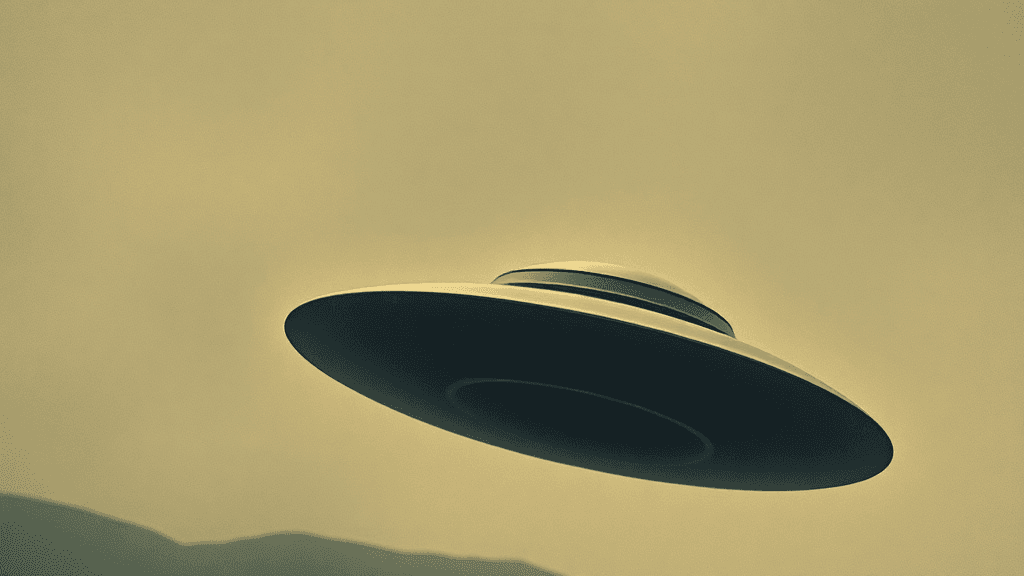
As he raised the camera, motion at the edge of his left eye caught his attention: a silvery, hat-shaped object moving slowly left to right across Myford Road. He estimated it at about an eighth of a mile away and 150 feet up, and judged its size by the 20-foot traffic lanes beneath it as roughly the same apparent width. It seemed to hover as it crossed his line of sight, and he photographed it through the windshield. As it moved east it tipped and showed a dark underside, from which a greenish-white beam seemed to rotate clockwise, once about every two seconds. He took a second picture through the passenger window and a third as the object began to turn, wobbling "similar to a gyroscope when losing its stability".
The object then gained altitude and sped off north-northeast toward the Santa Ana Freeway, leaving a ring of bluish-black smoke hanging at the point it had occupied. Heflin drove a hundred or two hundred yards up the road, stepped out, and took a fourth picture of the ring, which was drifting and distorting in a light wind but looked oddly "solid". Only then did the radio work again. He showed the pictures to co-workers that afternoon; some were disturbed by the fourth, which looked nothing like exhaust from an experimental plane, and he stopped showing it.
The pictures spread informally. Heflin lent the originals to colleagues and to his sister, whose friends took them to a Santa Ana drugstore. There the co-publisher of the Santa Ana Register saw copies, and chief photographer Clay T. Miller persuaded a reluctant Heflin to bring the originals in. The Register published the first three photographs on September 20, 1965, six weeks after the event; the New York Times followed on September 22. Heflin neither asked for nor received payment for the pictures' worldwide circulation, and one of them later appeared under "Spacecraft" in the 1968 Encyclopedia Britannica.
A second Orange County sighting that week was cited as corroboration. Around 9 p.m., Mr. and Mrs. Ralph Joseph, driving the Santa Ana Freeway in Anaheim about ten miles away, reported a large, silent, glowing dome-shaped disc resting on high-voltage lines above the road, with other motorists stopped on the shoulder. NICAP interviewed them and found them solid, but no further witnesses were located and the media never mentioned it.
Investigation
Military and Air Force. Before civilian investigators arrived, Marine Corps Intelligence officers visited Heflin, interviewed him and borrowed the first three prints to copy; they returned them unmarked. The Air Force then sent Captain Charles F. Reichmuth, who questioned Heflin for more than three hours, checked with his supervisors and wrote that he could find no evidence to dispute their view of Heflin as mature and trustworthy: "From all appearances, he is not attempting to perpetrate a hoax." Yet a Blue Book photo analysis report described a comparison shot of a 9-inch tray tossed into the air 15 to 20 feet from the camera, and the project officially listed the case as a hoax. NICAP's retort was that the verdict contradicted the Air Force's own field investigator, and that Heflin's photographs showed the power lines and the object equally sharp, which a nearby thrown object should not have been.
The NORAD visitors. On September 20 a man calling himself a NORAD colonel telephoned Heflin and warned him against further press contact. On September 22 two men in civilian clothes came to his door; one flashed a salmon-and-green identity card without a photograph. Having had the photos returned by the Marines and the Air Force, Heflin lent them the three pictures of the craft, and they never came back. NORAD denied any knowledge, and Heflin's congressman, Representative Utt, was told its offices had been searched with no result. Another visitor, "Captain C. H. Edmonds", turned up on October 11, 1967 with a similar photo-less card, asked what UFO groups Heflin belonged to, and left while Heflin's hi-fi crackled and a purplish glow was seen in a parked car. Heflin also reported an unlisted number repeatedly leaking to crank callers. Whoever the visitors were, the affair left researchers working only from copies of uncertain generation.
NICAP's Los Angeles subcommittee. Led by biophysicist Leslie Kaeburn and, after his death, Idabel Epperson, with aviation engineers John Gray and Edward Evers, the subcommittee ran a two-year background check on Heflin, surveyed the site, and had the pictures examined by six photographic experts or teams. UPI photo specialists reproduced the shots with the same equipment and judged the originals genuine. Robert Nathan, a scientist at a southern California aerospace firm who worked on the pictures as a private volunteer (sometimes misdescribed as an official JPL study), enhanced them and found no string or support, a black band of particulate matter around the craft, and an unexplained fuzziness. His enhancement of Photo 2 also brought out a wedge of light on the underside, consistent with Heflin's rotating beam.
James McDonald and the Condon Committee. In 1966 the atmospheric physicist James E. McDonald took up the case and, on December 27, 1967, wrote to Heflin that his pictures "remain the outstanding photographic evidence yet submitted concerning UFOs." He confirmed the radio failure with Heflin's supervisor and found that other Highway Department radios had also lost signal, but he came to doubt the fourth photo: his copy showed heavy cloud that his weather records said could not have formed. NICAP answered that copies differed in exposure and that the camera's light meter would flatten the sky in the three van-window shots. In January 1968 McDonald and astronomer William Hartmann, who handled photo cases for the Condon Committee, visited El Toro and the site. Hartmann doubted that three Polaroids could be taken in roughly twenty seconds (Heflin had demonstrated it for NICAP), and tested a small model on a string and a lens cap on a thread; his lens-cap shot looked a good match for the second picture. The Condon Report of 1969 judged the Heflin photographs "of little probative value".
Ground Saucer Watch. In the mid-1970s William Spaulding's Arizona group, Ground Saucer Watch, enhanced fourth-generation copies, reported a "string" running down to the object, and listed the case among crude hoaxes. Under challenge from Epperson and others, Spaulding conceded the line might be a scratch, but never formally withdrew the verdict. MUFON analyst Jeffrey Sainio later argued the line was either a multigeneration copying artifact or a deliberate addition.
The return of the originals
Heflin kept working for the road department for fifteen more years, then moved to northern California around 1985 with a lead-related bone-marrow condition. One day in 1993, he told researchers, a woman telephoned twice asking whether he had checked his mailbox. The second time he found a plain manila envelope with no postage containing what appeared to be his three missing Polaroids. His blue-ink numbers 1 to 3 were on the backs, matching the 4 on the photo he had kept. Added were "original" in grease pencil, a faint "13" in pencil, and fingerprints. Heflin entrusted all four to researcher Ann Druffel, who paid $850 toward his medical costs, and the prints entered her SKYNET Library.
The case for / against
For. The witness had no motive, sought no publicity or money, and passed scrutiny from the Marines, the Air Force's own captain, NICAP, McDonald and Hartmann. The radio failure was independently corroborated by his supervisor and other highway radios. In 2000 Druffel, physicist Robert Wood and image specialist Eric Kelson published a reanalysis of the originals in the Journal of Scientific Exploration. They reported that enhancement revealed no string or support, that sky contrast was similar across all four frames, and that a trail of dark particulate in Photo 3 matched the material of the smoke ring in Photo 4. They concluded that the fourth frame belonged to the set, answering McDonald's objection, and they reconfirmed the wedge of light. They also found a persistent unexplained blur around the object, which prevented firm size and distance estimates.
Against. Nothing independent shows a large object over Myford Road: El Toro's radar and the FAA-Marine control center logged nothing unusual, and no other witness to the object itself came forward. A small close object is consistent with the photographs, and the camera could focus sharply at short range; Hartmann's lens-cap test and the Air Force's tray test showed that a small thrown or suspended model can give a similar image, though as Druffel's team notes, that shows only that a fake is possible. The most serious problem is chain of custody: for 28 years the originals were out of Heflin's hands and every study used copies of unknown generation. The authors of the 2000 reanalysis are also long-standing advocates, and the markings on the returned prints cannot be traced to anyone. The reappearance of the prints by an anonymous mail drop would please a hoax theorist and a conspiracy theorist alike. The NORAD and Edmonds episodes rest on Heflin's own testimony.
Cultural impact
The Heflin photographs became one of the canonical "best photo cases" alongside McMinnville and Trindade. They fed the idea that the government both studied and suppressed UFO evidence, since the Air Force dismissed the pictures while impersonators appeared to confiscate them, and McDonald's private suspicion that a late informant's letter on a related case smelled like official disinformation is the first sign in his papers of his drift away from the "grand foul-up" view of official indifference. The case also illustrates a recurring fault line in ufology: the same image can be a strong anomaly to NICAP's volunteers and a replicable trick to the Condon Committee, and neither side can settle the question without the missing object.
Current status
The Heflin case remains unresolved. No hoaxer has been identified, and no confession has appeared. Blue Book's "hoax" label rests on thin experimentation and sits awkwardly with its own officer's report, while the strongest defense comes from advocates who held the originals. The photographs are still reproduced as a leading 1960s photographic case, with modern commentators generally treating them as unexplained but not conclusive. The sources reviewed record Heflin's own early guess, an experimental aircraft from El Toro, and the base denied it.
Witnesses
Rex E. Heflin, 38, Orange County road department maintenance engineer (fifteen years' service), sole direct witness to the object and the smoke ring. His supervisor Herm Kimmel heard the van radio cut off mid-transmission. Mr. and Mrs. Ralph Joseph reported a separate glowing disc on power lines at Anaheim the same week.
Evidence
- Four Polaroid Model 101 photographs (three through van windows, one outdoors of the smoke ring); originals lost 1965 and returned 1993
- Radio failure during sighting, corroborated by supervisor and other Highway Department radios
- Enhancement by Robert Nathan (1960s) and Druffel, Wood and Kelson (Journal of Scientific Exploration, 2000): no string, particulate trail linking Photo 3 to the smoke ring, wedge of light under the object, unexplained blur
- UPI photographic test, Marine Corps Intelligence and USAF (Capt. Reichmuth) interviews
- Contrary: Blue Book hoax verdict, Hartmann lens-cap test in the Condon Report, Ground Saucer Watch 'string' claim, no radar return
Filed under
Watch
Meet the Top Gun Pilot Who Chased a UFO in an F/A-18F Super Hornet
New photos of alleged Roswell alien has people talking
Photo captures UFO over Santee barn
Ep. 4 | My black triangle UFO sighting | The Basement Office
UFO's Are Real | FULL MOVIE | Aliens Sci-Fi Documentary
Where this entry came from
ProvenanceAgent indexedUpdated 4d ago7 sources
Drafted by the archive's AI research agent from the sources below; corrections from readers are reviewed and folded in.
- First indexed
- 12 JUN 26 // 00:19Z
- Last updated
- 08 NOV 26 // 04:47Z
- Reanalysis of the 1965 Heflin UFO Photos, Ann Druffel, Robert M. Wood, Eric Kelson, Journal of Scientific Exploration 14(4), 583-622
- UFOs at close sight: The Rex Heflin photographs case, Patrick Gross, Patrick Gross UFO Database
- Rex Heflin UFO Photographs - Santa Ana, California, UFO Evidence
- Heflin's 1965 photos finally validated, Reality Research Organization
- IMCAT Case Directory: 3 August 1965, Santa Ana, California, NICAP
- Condon Committee, Wikipedia
- James E. McDonald, Wikipedia
Notes
- Reanalysis of the 1965 Heflin UFO Photos, Ann Druffel, Robert M. Wood, Eric Kelson, Journal of Scientific Exploration 14(4), 583-622
- UFOs at close sight: The Rex Heflin photographs case, Patrick Gross, Patrick Gross UFO Database
- Rex Heflin UFO Photographs - Santa Ana, California, UFO Evidence
- Heflin's 1965 photos finally validated, Reality Research Organization
- IMCAT Case Directory: 3 August 1965, Santa Ana, California, NICAP
- Condon Committee, Wikipedia
- James E. McDonald, Wikipedia
Also available
The Phenomenon
Documentary examining the history of UFO sightings since World War II and recent Pentagon UAP videos, featuring testimony from government, military, and NASA officials about unidentified aerial phenomena and their implications.
I Know What I Saw
Documentary featuring former military officers and pilots testifying at the National Press Club in Washington, D.C. about their encounters with unidentified aerial phenomena, including the Phoenix Lights incident and other major cases.
Out of the Blue
Comprehensive investigation into the UFO phenomenon featuring interviews with military and government personnel about documented UFO sightings and encounters, including historical cases with photographic evidence.
UFOs: Past, Present, and Future
Classic documentary narrated by Rod Serling examining prominent UFO sightings from the post-World War II era through the early 1970s, featuring analysis of photographic evidence and government perspectives on the phenomenon.
Buying through these links supports the library. We may earn a commission.