The UFO Library: Radar and visual
Japan Airlines Flight 1628 UFO Encounter
Commercial cargo pilot Captain Kenji Terauchi reported three unidentified objects with rectangular light arrays tracking a Boeing 747-200F for 400 miles at 35,000 feet; radar evidence remains contested.
The Encounter
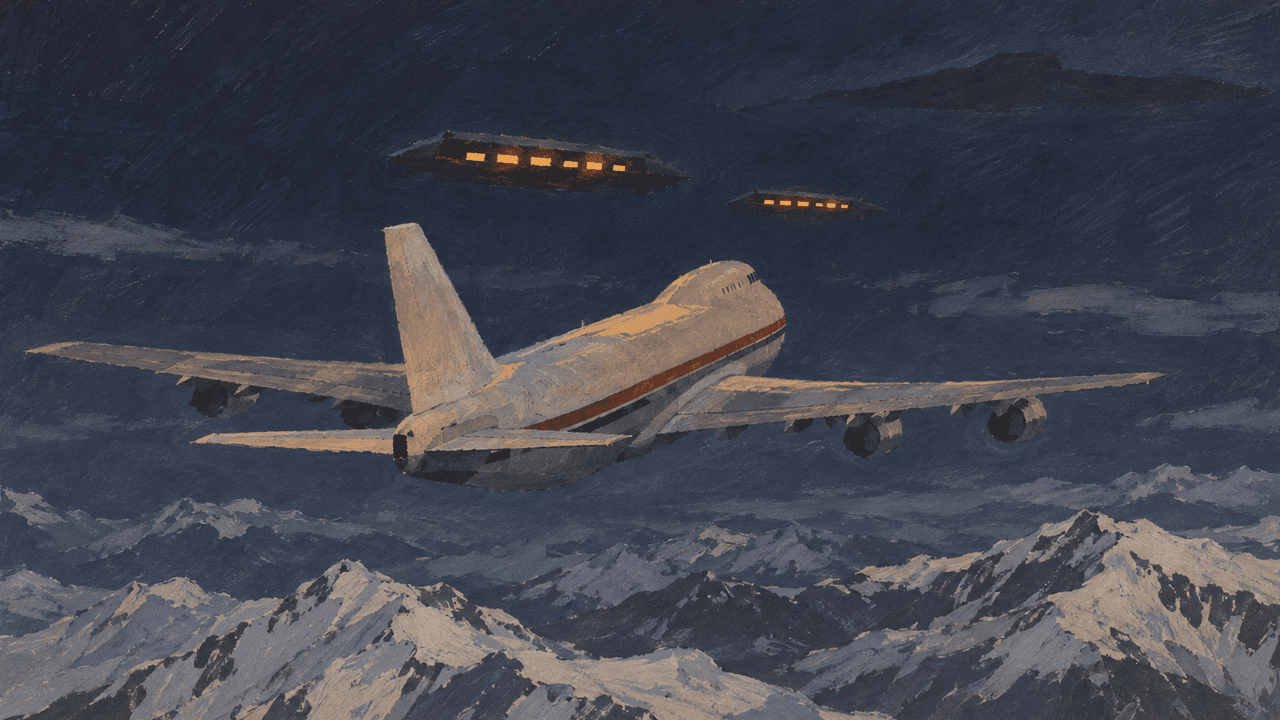
On the evening of November 17, 1986, Captain Kenji Terauchi, first officer Takanori Tamefuji, and flight engineer Yoshie Tsukuba were piloting Japan Airlines Flight 1628, a Boeing 747-200F cargo aircraft carrying Beaujolais wine from Paris to Narita Airport near Tokyo. At approximately 17:11 local time, as the aircraft was en route at 35,000 feet in airspace near Anchorage, Terauchi observed two unidentified objects suddenly rise from below and move to flank the aircraft on both sides. Over the next 31 minutes, he reported witnessing what he described as "two small ships and the mothership"—objects allegedly larger than aircraft carriers, configured with rectangular arrays of glowing nozzles or thrusters. The captain reported the objects' cabin illuminated the 747, and he could feel heat radiating from them.
Terauchi immediately notified Anchorage Air Traffic Control (ARTCC), initiating a chain of events that brought military radar stations into the picture. When advised to take evasive action, he lowered the aircraft's altitude and initiated a descending spiral. The objects reportedly maintained position relative to the 747 throughout, staying visible for over 400 miles of flight path before eventually breaking off as the aircraft approached Anchorage.
Radar and Ground Corroboration
What initially distinguished this sighting was not merely eyewitness testimony but apparent radar confirmation. The 747's onboard weather radar clearly painted a green, cloud-like target approximately 7–8 miles away—precisely where the crew visually observed the objects. FAA controllers at Anchorage Center, when queried, initially reported radar contacts matching the JAL flight's position. U.S. Air Force radar at Elmendorf Air Base (adjacent to Anchorage) was directed to scan the area and registered what appeared to be a primary radar return (raw echo without transponder signal) in the vicinity of Flight 1628, though it proved intermittent and difficult to maintain lock.
However, the radar picture quickly became muddied. Contemporaneous military radar imagery was later reinterpreted as clutter rather than a genuine target. FAA controllers' radar displays were similarly reexamined: objects appearing near JAL 1628 on their screens were attributed to "split-image" artifacts—known radar anomalies in that geometry and airspace. Critically, two other nearby aircraft—a United Airlines cargo jet and a USAF C-130 Hercules—were asked to visually search for the objects but reported seeing only Flight 1628 itself.
Official Investigation and Skeptical Explanations
The FAA formally investigated the incident, and the case became a centerpiece of debate within the UFO research community. Skeptical investigator Phillip J. Klass proposed a conventional explanation: Terauchi had mistaken the planets Jupiter and Mars for spacecraft. Jupiter, visible at approximately 10 degrees above the horizon at the time and location, combined with viewing angle and atmospheric refraction, could have created an optical illusion consistent with Terauchi's description. Additionally, Klass and others noted that Terauchi had a history of UFO sightings both before and after this encounter—subsequent reports were traced to lights from small villages, raising questions about his observational reliability.
The FAA ultimately characterized Terauchi as a "UFO repeater"—an individual prone to misinterpreting mundane phenomena as anomalous—though it stopped short of declaring the Flight 1628 case definitively explained. Terauchi stood by his account, maintaining that what the crew witnessed did not match the characteristics of known celestial bodies or aircraft.
Credibility and Legacy
The incident remains one of aviation's most documented yet contentious UFO claims. Its strength rests on the credibility of commercial pilots and crew trained to observe the sky, plus multi-source radar inputs. Its weakness lies in the absence of independent visual confirmation from nearby aircraft, the retroactive dismissal of military and civilian radar data as instrumental artifacts, and the skeptical theory plausibly accounting for the sighting. No physical evidence was recovered. The case exemplifies how even high-credibility witnesses and technological corroboration can yield interpretations that range from genuine anomaly to misidentification.
Witnesses
Captain Kenji Terauchi (pilot, primary observer) — experienced commercial aviator who led the initial report and maintained consistency in his account. First Officer Takanori Tamefuji and Flight Engineer Yoshie Tsukuba — both confirmed the sighting and assisted in documentation. Their credentials as trained aviation professionals lent initial weight to the report.
Evidence
Crew testimony: coherent, detailed descriptions of two escort objects and a larger 'mothership' with rectangular light arrays; reported heat and cabin illumination. 747 onboard weather radar: clear green target 7–8 miles distant, corresponding to visual sightings. Military radar (Elmendorf AFB): intermittent primary return initially noted, later classified as clutter. FAA Anchorage ARTCC radar: no persistent unidentified target, though brief returns attributed to split-image effects. Negative evidence: nearby United Airlines and C-130 aircraft reported no visual contact with objects other than JAL 1628.
Filed under
Watch
Boeing 747 Followed by a UFO | An Out Of This World Encounter | Japan Air Lines Flight 1628
Japan Airlines Flight 1628 - UFO Incident Animation
Japan Airlines 1628 UFO Encounter, 1986
The Remarkable Japanese Airline 1628 Pilots Close UFO Encounter in 1986 - FindingUFO
The Flight 1628 UFO Incident
Where this entry came from
ProvenanceAgent indexedUpdated 2mo ago4 sources
Drafted by the archive's AI research agent from the sources below; corrections from readers are reviewed and folded in.
- First indexed
- 28 AUG 26 // 12:18Z
- Last updated
- 28 AUG 26 // 12:18Z
- Japan Air Lines Cargo Flight 1628, Wikipedia contributors, Wikipedia
- What Really Happened to Japan Airlines Flight 1628 in 1986?, The Debrief, The Debrief
- FAA Japan Air Lines Flight 1628 Records, Federal Aviation Administration, Internet Archive
- Revisiting the 1986 Japan Airlines JAL 1628 UFO Incident: A Historical UAP Encounter, UFOPulse, UFOPulse
Notes
- Japan Air Lines Cargo Flight 1628, Wikipedia contributors, Wikipedia
- What Really Happened to Japan Airlines Flight 1628 in 1986?, The Debrief, The Debrief
- FAA Japan Air Lines Flight 1628 Records, Federal Aviation Administration, Internet Archive
- Revisiting the 1986 Japan Airlines JAL 1628 UFO Incident: A Historical UAP Encounter, UFOPulse, UFOPulse
Also available
I Know What I Saw
Documentary featuring testimony from credible UFO witnesses worldwide—military pilots, FAA officials, and former government personnel—discussing significant UFO encounters including the Japan Airlines Flight 1628 incident over Alaska.
Out of the Blue
Comprehensive UFO documentary examining 50 years of sightings and government denials. Features interviews with military officers, pilots, and scientists investigating credible UFO incidents including the JAL 1628 case.
Secret Access: UFOs on the Record
History Channel documentary special examining UFO sightings supported by credible witnesses including military generals, pilots, FAA officials, and astronauts. Features the Japan Airlines Flight 1628 incident as a key case study.
The Alaska Triangle
Series. Documentary investigation into UFO sightings and unexplained phenomena in Alaska. Season 1, Episode 8 "Flight 1628 and Thunderbird" focuses on the Japan Airlines Flight 1628 incident and witness testimony from the encounter.
Aliens in Alaska
Series. Documentary exploration of UFO sightings, abductions, and extraterrestrial encounters throughout Alaska. Features episodes covering the Japan Airlines Flight 1628 incident and investigates why Alaska is a hotbed for unexplained aerial phenomena.
Buying through these links supports the library. We may earn a commission.