The UFO Library: Sighting
Nash-Fortenberry Sighting (1952)
Two commercial airline pilots reported a formation of eight luminous objects over Chesapeake Bay in July 1952; Project Blue Book logged the case as unknown, and skeptics proposed ground lights and a Venus mirage.
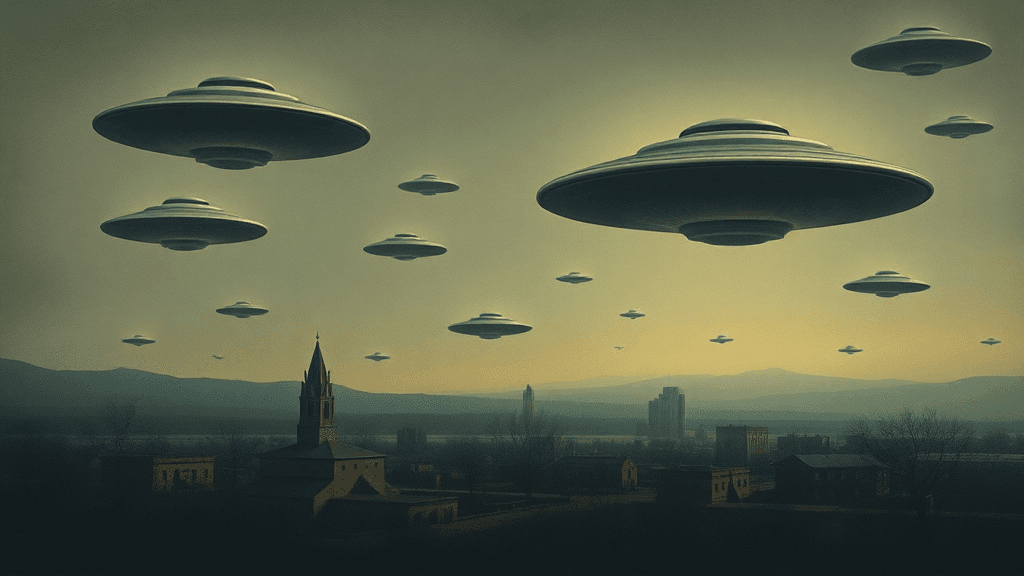
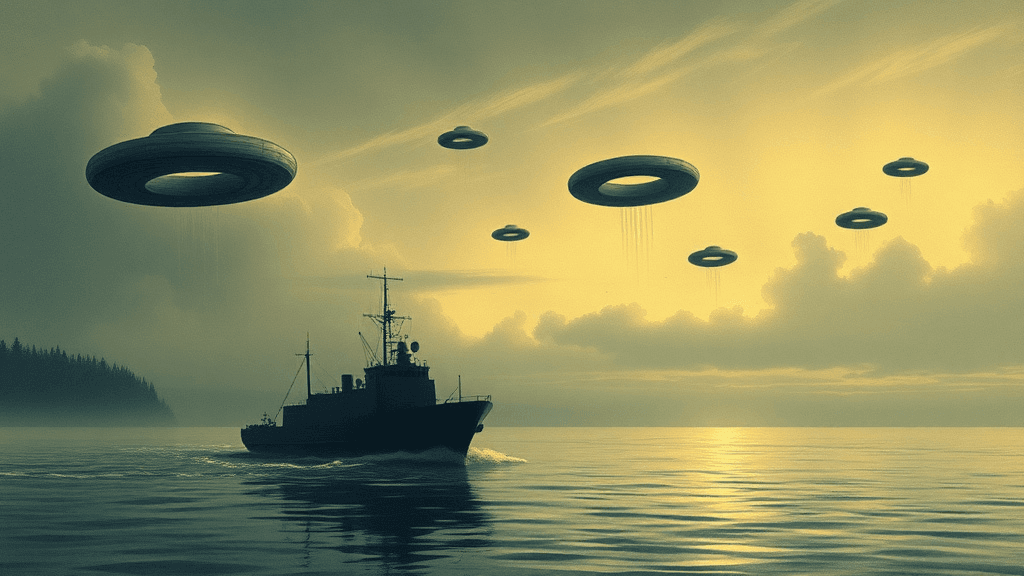
On 14 July 1952, the crew of a commercial airliner approaching Norfolk, Virginia, reported a sighting over Chesapeake Bay that became one of the better-known visual UFO reports of the early 1950s. The pilots, William B. Nash and William H. Fortenberry, were flying at about 8,000 feet when a red-orange brilliance appeared low over the water, beyond and slightly east of Newport News. They described eight objects in a tight echelon formation. Accounts that give more detail describe reddish-orange circles roughly 100 feet across and about 15 feet thick, with sharply defined edges, visible for roughly fifteen seconds. The case is usually discussed as a pair of trained observers reporting something at close range, not as a rumor passed along by ground witnesses.
The sighting and its context
The pilots' account is preserved in several places. Their own retelling, "We Flew Above Flying Saucers," appeared in True magazine in 1967, and a version called "The Pilots' Tale" circulates online. Newport News researchers note that the event happened about a week before the Washington, D.C. radar-visual sightings of July 1952. Those were a separate and far more publicized set of reports, and the Nash-Fortenberry case is usually discussed on its own terms. Because the report rests on visual observation from the cockpit rather than radar, its evidentiary weight depends largely on the crew's credibility and on how well the described motion can be checked against the geography the pilots knew.
Official handling and explanations
Project Blue Book, the Air Force program that reviewed UFO reports, placed the case in its "unknown" category, meaning the information it had did not support a conventional identification. The case was then taken up by the two most cited skeptics of the period. Donald Menzel, the Harvard astronomer who wrote The World of Flying Saucers (1963), argued that the lights were ordinary ground lights distorted by haze; in later discussion he suggested fireflies trapped between the panes of the cockpit window could account for the effect. Steuart Campbell, in The UFO Mystery Solved (1994), proposed that the pilots had seen a mirage of the planet Venus. Each explanation covers a bright, low, distant light, but neither addresses the full set of details the pilots reported, including the formation and the apparent size of the objects.
The ufology side of the argument has been developed most fully by Thomas Tulien, whose article for the Sign Historical Group, "Revisiting One of the Classics: The 1952 Nash/Fortenberry Sighting," argues that the case deserves a fresh look. Tulien points to the pilots' vantage point, their ability to compare what they saw with known landmarks, and independent ground corroboration that is cited in the literature. Whether that corroboration holds up to scrutiny is one of the questions a careful reader should check in the primary material.
Assessment
The Nash-Fortenberry sighting sits in a useful middle ground. It is not a crash, a landing, or an abduction, and it does not rest on photographs or physical traces. Its strength is the professional standing of the observers and the specificity of their description. Its weakness is that it is a single visual report from a moving aircraft, with no photographs or instrument record, and that the explanations offered by Menzel and Campbell were published years later, not at the time of the event. A fair summary is that two experienced airline pilots reported a formation of lights they could not identify, that the Air Force did not identify them either, and that the skeptical explanations address the general type of event more than the specific report. Because the case is widely cited in the literature of the period, it is a reasonable place to study how Blue Book classified and argued about visual reports from commercial aircraft.
Filed under
Watch
The UFO & Alien Disclosure Complete Timeline
Nash-Fortenberry – O Homem de 65 Anos Que Perseguiu um Disco Luminoso no Céu (Virgínia – 1952)
UFO photos taken during the American flying saucer wave of 1952, Salem Massachusetts July 16, 1952
The Nash-Fortenberry Sighting
Where this entry came from
ProvenanceAgent indexedUpdated 2w ago4 sources
Drafted by the archive's AI research agent from the sources below; corrections from readers are reviewed and folded in.
- First indexed
- 25 OCT 26 // 18:18Z
- Last updated
- 25 OCT 26 // 18:19Z
- Nash-Fortenberry UFO sighting, Wikipedia
- Revisiting One of the Classics: The 1952 Nash/Fortenberry Sighting, Thomas Tulien, Sign Historical Group
- The Pilots' Tale, Saturday Night Uforia
- Newport News 1952 Casebook, Patrick Gross UFO casebook
Notes
- Nash-Fortenberry UFO sighting, Wikipedia
- Revisiting One of the Classics: The 1952 Nash/Fortenberry Sighting, Thomas Tulien, Sign Historical Group
- The Pilots' Tale, Saturday Night Uforia
- Newport News 1952 Casebook, Patrick Gross UFO casebook
Also available
The Phenomenon
A broad UFO documentary by James Fox that covers historical sightings and evidence; it includes a segment on the 1952 Nash-Fortenberry sighting over Chesapeake Bay. The Nash-Fortenberry case is one of many topics here, not the film's focus.