The UFO Library: Mass sighting
Norway Spiral (2009)
A vast luminous spiral filled the pre-dawn sky over northern Norway on 9 December 2009, witnessed by thousands across multiple counties; confirmed the following day as a failed Russian Bulava ICBM test launched from a submarine in the White Sea.
Background
The RSM-56 Bulava — NATO reporting name SS-NX-30 — was Russia's flagship sea-launched ballistic missile program of the 2000s, designed to arm the new Borei-class nuclear-powered submarines. From its first test in 2004, the program had been plagued by a disturbing failure rate. By December 2009 the missile had completed roughly twelve test launches, of which around eight had ended in partial or total failure. Propulsion malfunctions, guidance errors, and stage separation failures had all been recorded, and the Russian Navy's acquisition plans were being quietly revised.
On the morning of 9 December 2009, a Borei-class submarine — the Dmitry Donskoy, the test platform most commonly used in early Bulava trials — was positioned in the White Sea, the enclosed arm of the Arctic Ocean that lies east of the Kola Peninsula, well within Russian territorial waters. A NAVTEX coastal warning — a standard maritime safety broadcast issued whenever military or hazardous activity is planned — had already been transmitted to mariners instructing them to avoid a specific sector of the White Sea during a defined launch window. That warning, mundane and barely noticed at the time, would become an important piece of documentary evidence placing the launch precisely where and when Russian authorities initially denied it had occurred.
Four hundred kilometres to the west, across the Norwegian Sea, residents of northern Norway were preparing for the short Arctic day. Tromsø, situated above 69°N, lies well within the Arctic Circle; in early December it experiences polar night, the period when the sun does not rise above the horizon at all. Conditions that morning were partly cloudy, but breaks in the overcast gave many people an unobstructed view of the eastern sky just before 8 AM.
Events
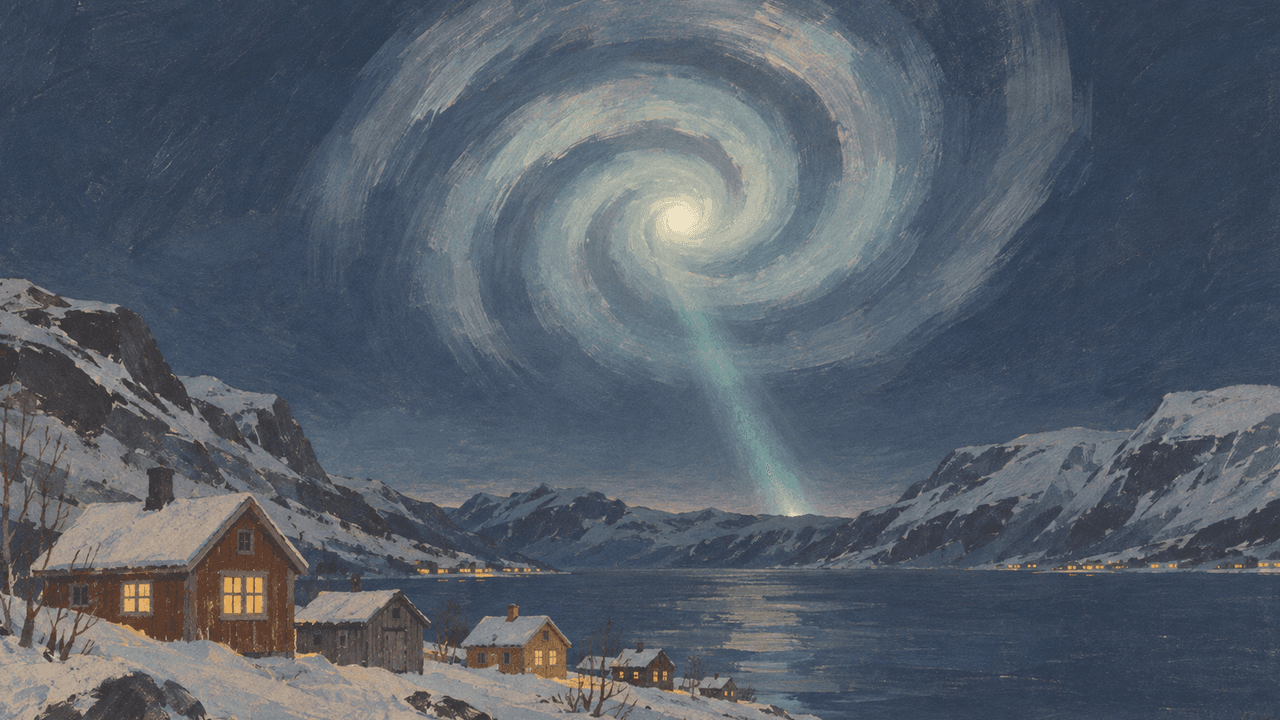
The phenomenon began at approximately 07:45–08:00 local time. Eyewitnesses across the counties of Trøndelag, Troms, and Finnmark looked up from outdoor activities, traffic, or simply their kitchen windows to see something they had no immediate framework to explain: a bright point of bluish-white light in the eastern sky, trailing a beam and surrounded by a coiling halo of luminosity that was visibly growing and rotating as they watched.
Witnesses described a pale blue or greenish beam projecting from the central point — almost like a searchlight aimed horizontally across the sky — while a concentric, whirlpool-shaped helix of grey-white light expanded outward from the same origin. The spiral rotated slowly in a clockwise direction. There was no sound — a quality that made the spectacle more unsettling rather than less, given its scale. The rotating structure grew to subtend an angular diameter that observers estimated as several times the apparent width of a full moon — large enough to be unmistakably prominent against the dark Arctic sky.
After approximately ten minutes the visual character of the phenomenon changed. The central bright point dimmed, and where the spiral had been tightest a dark circular patch appeared — a void that witnesses variously described as a "black hole" or a "dark vortex." This dark centre expanded as the outer spiral diffused and faded, until the whole spectacle had dissolved into the pre-dawn sky. The entire event, from first light to disappearance, lasted roughly ten minutes.
Mobile phones and cameras had by 2009 become nearly ubiquitous in Norway. Dozens of videos and still photographs were captured from vantage points ranging from urban rooftops in Tromsø to rural roads in Finnmark. The footage, uploaded to Norwegian news sites and YouTube within hours, was striking in its consistency: every piece of video showed the same rotating structure evolving in the same sequence, confirming that witnesses across a wide geographic area were observing a single, real atmospheric phenomenon.
Initial reaction in the Norwegian press was genuinely baffled. Aftenposten, one of Norway's largest newspapers, ran early reports describing the sighting as inexplicable. Hypotheses floated in the first hours included a discharge of Birkeland currents (an aurora-related electrical phenomenon), a rocket or space debris re-entry, an optical projection experiment, an accidental atmospheric effect from the Large Hadron Collider — which had restarted operations that autumn — and, predictably, a UFO of extraterrestrial origin or a wormhole portal opening over Norway. Each hypothesis circulated rapidly online before the morning was out.
Investigation
Scientific investigation moved quickly, aided by the volume of photographic evidence and the presence of established observatories in the region. Researchers at the Tromsø Geophysical Observatory, one of the world's leading centres for auroral research, examined the imagery within hours. Observatory staff offered a preliminary but confident assessment: the geometry and colour of the phenomenon were inconsistent with any known aurora type, and the rotating character of the light was more consistent with propulsion exhaust illuminated from above — by sunlight — than with any atmospheric electrical process.
The physics were understood quickly by aerospace engineers who studied the footage. When a solid-fuel or liquid-fuelled rocket motor suffers a thrust vector control failure and its body begins to rotate uncontrollably, the exhaust plume — or, in a leaking propellant scenario, the expelled fuel — is thrown outward centrifugally in a rotating cone. Observed from a distance directly below or off-axis, this creates the characteristic logarithmic spiral pattern: each successive ring of expelled material is deposited at a slightly wider radius, producing a shape mathematically identical to a nautilus shell cross-section. The distinctive blue-green colour was explained by the combustion of aluminium compounds in the Bulava's solid-fuel propellant, which produce aluminium oxide particulate that scatters light preferentially at shorter wavelengths, giving the plume a blue-green cast.
Crucially, altitude mattered enormously for visibility. Calculations based on the known position of the White Sea launch area and the observed geometry of the sightings placed the rocket's operating altitude at well above 100 kilometres — in the mesosphere or lower thermosphere. At that height and at that Arctic latitude in December, the Sun had already risen above the geometric horizon for objects in the upper atmosphere even though it had not yet risen for observers on the ground. The exhaust cloud was bathed in direct sunlight while the landscape below remained in pre-dawn darkness — a disparity of illumination that made the spiral blaze brilliantly against the dark sky and gave it an eerie, self-luminous quality quite unlike any aircraft light or aurora.
The dark centre observed in the final phase of the phenomenon was also explicable: as the rocket's fuel was exhausted or as rotation produced a conical vortex along the central axis, a clearing formed at the centre of the expanding gas cloud, creating the impression of a void or aperture opening in the middle of the spiral.
Visualization work by Doug Ellison, a space enthusiast and graphic designer at UnmannedSpaceflight.com, produced a convincing animated simulation of a tumbling rocket stage expelling fuel in two directions simultaneously. The simulation matched the footage with high fidelity and was widely shared in the days following the event, providing a clear visual explanation accessible to a lay audience.
On the Russian side, the initial response was characteristically opaque. Officials contacted on 9 December denied that any launch had occurred. Within twenty-four hours an anonymous Russian military source acknowledged a failed submarine-launched test, and on 10 December 2009 the Russian Defence Ministry issued an official statement confirming that a Bulava missile test had been conducted from the White Sea, that the missile's third-stage propulsion system had malfunctioned, and that the test had been unsuccessful. No further technical detail was provided, but the admission was sufficient to anchor the scientific explanation with the authority of primary source confirmation.
The Case For and Against
The Norway Spiral stands in an unusual position in the annals of UFO reports: it is a case where the extraordinary phenomenon was genuinely real and witnessed by thousands, the photographs and videos were entirely authentic, and yet the explanation turned out to be entirely prosaic. This combination — real and spectacular spectacle, mundane and well-understood cause — makes it a valuable case study in the epistemology of UFO reporting.
The case that the explanation is complete: The NAVTEX maritime warning issued before the event placed a hazard zone in the White Sea during the exact window of the sighting. The Russian Defence Ministry confirmed the launch on the following day. The physics of a spinning rocket stage producing a logarithmic spiral in its exhaust plume are well established in rocket engineering literature, and the same spiral pattern has been observed on smaller scales in multiple other rocket failures and controlled experiments. The colour, altitude, duration, and geometry all match the Bulava failure hypothesis. Multiple independent videos from widely separated locations show the same event evolving in real time from different angles, ruling out any possibility of a localised projection hoax. No witness reported any sound, which is consistent with the enormous distance from the White Sea.
Arguments raised against the consensus: A small number of researchers noted that the spiral was unusually symmetrical and sustained for what was claimed to be a chaotic mechanical failure. Some in the UFO community pointed out that Russian authorities were slow to confirm and suggested the timing — the eve of Obama's Nobel arrival — was too symbolically loaded to be coincidental. These arguments have not been developed in peer-reviewed literature or supported by physical evidence. Proposals involving the HAARP ionospheric research facility or electromagnetic scalar weapons were made without supporting data. The scientific consensus among physicists and aerospace engineers is that the Bulava explanation is both necessary and sufficient, and no credible supplementary hypothesis has gained traction.
Cultural Impact
The Norway Spiral's timing added an irresistible layer of symbolic resonance that amplified its global virality. 9 December 2009 was the eve of President Barack Obama's arrival in Oslo to accept the Nobel Peace Prize — awarded that year amid international controversy, given that the United States was simultaneously prosecuting wars in Afghanistan and Iraq. The coincidence that a vast, otherworldly spiral appeared in the Norwegian sky the night before the American president arrived to collect the world's most prestigious peace award was seized upon by commentators across the political and conspiratorial spectrum. Online communities generated memes suggesting everything from divine portent to a deliberate Russian military demonstration aimed at Washington — an interpretation coloured by the Bulava missile's nuclear delivery role.
The event also demonstrated, perhaps more vividly than any comparable episode, how radically the internet and ubiquitous camera phones had transformed UFO reporting. Within hours of the sighting, the best footage was accessible globally. Within a day, a credible scientific explanation had been assembled by amateur researchers and posted online — faster than any official investigation could have managed. The Norway Spiral became a case study in what might be called crowdsourced identification: the same networked public that initially amplified speculative interpretations also supplied the observational data that resolved them.
In UFO research circles, the Norway Spiral occupies a complex niche. It is frequently cited by sceptics as a canonical example of how genuinely spectacular and anomalous-looking phenomena can arise from prosaic causes, and how even numerous sincere witnesses cannot be relied upon to correctly identify what they are seeing. It is also cited, somewhat paradoxically, by proponents of the view that government or military activities produce unexplained-looking phenomena that the public is left to misinterpret — sometimes, they suggest, deliberately.
The spiral appeared in numerous UFO documentary productions in the years following 2009, sometimes presented fairly alongside the Bulava explanation and sometimes not. It became one of the most recognised images in the popular UFO iconography of the 2010s, alongside the Phoenix Lights footage and the USS Nimitz Tic Tac video.
Current Status
The Norway Spiral of 9 December 2009 is considered a fully resolved case by the scientific and aerospace communities. The Russian Defence Ministry's confirmation, the pre-existing NAVTEX documentation, the physical modelling of spiral geometry from a tumbling rocket stage, the altitude calculations, and the spectroscopic consistency of the exhaust colour collectively constitute one of the most thoroughly explained mass UFO sightings on record.
The Bulava missile program itself eventually achieved a degree of operational success: after further modifications to the propulsion and guidance systems, the missile was accepted into Russian naval service in 2012 and began deployment aboard Borei-class submarines. The White Sea test that produced the Norway Spiral was among the program's most publicly embarrassing failures — made conspicuous by geography, by the pre-dawn darkness that maximised the plume's brightness contrast, and by the sheer density of cameras in the path of the phenomenon.
For researchers and educators interested in the psychology of anomalous perception, the Norway Spiral remains a canonical example of how context, expectation, and the absence of a ready explanation can transform an observed phenomenon into something that feels supernatural. Thousands of people who witnessed the spiral reported a visceral sense of the uncanny — not because the spiral was inherently threatening, but because it did not correspond to any category in their prior experience. That gap between perception and explanation is arguably the fertile ground in which UFO belief grows, and the Norway case offers the rare opportunity to examine that gap with the answer fully in hand.
Witnesses
Thousands of residents across Trøndelag, Troms, and Finnmark counties in northern Norway, as well as observers in parts of northern Sweden. Witnesses included commuters, farmers, students, and journalists. Multiple independent video recordings were captured from urban and rural locations, providing corroborating footage from different azimuthal angles.
Evidence
- Dozens of independent video recordings and still photographs captured from multiple locations across a wide geographic area
- NAVTEX maritime safety broadcast issued prior to the event warning ships away from a White Sea sector during the launch window
- Russian Defence Ministry official acknowledgement of a failed Bulava ICBM test on 10 December 2009
- Anonymous Russian military source confirmation on 9 December 2009
- Physical modelling by aerospace researchers showing that a spinning rocket stage expelling propellant produces a logarithmic spiral matching the observed geometry
- Animated simulation by Doug Ellison (UnmannedSpaceflight.com) matching the footage
- Altitude calculations placing the phenomenon at >100 km, consistent with a White Sea launch reaching the mesosphere
- Colour analysis consistent with aluminium oxide exhaust from solid-fuel rocket propellant
Filed under
Watch
What Is This Mysterious Spiral Anomaly in the Norwegian Sky?
Lights Over Norway: UFO or Military Rocket?
Spiral Phenomenon Explained
The Norway spiral * Best video
Spiral Phenomenon Explained
Where this entry came from
ProvenanceAgent indexedUpdated 4mo ago8 sources
Drafted by the archive's AI research agent from the sources below; corrections from readers are reviewed and folded in.
- First indexed
- 30 MAY 26 // 16:18Z
- Last updated
- 17 JUN 26 // 04:48Z
- 2009 Norwegian spiral anomaly, Wikipedia
- Norway spiral: A rocket scientist explains the mystery, Christian Science Monitor
- Bizarre Sky Spiral Caused by Failed Missile, Clara Moskowitz, Space.com
- Norwegian Spiral 2009, Roswell UFO Museum
- Failed Russian Rocket Suspected in Light Show, ABC News
- What Was the Norway Spiral?, Universe Today
- Russia's Ailing ICBM Program, IEEE Spectrum
- Details Surface on Failed Russian Missile, Fox News
Notes
- 2009 Norwegian spiral anomaly, Wikipedia
- Norway spiral: A rocket scientist explains the mystery, Christian Science Monitor
- Bizarre Sky Spiral Caused by Failed Missile, Clara Moskowitz, Space.com
- Norwegian Spiral 2009, Roswell UFO Museum
- Failed Russian Rocket Suspected in Light Show, ABC News
- What Was the Norway Spiral?, Universe Today
- Russia's Ailing ICBM Program, IEEE Spectrum
- Details Surface on Failed Russian Missile, Fox News
Also available
Invasion Earth
National Geographic documentary series investigating UFO sightings worldwide. Episode covers the mysterious spiral light phenomenon observed over Norway in December 2009, examining the event alongside scientific and military expert analysis.
The Proof is Out There - Modern Day Dinosaur Sighting, Mysterious Lights Above Norway and Girl Punches Down Tree
History Channel documentary series episode investigating mysterious phenomena. Season 3, Episode 1 examines reports of strange lights above the Hessdalen Valley in Norway and other unexplained aerial phenomena.
Buying through these links supports the library. We may earn a commission.