The UFO Library: Crash and retrieval
Salta UFO Flap and Alleged Crash ("Roswell Argentino")
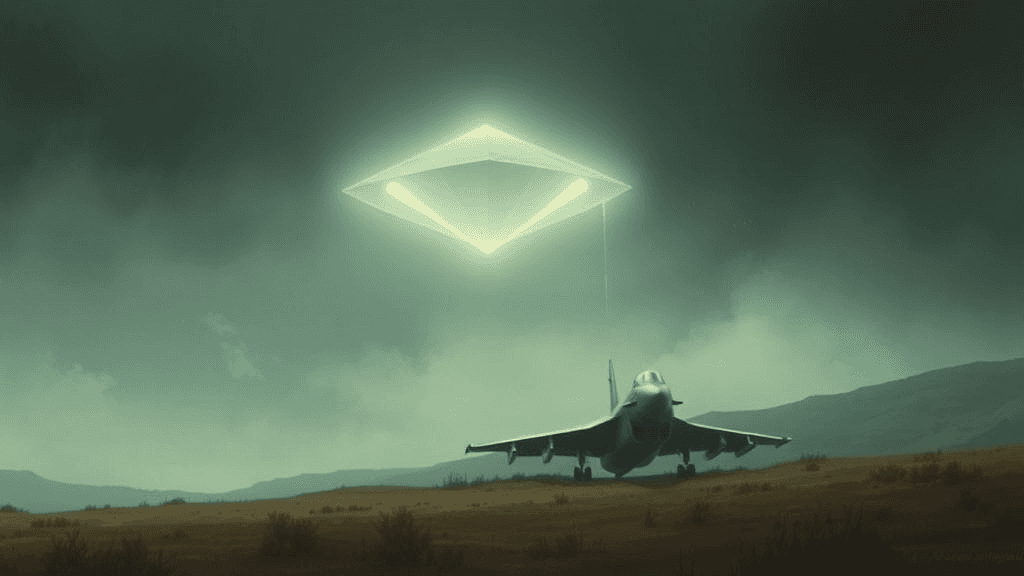
A months-long 1995 Argentine UFO wave culminated in a reported explosion and smoke column over Serranía Colorada near Joaquín V. González, Salta, that local lore has since dubbed the "Roswell Argentino."
Background
Argentina has one of Latin America's longest continuous UFO-reporting traditions, and by the mid-1990s the northwestern province of Salta was no stranger to anomalous sightings. What set 1995 apart was scale: over roughly five months, from late July through December, Argentine emergency lines, newsrooms, and the Air Force's own channels were flooded with reports of silent, maneuvering lights and triangular craft from across the country's northwest. The wave opened on July 31, 1995, with a widely reported incident far to the south in Bariloche, where Aerolíneas Argentinas pilot Jorge Polanco reported a UFO that forced him into evasive maneuvers, an event that coincided with a power outage reported to him from air traffic control. In the following weeks, similar reports rolled in from Laguna Setúbal in Santa Fe province, Capilla del Monte in Córdoba (itself already a fixture of Argentine UFO folklore), and Navarro in Buenos Aires province. Against this backdrop of a genuinely nationwide flap, residents of Salta began reporting a silent triangular or delta-shaped craft with pulsating red and white lights hovering over Cerro San Bernardo above the provincial capital. It was this saturated, anxious climate — described by contemporary Argentine press as gripping the whole region — into which the Joaquín V. González incident landed a little over two weeks later.
Argentina's UFO tradition did not begin in 1995. The country had already produced its own long-running mysteries, from the Córdoba hill town of Capilla del Monte — itself linked in local lore to an alleged 1968 saucer landing at Cerro Uritorco — to a steady stream of pilot and radar reports collected informally by the Air Force since the 1960s. What made 1995 distinctive was less any single sighting than its density and geographic spread: multiple provinces reporting compatible phenomena within the same season gave the wave a coherence that isolated sightings usually lack, and it is against that backdrop that Joaquín V. González's explosion registered as something more than a local curiosity.
Events
On either August 17 or 18, 1995 (Argentine sources disagree on the exact date, and on the time — El Tribuno's 2023 retrospective gives roughly 1:50pm, while a 30th-anniversary account in Revista Salvador gives around 6am), residents of the small town of Joaquín V. González, in Salta's Anta department, reported a powerful explosion that shook windows across the town — witnesses insisted it was distinct from a routine sonic boom. Moments later, dozens of townspeople saw a large column of dark smoke rising from the direction of Serranía Colorada, a range of forested hills roughly ten kilometers outside town. Many assumed, reasonably, that a light aircraft or a large meteorite had come down. Revista Salvador's retrospective adds a detail not present in most English-language retellings: a significant power outage affected much of the town at around the same time, reportedly coinciding with the object's passage near the local electrical plant — an echo of the blackout reported weeks earlier during the Bariloche sighting.
The case's central witness is a local civilian pilot most commonly named Antonio "Tony" Galvagno (a 2025 Argentine retrospective instead gives his first name as Héctor, one of several inconsistencies that dog even the Argentine sourcing on this case). Galvagno, described by the Hispanic-ufology research blog Inexplicata as a crop-dusting pilot who later became a respected local UFO researcher, took off in an ultralight aircraft to scout the impact area, initially assuming he would find aircraft or meteorite wreckage. Over roughly the following two weeks he conducted repeated aerial searches. He reported spotting what he described as a cloud of soot laced with "metallicized particles" rising from the hills — smoke, in his account, unlike that of an ordinary brush fire. On the ground, an area described as roughly 500 meters wide and five kilometers long was said to be scorched, with vegetation that, according to Galvagno decades later, never grew back.
No aircraft, either military or civilian, was reported missing in the area at the time, and no bolide or meteor fall was logged by any observatory serving the region — a gap that ufology sites treat as evidence of an anomalous craft, and that skeptics treat instead as simply the predictable absence of instrumentation capable of detecting a small, localized event in a sparsely monitored rural province. Word of the incident spread quickly beyond Anta department: by the following day, national outlets in Buenos Aires were already characterizing it as a possible UFO crash, a framing that both fed and was fed by the ongoing nationwide wave.
Investigation
Within days, Argentina's Gendarmería Nacional (national gendarmerie) and the Fuerza Aérea Argentina (Air Force) moved into the Serranía Colorada area and restricted access, citing reasons of national security. Galvagno and other locals who continued to fly or hike toward the site say they were warned off by gendarmerie personnel. No press or civilian investigators were permitted to reach whatever lay at the presumed impact point, and no official report, photograph, or physical sample was ever released to the public. According to the Revista Salvador retrospective, authorities' only response — offered informally rather than as a published finding — gestured vaguely toward satellite debris or space junk, an explanation that was never substantiated with wreckage, tracking data, or a named object.
It bears noting that no standing Argentine government body existed in 1995 specifically tasked with investigating aerial phenomena in the way later structures would be: the Comisión de Estudios de Fenómenos Aeroespaciales (CEFAE) was not created until 2011, and was reorganized into today's Centro de Identificación Aeroespacial (CIAE) only in 2019. Whatever inquiry the Air Force conducted into the Salta events in 1995 — and into the broader wave, including the Bariloche, Laguna Setúbal, and Capilla del Monte reports from the same months — was handled on an ad hoc basis rather than by a dedicated UFO office, which likely contributes to the absence of any declassified paper trail specific to Joaquín V. González. The case nonetheless drew heavy national media coverage at the time, including segments on the television programs of celebrity hosts Susana Giménez and Jorge Guinzburg, and a feature in Gente magazine, cementing it in the national imagination even without any government confirmation.
The case for and against
The case for taking the episode seriously rests on its wave context and multiplicity of witnesses: the explosion and smoke column were reported by numerous townspeople independently and roughly simultaneously, a pattern of the kind investigators generally weight more heavily than a lone sighting. It also arrived amid an already well-attested national flap with its own contemporaneous press coverage (the Bariloche pilot report, in particular, involved a named commercial aviator making a report through official channels). The military's documented decision to cordon off the search area, whatever its actual motivation, lent the story an air of official significance that has helped it endure for three decades.
The case against treating it as an actual crash-retrieval event is considerably stronger on close reading. The physical "evidence" — the burn scar, the metallic-looking soot, the failure of vegetation to regrow — exists only in secondhand descriptions from Galvagno and local testimony; no sample was ever independently tested, no photograph of debris has surfaced, and no coordinates for the alleged site have been published with enough precision for outside verification. Even the most basic facts of the story are inconsistently reported within Argentina itself: sources disagree on the witness's first name (Antonio versus Héctor), on whether the explosion happened on August 17 or 18, and on whether it happened near 6am or nearly 2pm. A genuine downed-craft event of this scale, cordoned off by two branches of the armed forces, would be expected to leave some trace in Argentina's subsequent UFO declassification efforts — yet, per Argentine outlets covering the case's anniversaries, no declassified document has ever definitively addressed it. The likeliest mundane candidates — an aircraft or small-scale explosive/industrial incident, a bolide airburst (a category with a well-documented history of producing loud explosions and columns of smoke, as with the 2013 Chelyabinsk meteor), or a grass/forest fire coincidentally following an unrelated loud noise — were never rigorously investigated and ruled out in public, leaving the case in the same evidentiary limbo as most alleged crash-retrievals: neither disproven nor demonstrated.
Cultural impact
Within Argentine ufology, the Joaquín V. González incident is second in stature only to the country's other famous cases, and it is routinely marketed and remembered under the explicit label "Roswell Argentino" — a deliberate echo of the 1947 Roswell incident in New Mexico, right down to the shared narrative beats of an explosion, a debris field, military secrecy, and an enduring local legend outliving any official account. The comparison has been reinforced by the town's own tourism and identity: outlets like Inquisitive Wonder have profiled Joaquín V. González as effectively "Argentina's UFO town," and Salta's flagship newspaper El Tribuno has returned to the story on the 25th, 28th, and 29th anniversaries (2020, 2023, and 2024), each time noting that the mystery remains unresolved. The story has also circulated widely on English-language UFO-interest sites (UFO Insight, The UFO Chronicles, Project Black Echo, Lores and Legends), which tend to present Galvagno's account largely at face value, illustrating how a locally contested legend can harden into an internationally cited "case" once repeated across enough secondary sources without renewed scrutiny of the primary Argentine record.
The case also sits within a broader Latin American pattern of "local Roswell" legends that emerged or gained traction in the 1990s, most famously Brazil's Varginha UFO incident of January 1996 — a reported creature encounter and alleged military recovery operation in Minas Gerais that unfolded just months after Joaquín V. González and shares its core structural elements: a loud precipitating event, local witnesses, uniformed personnel restricting access, and an enduring absence of released physical evidence. Argentine and Brazilian ufologists have periodically drawn the comparison between the two cases explicitly, treating them together as the region's strongest crash-retrieval claims even though, as with Salta, no debris or biological sample from Varginha has ever been independently authenticated either.
Current status
Three decades on, the case remains formally unresolved: no Argentine government agency has issued a public accounting of the August 1995 Serranía Colorada event, and no physical evidence has been produced for independent examination. Serranía Colorada continues to draw occasional ufologist pilgrims, and the case is kept alive largely through anniversary journalism in Salta's regional press rather than through any new investigative development. Absent a located, testable sample of the reported "metallicized" debris or the declassification of a specific Air Force file addressing Joaquín V. González by name, the Salta case is best understood as a striking, well-remembered local legend anchored in a real and well-documented regional UFO wave, rather than as a verified crash-retrieval event on a par with the evidentiary record — thin as it is — surrounding Roswell itself.
Witnesses
Antonio (or, per one Argentine 30th-anniversary account, Héctor) "Tony" Galvagno, civilian ultralight/crop-duster pilot who conducted the aerial searches; Jorge Polanco, Aerolíneas Argentinas pilot who reported a separate UFO encounter near Bariloche on July 31, 1995, during the same national wave; dozens of unnamed residents of Joaquín V. González who reported the explosion and smoke column; Gendarmería Nacional and Fuerza Aérea Argentina personnel who cordoned off the site.
Evidence
- Contemporary Argentine press and national TV coverage (Susana Giménez's and Jorge Guinzburg's programs, Gente magazine) of the August 1995 explosion and smoke column
- Multiple independent local witness accounts of the blast and a town-wide power outage
- Galvagno's firsthand aerial-search account of sooty, "metallicized" smoke and a c. 500m x 5km burn scar with vegetation that allegedly never regrew
- Documented Gendarmería/Air Force restriction of the search area, citing national security
- Corroborating wider wave: contemporaneous reports from Bariloche, Laguna Setúbal, Capilla del Monte, and Navarro across the same months
- No independently tested physical sample, photograph of debris, or declassified official report specific to the Serranía Colorada event has ever been published
Filed under
Watch
【斗破苍穹】EP001-219全集完结💥 一口气看完萧炎传奇之路!大结局内容一次看爽 |《鬥破蒼穹》|BTTH |MULTISUB
🕵️♂️ The Crime Doctor: A Tale of Mystery and Intrigue 🔍 | E. W. Hornung
Where this entry came from
ProvenanceAgent indexedUpdated 2mo ago8 sources
Drafted by the archive's AI research agent from the sources below; corrections from readers are reviewed and folded in.
- First indexed
- 11 AUG 26 // 15:22Z
- Last updated
- 10 SEP 26 // 04:45Z
- Continúa el misterio del supuesto ovni de Joaquín V. González, conocido como el "caso Roswell argentino", El Tribuno staff, El Tribuno
- A 30 años del "Roswell Argentino" en 1995, Revista Salvador staff, Revista Salvador
- Salta and the 1995 "UFO Crash", Scott Corrales, citing researcher Guillermo Aldunati, Inexplicata: The Journal of Hispanic Ufology
- UFO Crash In Argentina – The 1995 Salta Case, UFO Insight Research Team, UFO Insight
- Argentinean Roswell: The 1995 Salta UFO Crash, The UFO Chronicles Staff, The UFO Chronicles
- Salta Close Encounter Case: Roswell Argentino, Antonio Galvagno and the 1995 Crash Legend, Project Black Echo Research, Project Black Echo
- The Argentine UFO Flap of 1995, Lores and Legends Contributors, Lores and Legends
- Joaquín V. González: Argentina's UFO Town, Inquisitive Wonder, Inquisitive Wonder
Notes
- Continúa el misterio del supuesto ovni de Joaquín V. González, conocido como el "caso Roswell argentino", El Tribuno staff, El Tribuno
- A 30 años del "Roswell Argentino" en 1995, Revista Salvador staff, Revista Salvador
- Salta and the 1995 "UFO Crash", Scott Corrales, citing researcher Guillermo Aldunati, Inexplicata: The Journal of Hispanic Ufology
- UFO Crash In Argentina – The 1995 Salta Case, UFO Insight Research Team, UFO Insight
- Argentinean Roswell: The 1995 Salta UFO Crash, The UFO Chronicles Staff, The UFO Chronicles
- Salta Close Encounter Case: Roswell Argentino, Antonio Galvagno and the 1995 Crash Legend, Project Black Echo Research, Project Black Echo
- The Argentine UFO Flap of 1995, Lores and Legends Contributors, Lores and Legends
- Joaquín V. González: Argentina's UFO Town, Inquisitive Wonder, Inquisitive Wonder
Also available
UFO Dossier: South America
Documentary examining remarkable UFO cases across South America, including Argentine incidents, documented through photographs, videos, and indigenous contact legends in Brazil.
Witness of Another World
Documentary following Juan Oscar Pérez, an Argentine gaucho, through his multiple close encounters with UFOs and extraterrestrial beings, featuring astrophysicist Jacques Vallée exploring the psychological and spiritual impact of these encounters.
The Unexplained Files: Argentina UFO, Mothman and Morgellon's Disease
Science Channel episode examining UFO incidents in Joaquin V. Gonzalez, Argentina, including the 1995 crash near Salta and subsequent 2009 mass sighting witnessed by over 30 people.
Signal From the South: Argentina UFOs
Series. Discovery documentary exploring Argentina's role as one of the world's most persistent UFO hotspots, covering Cold War-era sightings to mass civilian encounters and declassified military reports spanning decades.
UFOTV Presents: UFOs in South America
Documentary investigating UFO sightings and unexplained phenomena across South American countries, including multiple Argentine incidents documented through archival footage and eyewitness accounts.
Buying through these links supports the library. We may earn a commission.