The UFO Library: Physical trace
Tully Saucer Nest (1966)
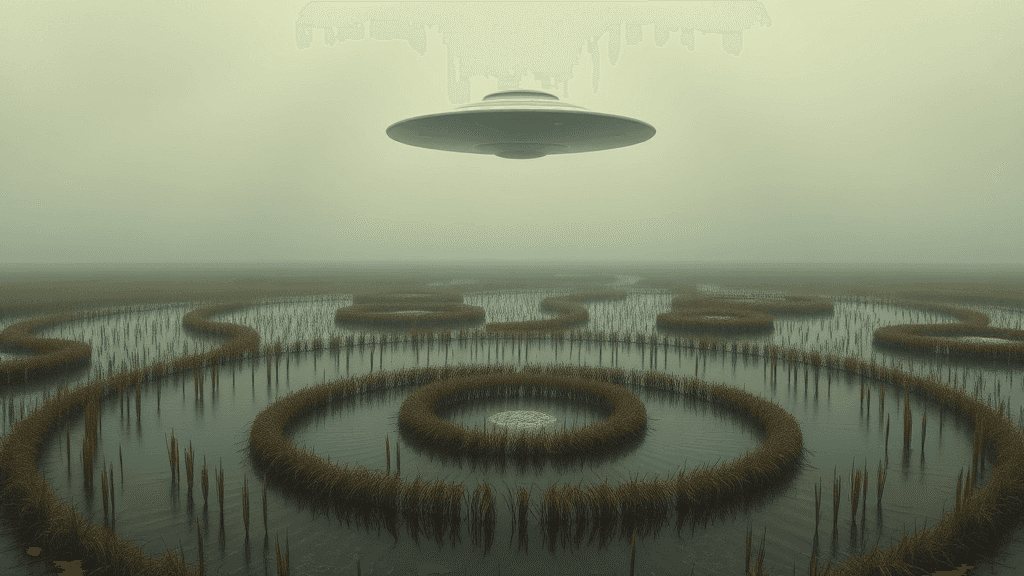
On 19 January 1966 banana farmer George Pedley reported a saucer-shaped object rising from a lagoon near Tully, Queensland, and a circular reed 'nest' appeared on the water; the RAAF's explanation, a willy willy, is disputed by UFO researchers.
Background
Tully is a sugar and banana district in far north Queensland. In the mid-1960s its reed-choked lagoons and sugar-cane properties were unremarkable farmland, which is part of why the events at Horseshoe Lagoon drew attention. The case is usually called the Tully 'saucer nest' after the circular mats of reeds that appeared on the water. Its accounts were assembled largely by Australian UFO groups, and the surviving documents, including RAAF and police paperwork, are the basis for most of what is known.
The 1966 sighting
At about 9 a.m. on 19 January 1966, George Pedley, a 28-year-old banana farmer, was driving a tractor near the lagoon on land owned by Albert Pennisi. He heard a hissing sound and reported seeing a grey, saucer-shaped object about 25 feet across rise from the lagoon, reach treetop height and leave to the south-west within seconds. He heard no other sound. Accounts differ on the detail: the UFO Research Queensland's Tully Report summary gives about four seconds, while the RAAF recorded about 15 seconds and Pedley estimated 30 seconds in 1981, according to the Project 1947 catalogue entry.
When Pedley returned, a circular area of the lagoon had been cleared of reeds and its water was slowly turning. By around noon a floating mass of green reeds about 30 feet across sat on the water in a radial pattern, its outer edge sloping down. The top of the reeds turned brown within hours while the undersides stayed green, and UFO Casebook reports that hand-pulled reeds took about three days to brown. Nearby, tear-drop-shaped marks about 3 to 4 inches long were found in a line roughly 12 inches apart in a paddock, and a rectangular patch of grass had been clipped. Project 1947 records smaller nests found the next day and a later, larger nest in 1969 that a botanist judged unlikely to have a natural cause.
Investigation and explanations
Pedley reported the sighting to Tully police that evening. Sergeant A.V. Moylan visited the site with Pedley, completed the RAAF report form and took a grass sample. Moylan first suggested a small helicopter and later relayed a local view that a whirlwind could leave such marks. RAAF headquarters favoured 'small isolated waterspouts'. Samples tested at the University of Queensland showed nothing unnatural. A February 1966 Department of Air letter pointed to turbulence or downdraughts and stated there was 'no explanation for the visible phenomena'. A 1973 Defence letter named the willy willy, a small local whirlwind, as the most probable explanation. The Commonwealth Aerial Phenomena Investigation Organisation's 1966 report, as summarised by circlemakers.org, likewise found no explanation and did not confirm a UFO.
Not everyone accepted this. UFO Casebook's author concedes the whirlwind is the most probable explanation of the proposed causes but not a conclusive one. The objections are specific: the day was sunny with little wind, Pedley described two saucers face to face rather than a mass of swamp debris, no debris fell where a whirlwind would have dissipated, and a whirlwind does not explain how clear water became covered with reeds within three hours.
Credibility and legacy
The case is contested rather than fringe. The physical traces, the official papers and the witness accounts are real, but the record is inconsistent, and the Project 1947 author lists several discrepancies. Pedley later said he first saw the object in the air rather than rising from the lagoon, and denied calling it a spaceship; the swirl direction on the RAAF form was overtyped. Pennisi, the landowner, reports recurring dreams of a saucer landing and further nests in later decades, and says a round-the-clock watch by researchers, police and air force personnel may have ended the visits. Those later nests are reported by sources that the RAAF file does not cover.
The Tully nests remain a reference point in Australian UFO literature because they are documented as physical evidence rather than just lights in the sky. Whether the reed rings were made by a whirlwind, by a hoax, or by something no official explanation accounts for, the case shows how a single rural sighting became an enduring story of unexplained marks on the ground and water.
Witnesses
- George Pedley (28), banana farmer, driving a tractor near the lagoon; the primary witness. Gave differing accounts of the object's rise and duration in later years.
- Albert Pennisi, owner of the lagoon and surrounding land. Photographed the reed mass, collected samples, and later reported further nests.
- Sgt A.V. Moylan, Tully police, who visited the site with Pedley and completed the RAAF form.
- Christine Rounland, who found the tear-drop ground marks in a nearby paddock.
- Tom Warren and Hank Penning, who found two smaller nests on 20 January.
Evidence
- Reed mass about 30 feet across with a radial, clockwise pattern; top surface browned within hours.
- Circular, slowly rotating reed-free water seen the same morning.
- Clipped grass patch and a line of tear-drop marks in a paddock. No plaster casts were made, and visitors later obliterated some marks.
- Samples tested at the University of Queensland showed nothing unnatural; physics tests found only background-level beta activity.
- Official papers: RAAF report form, a Department of Air letter (February 1966), and a Defence letter (1973).
Filed under
Watch
Queensland's X-Files: UFO sightings in North Queensland
Global crop circle phenomenon inspired by UFO mystery in Far North Queensland? 🛸 | Uncropped
The 1966 Tully, Australia, UFO landing and "saucer nest" discussed by George Pedley & Albert Pennisi
The Mysterious Tully Australia Saucer Nest UFO Incident from 1966 (Declassified File) - FindingUFO
Where this entry came from
ProvenanceAgent indexedUpdated 11d ago4 sources
Drafted by the archive's AI research agent from the sources below; corrections from readers are reviewed and folded in.
- First indexed
- 01 NOV 26 // 05:18Z
- Last updated
- 01 NOV 26 // 05:18Z
- The Tully Saucer Nest, B. Denton and C.A. Phillips, UFO Research Queensland
- Tully 1966 'Saucer Nest' case (Australian physical trace catalogue), Not identified on page, Project 1947
- The Tully Saucer Nest, B. J. Booth, UFO Casebook
- Tully nest case summary, Not identified on page, circlemakers.org
Notes
- The Tully Saucer Nest, B. Denton and C.A. Phillips, UFO Research Queensland
- Tully 1966 'Saucer Nest' case (Australian physical trace catalogue), Not identified on page, Project 1947
- The Tully Saucer Nest, B. J. Booth, UFO Casebook
- Tully nest case summary, Not identified on page, circlemakers.org
Also available
Close Encounters Down Under
Six-episode Australian UFO docuseries following first-hand witness accounts of alleged alien encounters across Australia and New Zealand. Episode 1, "Queensland's Tropical Coast" (44 min), is listed on TheTVDB's German page as covering the 1966 Tully saucer nest; the English description does not name it.
Buying through these links supports the library. We may earn a commission.