The UFO Library: Military encounter
Usovo Missile Base Incident (1982)
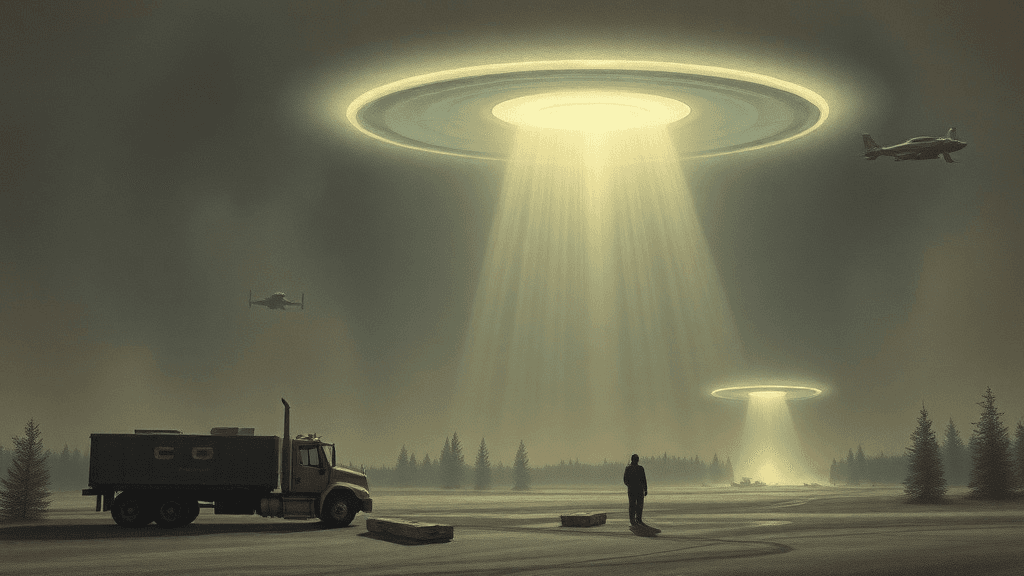
In October 1982 Soviet officers at a nuclear missile base near Usovo reportedly saw unidentified objects over their silos while launch controls behaved erratically; the account rests almost entirely on Colonel Boris Sokolov's 1993 interviews, which he later partly revised.
Background
The Usovo incident belongs to the Soviet side of the Cold War UFO record, and it became known in the West only after the USSR began to open its files in the early 1990s. The base lies near Usovo in present-day Ukraine, then part of the Soviet Union. Soviet state interest in UFOs was real but low-key: a state research programme ran from 1978 to 1990 under the USSR Academy of Sciences and the Ministry of Defence. Its authors, Yuli Platov and Boris Sokolov, later published a summary in the Bulletin of the Russian Academy of Sciences, and the programme's own account reports about 3,000 reports over 13 years, most explained as human technical activity or natural phenomena (Times Higher Education). That summary also notes that the investigators found no reports of landings, contact, or abductions in the Soviet material.
The reported incident
The Usovo account comes from a 1993 interview in which Sokolov, then a colonel and a Defence Ministry officer who coordinated the programme's military side, described unidentified objects appearing over a missile base. According to the version reported by IBTimes, officers saw unidentified objects above the silos, and a communications officer said a launch console activated without human input. Launch was halted when the objects disappeared, and power to the missiles returned to normal. The article dates the event to October 1982. Its main source is journalist George Knapp, who publicised the case on Mystery Wire and in the 1990s.
The launch-control malfunction is the element that gives the case its weight: an uncontrolled launch system would be a serious matter, and it is the reason the story was treated as a near-miss. Sokolov also gave an interview to ABC News.
Assessment and revision
The case is weakly documented and has since been partly walked back by its principal source. A 2000 paper by Sokolov and Platov in the Bulletin of the Russian Academy of Sciences describes the control-panel malfunction as having 'completely accidentally coincided in time' with the observed phenomena. That framing treats the panel fault and the sightings as coincident rather than causal, which contradicts the 1993 narrative in which the objects took control of the launch systems. A critical review of the Knapp material in the ASIRP journal notes that Knapp's depositions lack any technical appraisal of the panel malfunction and any conclusions from an investigating commission. The review, which quotes Huneeus, says Sokolov's 2000 article 'sounds totally different' from his early-1990s interviews, and offers two explanations for the shift: official pressure after Sokolov sold classified documents, or a 1993 narrative shaped for a paying Western audience.
No physical evidence has been published: no wreckage, no radar tracks, and no Soviet military record of the launch-control fault. The dates also disagree. Some accounts give October 4, 1982, while a Sokolov interview places an order to the base on October 5, 1983. The Soviet material that is public does not resolve this.
Current status
Usovo is cited in popular UFO literature as one of the most serious Soviet-era cases. Serious assessment rests on the later revisions rather than the 1993 story. The case is best treated as an unverified report from an insider whose account changed over time, and the 2000 paper is the most important document for anyone trying to evaluate it. The incident remains a useful example of how Cold War-era UFO claims depend on memory and selective release rather than on documents that can be independently checked.
Witnesses
Colonel Boris Sokolov (Soviet Defence Ministry officer) is the principal source; his 1993 interviews with George Knapp and ABC News supply most of the detail. Sokolov later co-authored a 2000 paper with Yuli Platov that revises the 1993 account. Unnamed officers at the base are reported to have seen the objects and a communications officer is reported to have described the launch console activating without human input.
Evidence
No physical evidence has been published. The main documentary material is the 2000 Sokolov–Platov paper in the Bulletin of the Russian Academy of Sciences, which states the panel malfunction coincided with the phenomena but does not treat them as causally linked. Knapp's documents were described by Huneeus as thin, with no technical appraisal or investigating-commission conclusions.
Filed under
Watch
Da Stalin a Putin: gli UFO Russi - X-File in Ucraina
Where this entry came from
ProvenanceAgent indexedUpdated 13d ago3 sources
Drafted by the archive's AI research agent from the sources below; corrections from readers are reviewed and folded in.
- First indexed
- 30 OCT 26 // 09:19Z
- Last updated
- 30 OCT 26 // 09:19Z
- Knapp's 'Russian UFO files' are mostly old news, even in 1993 Russia, Bernardo Huneeus, ASIRP Journal (Substack)
- Russia's Chilling UFO Files: Nukes Aimed at New York Nearly Fired As Aliens Vanished, International Business Times UK
- Soviet state UFO research (Platov and Sokolov summary), Times Higher Education
Notes
- Knapp's 'Russian UFO files' are mostly old news, even in 1993 Russia, Bernardo Huneeus, ASIRP Journal (Substack)
- Russia's Chilling UFO Files: Nukes Aimed at New York Nearly Fired As Aliens Vanished, International Business Times UK
- Soviet state UFO research (Platov and Sokolov summary), Times Higher Education
Also available
Top Secret UFO Projects: Declassified
Netflix docuseries (Series) that examines declassified UFO programs. Its Soviet-focused episode, "Soviet Secrets," covers the reported October 1982 UFO sighting at a Soviet missile launch facility near Usovo, which is not a standalone film about this incident.