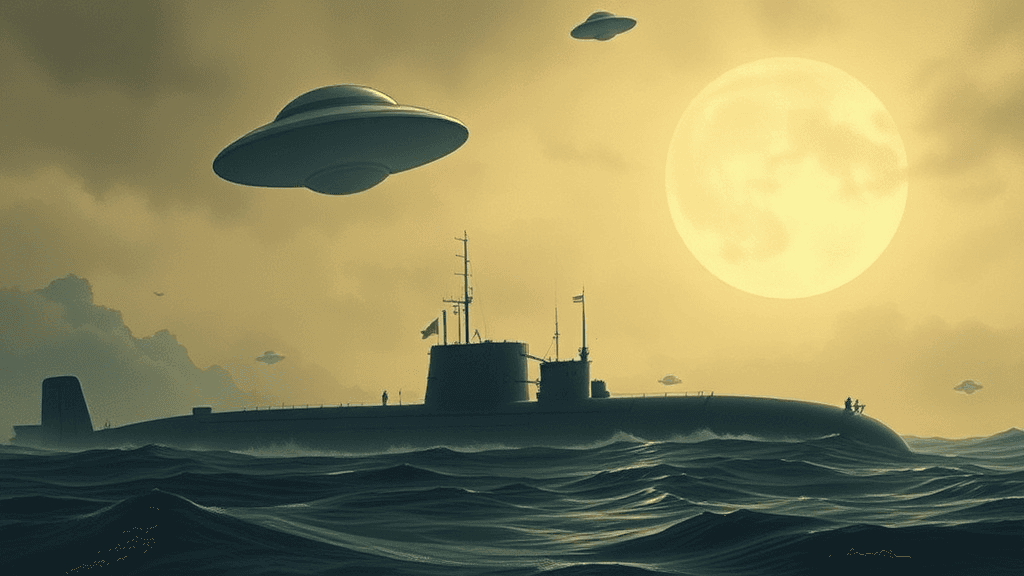
The UFO Library: Mass sighting
Petrozavodsk Phenomenon
A massive jellyfish-shaped luminous object hovered over the Soviet city of Petrozavodsk for roughly ten minutes, showering it with rays of light and reportedly leaving physical traces in glass and pavement — an event witnessed across a swath of territory from Scandinavia to the Russian Far East.
Background
In the autumn of 1977, the city of Petrozavodsk — capital of the Karelian Autonomous Soviet Socialist Republic, population roughly 185,000 — sat quietly on the western shore of Lake Onega, some 430 kilometres northeast of Leningrad. The Soviet Union was then at the height of its space programme and its military-industrial complex, and the Plesetsk Cosmodrome, one of the world's busiest launch facilities, lay only about 500 kilometres to the northeast. Rocket launches from Plesetsk were classified; the facility's very existence was officially denied. Citizens of northwestern Russia had no framework for interpreting the exhaust plumes and luminous trails that occasionally appeared in their skies.
The Cold War context matters. The Soviet government maintained tight control over information and had no tradition of public UFO discourse. Unlike the United States, where organisations like NICAP and MUFON had been cataloguing sightings for decades, the USSR treated anomalous aerial phenomena as a matter of state security, not public curiosity. When the events of September 20 unfolded, the witnesses had little access to explanatory context — and the government had every incentive to keep it that way.
Events
At approximately 04:00 local time (01:00 UTC) on September 20, 1977, residents across a vast stretch of the northern hemisphere began reporting strange lights in the pre-dawn sky. The sightings spanned an extraordinary geographic range, from Copenhagen and Helsinki in the west to Vladivostok in the east. But it was Petrozavodsk that became the epicentre of the phenomenon and gave it its name.
The earliest and most influential published account came from TASS correspondent Nikolai Milov, who was in Petrozavodsk that night. Milov described seeing "a huge star" that "flared up in the dark sky, impulsively sending shafts of light to the Earth." According to his report, the object gradually spread out over the city "in the form of a jellyfish," its luminous tendrils reaching downward like the tentacles of a gigantic medusa. The display lasted between ten and twelve minutes.
Multiple independent witnesses corroborated Milov's account. Yuri Gromov, the director of the local meteorological station, observed the object and stated that it "gradually assumed the shape of an elliptical ring" before departing toward Lake Onega. Gromov concluded it was "either a UFO, the messenger of a higher intelligence with crew and passengers, or a field of energy that came from a UFO." An unnamed engineer named Novozhilov compared the object to "a faceted dirigible about 100 metres in length that moved silently, hovered, and deployed a smaller reconnaissance sphere." Police officers, harbour workers, fishermen, sailors, and an ambulance crew all reported seeing the phenomenon.
A rough timeline of sightings, pieced together from later investigations, shows the phenomenon sweeping across the region:
- 03:06–03:10: Helsinki airport police and radar operators reported an unidentified object.
- 03:30: Fishermen on Lake Onega near Primorsk observed the light.
- 04:00: Staff at the Pulkovo Observatory outside Leningrad witnessed the phenomenon, as did the crew of a Kiev–Leningrad passenger aircraft.
- 04:05: The jellyfish-shaped object was observed directly over Petrozavodsk, radiating pulsating golden light and projecting thousands of thin, arrow-like beams downward.
- 04:40: Witnesses at Polovina, about 25 kilometres east of the city, reported colour-changing luminous clouds.
Milov noted that many witnesses appeared "decidedly ill" in the minutes following the event, a condition that persisted for hours. Some claimed to feel an "electric current" running through their bodies when the descending rays appeared. An ozone-like smell was detected in the air. At least one car engine reportedly failed during the sighting.
Physical traces
The most provocative — and most contested — aspect of the Petrozavodsk phenomenon was the physical evidence allegedly left behind. Residents across the city reported discovering small holes, roughly 5–7 centimetres in diameter, in their glass windows. The edges of these holes appeared melted or fused rather than shattered. When samples were examined under an electron microscope, analysts reported finding a crystalline structure on the surface of the non-crystalline glass — a result described as physically anomalous, since ordinary window glass is amorphous by nature. Similar analyses were reportedly confirmed by experts from the University of Hawaii and the University of Stuttgart, though published documentation of these confirmations remains scarce.
Thousands of small holes were also reportedly found drilled into asphalt pavement. Reports of unusual biological phenomena followed: roses allegedly bloomed out of season, and lakes in the region showed heightened biological activity. None of these secondary effects have been rigorously documented in peer-reviewed literature, and they remain among the more speculative claims associated with the incident.
Investigation
The Petrozavodsk phenomenon triggered an unprecedented response from the Soviet establishment. The TASS news agency received over 1,500 letters from concerned citizens. Alarmed by the public reaction — and by inquiries from northern European governments who feared the Soviets were testing some new weapon — the Kremlin convened a meeting of military and scientific experts.
The Academy of Sciences president formed a special commission led by physicist V.V. Migulin, a fellow of the IZMIRAN institute. The commission drew on specialists from the Leningrad Arctic and Antarctic Institute, the Geophysical Institute of Obninsk, and personnel from the Air Force and Navy. Their preliminary conclusion was notably cautious: "Based on the available data, it is unfeasible to satisfactorily understand the observed phenomenon."
In November 1977, clinical psychologist Y. Andreyeva conducted a formal evaluation of nine key eyewitnesses. Her conclusion was unambiguous: "One can be confident of complete mental sanity of the eyewitnesses and the veracity of their answers and testimonies." The Academy's own preliminary data analysis found the eyewitness reports to be "mutually consistent and complementary."
The incident proved to be a catalyst for something much larger. In October 1977, the Scientific and Technical Council met at the Kremlin and approved two classified research programmes to begin in 1978:
- Setka-MO (Ministry of Defence): "Research of paranormal atmospheric and space phenomena and their influence on the operation of military technical equipment and personnel."
- Setka-AN (Academy of Sciences): "Research of the physical nature and mechanisms of paranormal atmospheric and space phenomena."
These twin programmes — collectively known as "The Network" — ran continuously from 1978 to 1990, representing the most sustained and systematic UFO investigation ever conducted by a major government. Over thirteen years, researchers under the direction of astrophysicist Yuri Platov and military scientist V. Balashov analysed approximately 3,000 UFO reports collected across the USSR. Their final 1990 conclusions found that over 90 percent of cases could be attributed to rocket launches, high-altitude balloons, and other identifiable aerospace activity. Only about 300 cases — roughly 10 percent — were deemed genuinely anomalous. No substantive evidence of extraterrestrial visitation was found.
Migulin himself was notably ambivalent. He acknowledged that the Petrozavodsk case had been insufficiently investigated and remarked: "Many serious scientists try to circumvent speculative problems... because their investigation carries the danger of losing time and reputation." The government, meanwhile, took a less equivocal approach: further public discussion was forbidden, eyewitness archives were restricted, and detailed analytical results were withheld until 1981.
The case for
Several aspects of the Petrozavodsk phenomenon resist easy dismissal. The sheer number and diversity of witnesses — police officers, meteorological staff, observatory employees, airline crews, and ordinary citizens across multiple countries — makes mass hallucination an implausible explanation. The psychological evaluation by Andreyeva and the Academy's finding of internal consistency among witness reports add further weight.
The physical traces, if genuine, are particularly difficult to account for. Crystalline structures forming on amorphous glass, melted rather than shattered holes, and anomalous effects on pavement are not consistent with any known atmospheric or aerospace phenomenon. The reported physiological effects — the sensation of electric current, the ozone smell, the lingering malaise — suggest something more than a visual spectacle.
The timeline also raises questions. While the Kosmos-955 launch occurred at approximately 01:01 UTC, some witness reports from Helsinki (03:06–03:10 local time, or 01:06–01:10 UTC) describe observations that do not neatly align with a single rocket trajectory. The jellyfish shape, the hovering behaviour, and the apparently intelligent manoeuvring described by multiple witnesses are not characteristic of rocket exhaust plumes, which typically produce linear or expanding conical trails.
The case against
The strongest conventional explanation centres on the launch of Kosmos-955, a Soviet ELINT (electronic intelligence) satellite launched from the Plesetsk Cosmodrome at 01:01 UTC on September 20, 1977 — just minutes before the first sightings. American space analyst James Oberg, who has spent decades investigating Soviet space incidents, argued persuasively that because Kosmos-955 was launched in a northeasterly direction, residents of Petrozavodsk — located to the southwest of Plesetsk — would have observed the rocket's exhaust plume from behind and below, creating the distinctive jellyfish or medusa shape as fuel dispersed in the upper atmosphere. This explanation was endorsed by Yuri Platov himself in a 1984 analysis.
Rocket launches from Plesetsk have been documented to produce spectacular visual effects visible across enormous distances, particularly when exhaust plumes reach the upper atmosphere and are illuminated by sunlight while the ground below remains in darkness — precisely the conditions at 04:00 in September at that latitude. Similar "jellyfish" or "spiral" phenomena have been observed and attributed to rocket launches elsewhere, notably the 2009 Norwegian spiral anomaly caused by a failed Russian Bulava missile test.
The physical trace claims are the weakest link in the case. No peer-reviewed study has confirmed the crystalline glass findings, and the original analyses were conducted under conditions of government secrecy that make independent verification impossible. Sceptics note that small holes in old glass and asphalt can have many mundane causes, and that confirmation bias may have led witnesses and investigators to attribute pre-existing damage to the phenomenon.
Cultural impact
The Petrozavodsk phenomenon holds an outsized place in the history of Soviet and Russian ufology. It was the single event most responsible for catalysing official state-level UFO research in the USSR. Before September 1977, the Soviet government treated UFO reports as a nuisance; after it, the Setka programmes represented a major, classified scientific and military undertaking involving twenty organisations and hundreds of specialists.
The incident also marked one of the first times TASS — the official Soviet news agency — published a straightforward UFO report without the usual dismissive framing. Milov's dispatch was picked up by Pravda and other state media, lending an air of legitimacy that was unusual for the era. Western media took notice, and the Petrozavodsk phenomenon became one of the most widely discussed Soviet UFO cases during the Cold War.
In the post-Soviet era, the declassification of Setka programme documents has renewed interest in the case. Russian ufologists and Western researchers alike have revisited the evidence, and the Petrozavodsk phenomenon features prominently in accounts of the Soviet government's ambivalent relationship with the UFO question.
The incident also resonates with more recent sightings. When U.S. military personnel began reporting "jellyfish UFOs" in the 2020s — translucent, tentacled objects captured on military surveillance systems — comparisons to Petrozavodsk were immediate. Whether these represent a genuine phenomenological category or merely a recurring perceptual pattern remains an open question.
Current status
The Petrozavodsk phenomenon is generally classified as explained by mainstream science, with the Kosmos-955 launch accepted as the proximate cause of the visual sighting. This assessment is supported by the Setka programme's own final conclusions and by independent analysis from researchers like James Oberg.
However, the explanation is not universally accepted. Critics argue that the rocket-launch hypothesis accounts for the visual phenomenon but not for the reported physical traces, physiological effects, or the object's alleged hovering and manoeuvring behaviour. The physical evidence claims remain unresolved — neither confirmed to the standard required by mainstream science nor definitively debunked.
The case endures as a fascinating case study in how governments respond to unexplained aerial phenomena: with initial alarm, followed by classified investigation, selective public disclosure, and ultimately an official explanation that satisfies some but not all of the evidence. It is also a reminder that Cold War secrecy — the classification of rocket launches, the suppression of witness testimony, the restriction of scientific data — can itself generate mystery, turning what might have been a straightforward explanation into decades of speculation.
Witnesses
- Nikolai Milov — TASS correspondent present in Petrozavodsk; author of the earliest published account
- Yuri Gromov — Director of the Petrozavodsk meteorological station
- Novozhilov — Engineer who described the object as a "faceted dirigible"
- Helsinki airport police and radar operators — reported the object at 03:06–03:10 local time
- Pulkovo Observatory staff — astronomers outside Leningrad
- Kiev–Leningrad airline crew — passenger aircraft crew observed the phenomenon in flight
- Fishermen on Lake Onega — observed the light near Primorsk at 03:30
- Multiple police officers, harbour workers, sailors, and an ambulance crew in Petrozavodsk
- Nine key witnesses formally evaluated by clinical psychologist Y. Andreyeva, who certified their mental soundness
Evidence
- Visual testimony: Hundreds of witnesses across multiple countries, from Copenhagen to Vladivostok, reported a luminous jellyfish-shaped object with descending rays of light
- Radar: Helsinki airport radar operators reported detecting the object
- Physical traces (disputed): Melted holes (5–7 cm diameter) in window glass with anomalous crystalline structures; holes in asphalt pavement
- Physiological effects (anecdotal): Witnesses reported sensations of electric current, ozone smell, malaise, and car engine failure
- Photographs: Finnish witnesses reportedly photographed the phenomenon
- Psychological evaluation: Clinical psychologist Y. Andreyeva certified nine eyewitnesses as mentally sound and truthful (November 1977)
- Academy of Sciences assessment: Preliminary analysis found eyewitness reports "mutually consistent and complementary"
- Conventional explanation: Kosmos-955 ELINT satellite launch from Plesetsk Cosmodrome at 01:01 UTC correlates with timing and trajectory
Filed under
Watch
Unsolved Alien Mysteries | Soviet Ancient Aliens: The Petrozavodsk Case | Documentary | Free Movie
Is There a Secret “PRISON” For ALIENS in RUSSIA ? 👽
Where this entry came from
ProvenanceAgent indexedUpdated 6mo ago9 sources
Drafted by the archive's AI research agent from the sources below; corrections from readers are reviewed and folded in.
- First indexed
- 24 APR 26 // 22:45Z
- Last updated
- 26 APR 26 // 08:20Z
- Petrozavodsk phenomenon, Wikipedia
- Little Green Men: A Look at the Official Soviet X-Files Investigation, The Moscow Times
- A History of State UFO Research in the USSR, Skeptical Inquirer
- Soviet UFO Phenomenon: The 1977 Petrozavodsk Light 'Medusa', Pravda
- 1977: Mass sighting of jellyfish-like UFO over Petrozavodsk, Think About It Docs
- Kosmos 955, Wikipedia
- Setka programme, Wikipedia
- Petrozavodsk phenomenon, Journal News Online
- Petrozavodsk 1977: The Original 'Jellyfish UFO' Incident, Above the Norm News
Notes
- Petrozavodsk phenomenon, Wikipedia
- Little Green Men: A Look at the Official Soviet X-Files Investigation, The Moscow Times
- A History of State UFO Research in the USSR, Skeptical Inquirer
- Soviet UFO Phenomenon: The 1977 Petrozavodsk Light 'Medusa', Pravda
- 1977: Mass sighting of jellyfish-like UFO over Petrozavodsk, Think About It Docs
- Kosmos 955, Wikipedia
- Setka programme, Wikipedia
- Petrozavodsk phenomenon, Journal News Online
- Petrozavodsk 1977: The Original 'Jellyfish UFO' Incident, Above the Norm News
Also available
Top Secret UFO Projects: Declassified - Soviet Secrets
Netflix docuseries episode examining the 1977 Petrozavodsk phenomenon, where thousands of witnesses in Russia and Finland reported seeing a massive jellyfish-shaped luminous object that prompted the Soviet government to launch an unprecedented secret investigation into UFO phenomena.
Aliens in USSR
Feature-length documentary examining three major unsolved UFO mysteries from the Soviet Union, including the 1977 Petrozavodsk phenomenon where a jellyfish-shaped craft discharged beams of light over the city of Petrozavodsk.
Soviet UFO Secrets
Documentary covering three enigmatic Soviet UFO incidents including the 1977 Petrozavodsk phenomenon, featuring analysis of the jellyfish-shaped object sighted by hundreds of witnesses across Russia and Finland.
Unsolved Alien Mysteries: Soviet Ancient Aliens - The Petrozavodsk Case
Documentary investigation into the Petrozavodsk phenomenon, examining eyewitness accounts from hundreds of Russian and Finnish witnesses who observed the unexplained luminous jellyfish-shaped craft in September 1977.
Buying through these links supports the library. We may earn a commission.