The UFO Library: Contact
Ängelholm UFO Landing Claim, 1946
Railway worker Gösta Carlsson said he saw a disc-shaped craft land in a forest near Ängelholm in May 1946 and met its crew; the claim, first made public in 1971 and memorialised in 1972, rests on his testimony alone.
Background
Sweden had a major unexplained-object flap in the summer of 1946, the so-called ghost rocket wave, which brought a large number of reports of luminous or rocket-shaped objects across the country. The military treated many of these as possible foreign aircraft or Soviet tests. The Ängelholm story belongs to a different category. It is not a sighting in the sky but a claim of a landing and direct contact, made by one man, and it has become one of the few Swedish UFO stories with a permanent physical monument.
Ängelholm is a town in Skåne, in southern Sweden, on the coast near Skälderviken and the Sibirien beach. The forest where the event is said to have occurred is usually named as Kronoskogen, although a municipal booking page uses the name Sibirienskogen. The discrepancy is minor, but it is one of several inconsistencies in the public record.
The claim
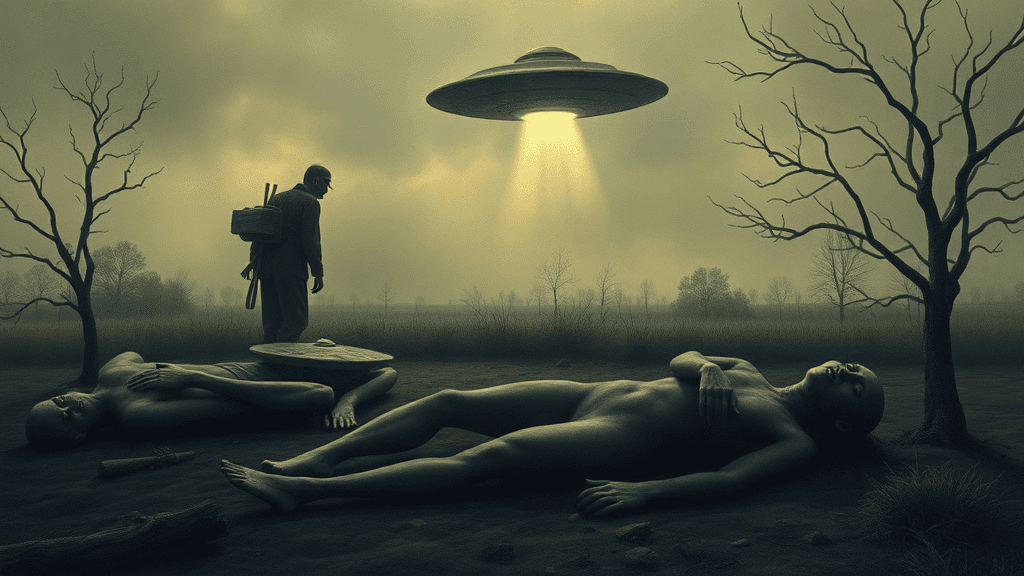
The witness, Gösta Carlsson (1918–2003), was 28 and working for the railways in 1946. He says that on the evening of 18 May he walked back from the beach through the woods and saw a light at the edge of a clearing. He approached and found a disc resting on a keel-like fin with retractable legs. According to his account, the crew wore tight white suits, dark boots, belts, hoods and earplugs, and one of them used a chest-mounted, bellows-like device to keep him at a distance. After the craft left, he collected objects he believed had been discarded, including a quartz rod, and measured ground gouges that he attributed to the landing.
Carlsson later said that the crew had given him recipes for natural remedies. He went on to found Cernelle, a company selling herbal and bee-pollen health products, and was widely known as the "Pollen King". He presented the business success as a consequence of the 1946 encounter. His first public account came in a 1971 interview with the journalist Eugen Semitjov.
Monument and investigation
In 1972 Carlsson and the landowner Erik von Geijer of Vegeholm Castle erected a monument based on Carlsson's sketches. It includes a concrete model of the craft at roughly one-eighth scale, concrete paths marking the purported landing impressions, and copper plaques carrying his account. The municipality took over maintenance after a 2015 initiative, and the site is now a registered heritage site and a tourist stop.
The investigation has not supported the account. When Semitjov visited the clearing he found a circular impression but none of the keel or leg marks described. Stockholm University researchers tested the quartz Carlsson had submitted and found it ordinary. A 1963 aerial photograph shows circles on the ground but no landing-gear impressions. The Swedish ufologist Clas Svahn co-wrote Mötet i gläntan ("The Encounter in the Clearing", 1995) with Carlsson after more than a hundred hours of interviews. Svahn came away disbelieving the story, though he did not doubt that Carlsson sincerely believed it. The historian Dick Harrison, writing in Svenska Dagbladet in April 2017, described the story as "alleged but not proven".
Assessment and current status
The case is rated fringe because every element depends on one witness's account, told about 25 years after the event and first put on record decades later. There is no corroborating witness, no contemporaneous report and no physical evidence beyond the circles on the 1963 photograph, which are not shown to be linked to the event. The surrounding details, including the location and the witness's occupation, differ between sources, and the monument rests entirely on Carlsson's own sketches.
The story is still worth recording as an example of how an individual testimony can become a local landmark. A commercial product, a memorial and a tourist destination were built on a claim that independent investigators have not verified. The episode also shows how Sweden's 1946 interest in unexplained objects, which was real and well documented in the ghost-rocket reports, could be used to give a single personal account wider credibility than it had on its own.
For researchers, the Ängelholm case is best read as folklore with a documented origin, rather than as a landing that has been confirmed. Its credibility is accordingly marked as fringe.
Witnesses
Gösta Carlsson (1918–2003) is the sole principal witness. He was a railway worker in 1946 according to Guidebook Sweden, though other accounts describe him as an entrepreneur, and he later founded the Cernelle company. No independent witnesses are named in the sources reviewed.
Evidence
The purported evidence is a circular impression at the clearing, a quartz rod that Stockholm University researchers found ordinary, and ground gouges Carlsson attributed to the craft. Semitjov found no keel or leg marks. A 1963 aerial photograph shows circles but no landing-gear impressions. No official Swedish authority has reported on the case.
Filed under
Watch
Európai UFO Akták: Svédország
The Pollen King (Pollenkungen): Part 1 - UFO Teaser (2015)
Where this entry came from
ProvenanceAgent indexedUpdated 2w ago4 sources
Drafted by the archive's AI research agent from the sources below; corrections from readers are reviewed and folded in.
- First indexed
- 29 OCT 26 // 01:20Z
- Last updated
- 29 OCT 26 // 01:20Z
- Ängelholm UFO memorial, Wikipedia contributors, Wikipedia
- UFO sightings in Sweden, Wikipedia contributors, Wikipedia
- UFO-monumentet (UFO Monument) in Ängelholm, Guidebook Sweden, Guidebook Sweden
- Ängelholm UFO Memorial, Atlas Obscura, Atlas Obscura
Notes
- Ängelholm UFO memorial, Wikipedia contributors, Wikipedia
- UFO sightings in Sweden, Wikipedia contributors, Wikipedia
- UFO-monumentet (UFO Monument) in Ängelholm, Guidebook Sweden, Guidebook Sweden
- Ängelholm UFO Memorial, Atlas Obscura, Atlas Obscura
Also available
Pollenkungen: Part 1 – UFO
The first part of a three-part documentary series about Gösta Carlsson, the self-styled "Pollen King" who claimed he met extraterrestrials in a Swedish glade in 1946. Ingsten interviews people who knew Carlsson and covers the 1972 monument at the claimed landing site. Series, Swedish audio with English subtitles.