The UFO Library: Physical trace
Falcon Lake UFO Incident
A close-range UFO encounter in Manitoba that left prospector Stefan Michalak with grid-patterned burns, confirmed environmental traces, and decades of unresolved medical and radiological questions.
Background
In the spring of 1967, Canada was in the middle of its centennial year, and Manitoba's UFO reporting climate was already active — the Royal Canadian Mounted Police (RCMP) and the Royal Canadian Air Force (RCAF) had fielded a steady trickle of sighting reports through the decade. Stefan ("Steve") Michalak, born in Poland in 1916, was an industrial mechanic living in Winnipeg who had survived Nazi concentration camps before emigrating to Canada after the war. He was also an enthusiastic amateur geologist, and on Saturday, May 20, 1967, he drove out to Whiteshell Provincial Park, roughly 150 kilometers east of Winnipeg near Falcon Lake, to prospect for quartz veins he believed might carry silver.
Michalak was alone in the bush that afternoon, a detail that would later cut both ways for the case's credibility: it meant no one witnessed the close encounter itself, but several people in the surrounding area independently reported unusual aerial lights around the same time, lending circumstantial support to his account.
Events
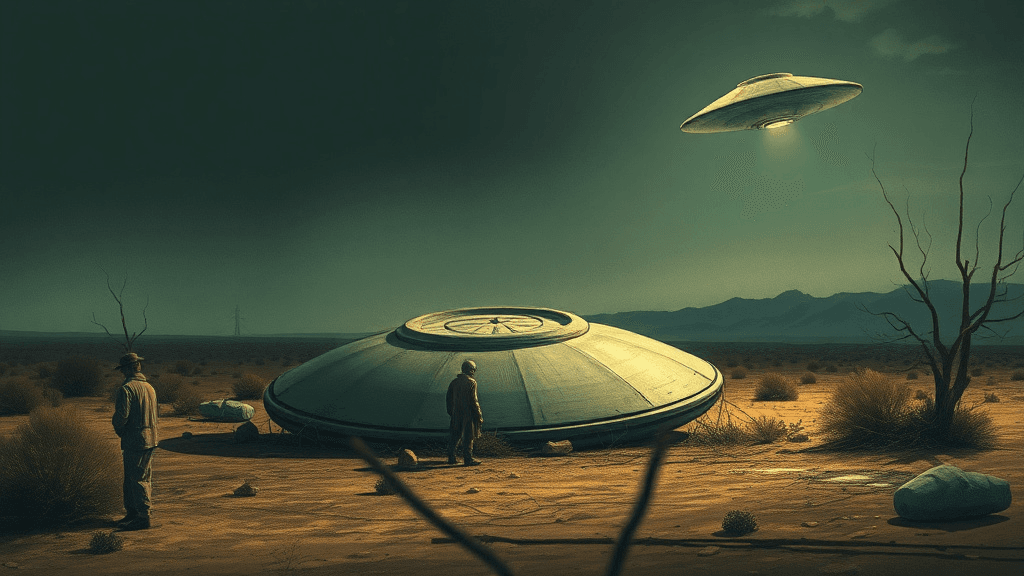
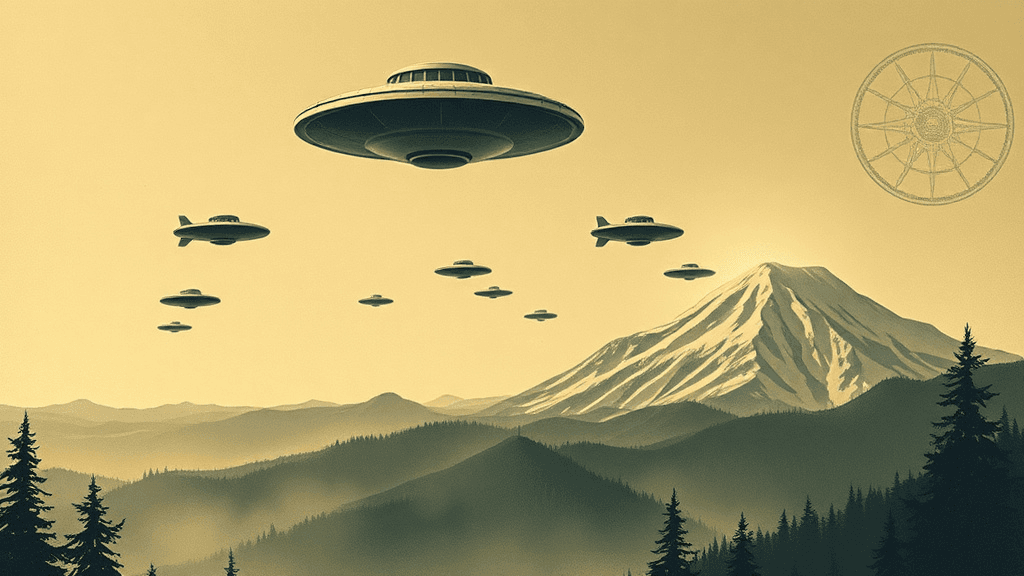
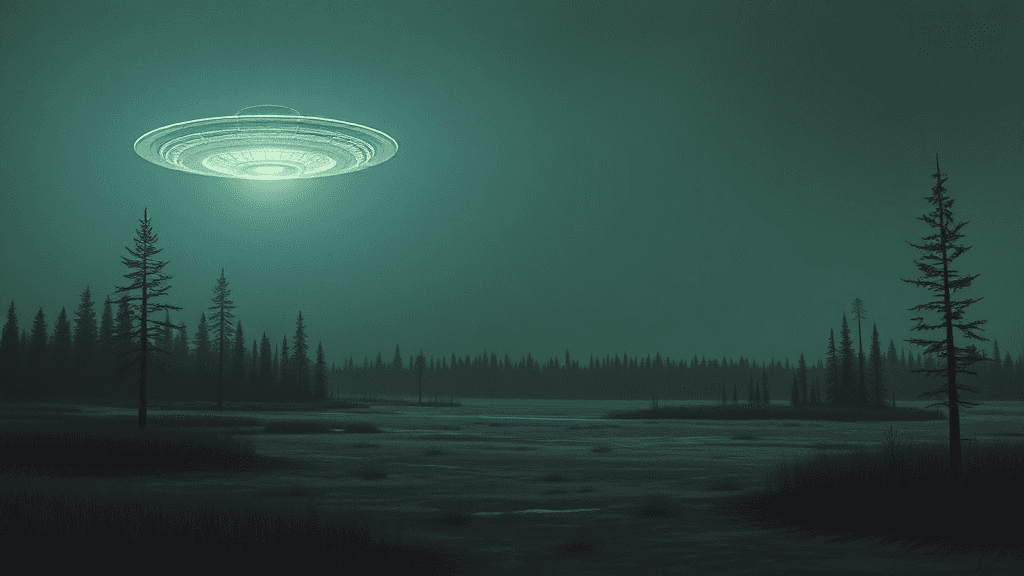
Around 12:15 p.m., Michalak noticed a pair of reddish, cigar-shaped objects descending toward a rocky outcrop not far from where he was working. One departed; the other settled and, according to Michalak, resolved from a featureless glow into a disc-shaped craft with a domed, silver-grey hull marked by a ring of small openings and an entryway with sliding panels. He estimated it at 30–50 feet across, hovering and then landing on the rock. As it cooled from red to a dull grey, panels along its side slid open, revealing an interior lit with shifting colored lights and a low humming, purple-tinged glow.
Curious rather than afraid, Michalak approached to within touching distance, sketching the object in his notebook as he went — sketches that later became key exhibits in the case file. He put on his welder's-style leather work gloves and reached toward what looked like an opening, later saying he wanted to see if the surface was truly as hot as it appeared. His fingertips melted against the glove almost instantly. Moments later, the panels snapped shut, the craft's orientation shifted, and a grid of exhaust vents released a blast of superheated gas that struck his chest. It ignited his shirt and undershirt and knocked him back; he tore the burning clothes off and threw them aside as the object rose, rotated, and departed at speed, leaving a scorched, roughly circular patch of cleared moss on the rock outcrop below.
Disoriented, nauseated, and in pain, Michalak made his way back to his car and drove himself into the town of Falcon Beach. Around 3 p.m. he reported the incident to Constable G.A. Solotki of the Falcon Beach Highway Patrol, describing being burned by a "spaceship." That evening he was treated for first-degree burns at Misericordia Health Centre in Winnipeg. Over the following days his condition worsened rather than improved: by May 23 he had lost 13 pounds, and reported nausea, vomiting, headaches, and strange metallic tastes and smells — symptoms consistent, in the eyes of sympathetic investigators, with some form of radiation or chemical exposure, though never definitively linked to one.
Investigation
What followed became, by most accounts, the most extensive UFO investigation in Canadian history, and it moved with unusual speed. On May 25–26, the RCMP and RCAF conducted aerial and ground searches of the reported site. Investigators interviewed staff at the Falcon Hotel, who told police Michalak had "consumed several beers" the previous evening — a detail skeptics would later seize on, and one that Michalak's defenders argued was irrelevant to burns with an unmistakably physical, patterned cause.
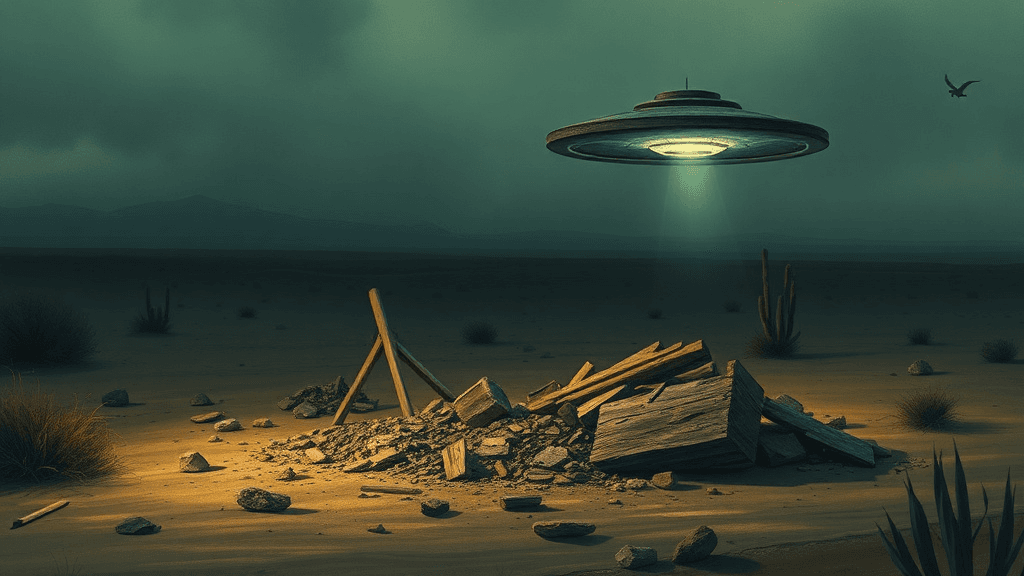
On June 26, Michalak returned to the site with a companion, Gerald Hart, and located what he believed was the exact landing spot: a roughly 15-foot circle where moss and lichen had been cleanly cleared from the underlying rock, in a pattern consistent with a blast of hot gas rather than fire or foot traffic. Soil samples he collected field-tested as "highly radioactive." Subsequent laboratory analysis by government scientists found only trace radioactivity confined to a rock crevice at the site — a level some investigators attributed to a natural radium-bearing vein in the local granite, or possibly to contamination from commercially available radium-based luminescent paint, of the kind then still used on watch dials and instrument panels. A small metallic fragment recovered from the area was analyzed by National Research Council astronomer Peter Millman, who found it roughly 95% silver with radioactivity comparable to a glow-in-the-dark wristwatch — and speculated it might have been dipped in pitchblende to fabricate a hoax artifact, though he stopped short of concluding that Michalak himself had planted it.
In October 1967, Roy Craig, a physical chemist working for the University of Colorado's federally funded UFO study — the Condon Committee — traveled to interview Michalak directly. The Committee's eventual, official classification of the case was "unexplained," with the pointed observation that if the encounter had occurred as described, it would constitute direct evidence of an alien craft operating in Earth's atmosphere — a rare admission from a body generally regarded as disposed toward mundane explanations. On November 6, 1967, Canada's Minister of National Defence, Léo Cadieux, announced that the government's own investigation file would not be released publicly, fueling early cover-up suspicions that persist in discussions of the case today.
The following January, in 1968, the press reported that Michalak's burns had "returned": photographs from that period show a grid of strikingly uniform, evenly spaced marks on his abdomen, visually distinct from the irregular first-degree burns documented in May 1967 — a distinction often blurred in popular retellings of the case. A psychiatric and dermatological review at the Mayo Clinic on August 6, 1968 concluded these 1968 marks were "obviously factitial" — that is, self-inflicted — while finding no evidence of significant mental illness in Michalak. This finding is frequently conflated in secondary sources with an earlier, separate psychiatric assessment of Michalak's general character, which described him as pragmatic and stable with no history of fabricating stories; the two evaluations concerned different things — his credibility as a person, and the specific authenticity of a later set of marks — and responsible retellings of the case keep them distinct.
The case for and against
The case's enduring reputation rests on a convergence of evidence types that rarely appear together: a physically documented injury with an unusual and specific pattern, an independently verifiable environmental trace at a precise location, elevated (if disputed) radiation readings, corroborating regional sightings, and a witness whose character was repeatedly vetted by police, physicians, and psychiatrists without turning up a motive or history of dishonesty. Michalak never altered the core details of his account across dozens of retellings over three decades, and during a 1990s filming session for Unsolved Mysteries, he disclosed to the crew — apparently for the first time on record — that he had survived Nazi concentration camps as a young man, a revelation that reportedly deepened the production team's assessment of him as a serious, non-sensational witness rather than someone seeking attention.
Against this stands a set of real inconsistencies. The Falcon Hotel's report of heavy drinking the night before, combined with the later-discredited 1968 burns, gave skeptics an opening to argue that the entire episode was constructed to explain an embarrassing accident, or — in a variant advanced by writers like Aaron Sakulich ("Iron Skeptic") and researcher John B. Alexander in the Journal of Scientific Exploration — to distract rival prospectors from a promising quartz claim. Sakulich and others have also pointed to discrepancies between Michalak's evolving public statements and Constable Solotki's original RCMP report. The radioactivity readings, often cited as the case's strongest physical evidence, are contested on both sides: proponents note that Michalak had no obvious way to fabricate a burn pattern of that geometric regularity, while skeptics note that natural radium deposits or contamination from radium paint offer plausible mundane sources, and that the site's radioactivity was never conclusively tied to any propulsion mechanism. No investigator — RCAF, RCMP, Blue Book, or the Condon Committee — ever produced a conventional explanation that accounted for the burns, the trace, and the radiation together, which is precisely why the case has remained open rather than closed as either confirmed or debunked.
Cultural impact
The Falcon Lake incident has been called "Canada's best-documented UFO case" by CBC News and "the world's most documented UFO sighting" by Atlas Obscura, claims that rest less on the case being conclusively proven than on the sheer density of official paperwork, physical evidence, and multi-agency involvement it generated relative to almost any other sighting on record. It has been the subject of a Journal of Scientific Exploration paper, museum exhibits, and the definitive book When They Appeared: Falcon Lake 1967 — The Inside Story of a Close Encounter, co-written by Michalak's son Stan Michalak and Manitoba ufologist Chris Rutkowski and launched on the incident's 50th anniversary in 2017.
In April 2018, the Royal Canadian Mint issued a $20, one-ounce pure silver commemorative coin — egg-shaped, glow-in-the-dark, and sold with an included black-light flashlight — depicting Michalak's encounter as part of its "Canada's Unexplained Phenomena" series; only 4,000 were struck. The case has also seeped into wider popular culture, inspiring folk musician Jim Bryson and the band The Weakerthans' 2010 concept album The Falcon Lake Incident, the 2013 film Rulers of Darkness, and a 1990s segment on Unsolved Mysteries.
Current status
Stefan Michalak died in 1999 at the age of 83, having maintained his account without variation to the end of his life; researcher Chris Rutkowski, who wrote his obituary, described him as "the witness in one of the most puzzling and well-documented CE2 cases on record." In 2019, the Michalak family donated the surviving case documents and Michalak's burned clothing to the University of Manitoba Archives, preserving the physical evidence for future examination. No government agency, Canadian or American, has ever issued a revised or closing statement altering the Condon Committee's 1969 classification of the case as unexplained. More than half a century on, Falcon Lake remains a fixture of Canadian UFO literature precisely because it resists easy sorting into either "hoax" or "proof" — a case built, unusually, almost entirely on physical and medical evidence rather than testimony alone, and one where that evidence still does not add up to a mundane explanation.
Witnesses
Stefan (Stephen/Steve) Michalak, primary and sole direct witness to the close encounter itself. No one else was present at the landing site, but multiple residents of the Falcon Lake / Whiteshell area independently reported unusual lights and an unidentified grey object in the sky around the same time on May 20, 1967, offering indirect corroboration.
Evidence
Physical traces: A roughly 15-foot-diameter circular patch of cleanly cleared moss and lichen on a flat granite outcrop at the reported landing site, confirmed by RCMP and RCAF searches. Medical evidence: A grid-patterned set of first-degree burns on Michalak's torso, photographed within days by APRO investigator J.B. Thompson and examined by more than a dozen physicians in Canada and the United States; distinct from a second, contested set of marks that appeared in January 1968 and was assessed by a Mayo Clinic panel as likely self-inflicted. Radiation: Soil samples field-tested as highly radioactive; later lab analysis found only trace radioactivity in a rock crevice at the site, variously attributed to a natural radium vein or contamination from radium-based luminescent paint. A small metallic fragment recovered nearby was found to be ~95% silver with slight radioactivity by NRC astronomer Peter Millman, who suggested possible hoaxing via pitchblende treatment. Documentary: RCMP incident reports, RCAF search records, Condon Committee (Roy Craig) interview notes, and a Canadian federal government investigation file that Defence Minister Léo Cadieux announced in November 1967 would not be released publicly. Artifacts: Michalak's burned shirt and undershirt, steel tape, and soil samples, later donated with the family's case files to the University of Manitoba Archives in 2019.
Filed under
Watch
Unsolved Mysteries with Robert Stack - Season 5, Episode 8 - Full Episode
The Falcon Lake Incident | Full Documentary
The Strange Case Of The Falcon Lake Incident
Falcon Lake Incident
UFO Mystery Unveiled | Falcon Lake | The Full Documentary Sci-Fi Movie | Free Movie
Where this entry came from
ProvenanceAgent indexedUpdated 3mo ago8 sources
Drafted by the archive's AI research agent from the sources below; corrections from readers are reviewed and folded in.
- First indexed
- 27 APR 26 // 08:24Z
- Last updated
- 08 AUG 26 // 04:45Z
- Falcon Lake Incident, Wikipedia Contributors, Wikipedia
- Falcon Lake incident is Canada's 'best-documented UFO case,' even 50 years later, CBC News, CBC News
- When They Appeared. Falcon Lake 1967: The Inside Story of a Close Encounter, Stan Michalak and Chris Rutkowski, Journal of Scientific Exploration
- UFOs at LAC: The Falcon Lake Incident, Library and Archives Canada, Library and Archives Canada
- UFOs at close sight: The Michalak close encounter, Falcon Lake, Canada, 1967 — Obituary, Chris Rutkowski, ufologie.patrickgross.org
- Mint's newest coin showcases famous Falcon Lake UFO encounter in Manitoba, CBC News, CBC News
- 1 oz. Pure Silver Glow-in-the-Dark Coin — Canada's Unexplained Phenomena: The Falcon Lake Incident, Royal Canadian Mint, Royal Canadian Mint
- RCMP report on the Falcon Lake incident, May 26, 1967, Royal Canadian Mounted Police, Library and Archives Canada
Notes
- Falcon Lake Incident, Wikipedia Contributors, Wikipedia
- Falcon Lake incident is Canada's 'best-documented UFO case,' even 50 years later, CBC News, CBC News
- When They Appeared. Falcon Lake 1967: The Inside Story of a Close Encounter, Stan Michalak and Chris Rutkowski, Journal of Scientific Exploration
- UFOs at LAC: The Falcon Lake Incident, Library and Archives Canada, Library and Archives Canada
- UFOs at close sight: The Michalak close encounter, Falcon Lake, Canada, 1967 — Obituary, Chris Rutkowski, ufologie.patrickgross.org
- Mint's newest coin showcases famous Falcon Lake UFO encounter in Manitoba, CBC News, CBC News
- 1 oz. Pure Silver Glow-in-the-Dark Coin — Canada's Unexplained Phenomena: The Falcon Lake Incident, Royal Canadian Mint, Royal Canadian Mint
- RCMP report on the Falcon Lake incident, May 26, 1967, Royal Canadian Mounted Police, Library and Archives Canada
Also available

The Falcon Lake Incident
A detailed investigation into Canada's best-documented UFO case from May 20, 1967, when Stefan Michalak encountered a landed craft and was burned by its exhaust vent in Whiteshell Provincial Park, Manitoba.
Unsolved Mysteries: The Falcon Lake UFO Incident
Episode from the classic NBC series documenting Stefan Michalak's 1967 close encounter at Falcon Lake with dramatic reenactments and interviews about Canada's most credible UFO case.
The Falcon Lake incident: Canada's famous UFO encounter in 1967
A documentary investigation of the Falcon Lake incident, featuring archive materials, expert analysis, and examination of the physical evidence and witness testimony from Canada's most documented UFO sighting.
Buying through these links supports the library. We may earn a commission.