The UFO Library: Military encounter
Gorman Dogfight
A 27-minute aerial pursuit between North Dakota Air National Guard pilot George F. Gorman and a luminous spherical object over Fargo, one of the three 'classic' UFO cases of 1948.
Background
By the autumn of 1948, the United States Air Force was barely a year old as an independent branch of the military, and its leadership was already grappling with an uncomfortable problem. Since Kenneth Arnold's landmark sighting in June 1947 and the Roswell incident that followed weeks later, reports of unidentified flying objects had been streaming into military channels at an unsettling rate. The Air Force had established Project Sign in January 1948 specifically to collect and evaluate these reports. By October of that year, Sign's investigators had already dealt with two deeply troubling cases: the Mantell incident of January 7, in which Kentucky Air National Guard pilot Captain Thomas Mantell died while pursuing an unidentified object, and the Chiles-Whitted encounter of July 24, in which two Eastern Air Lines pilots reported a near-collision with a rocket-shaped craft over Alabama. The third classic case of 1948 was about to unfold over the flatlands of North Dakota.
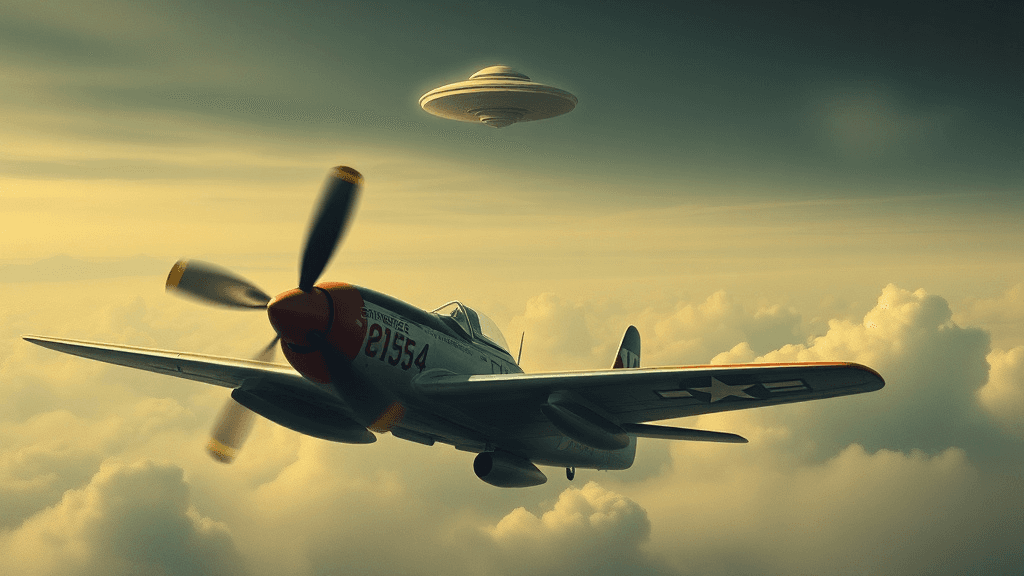
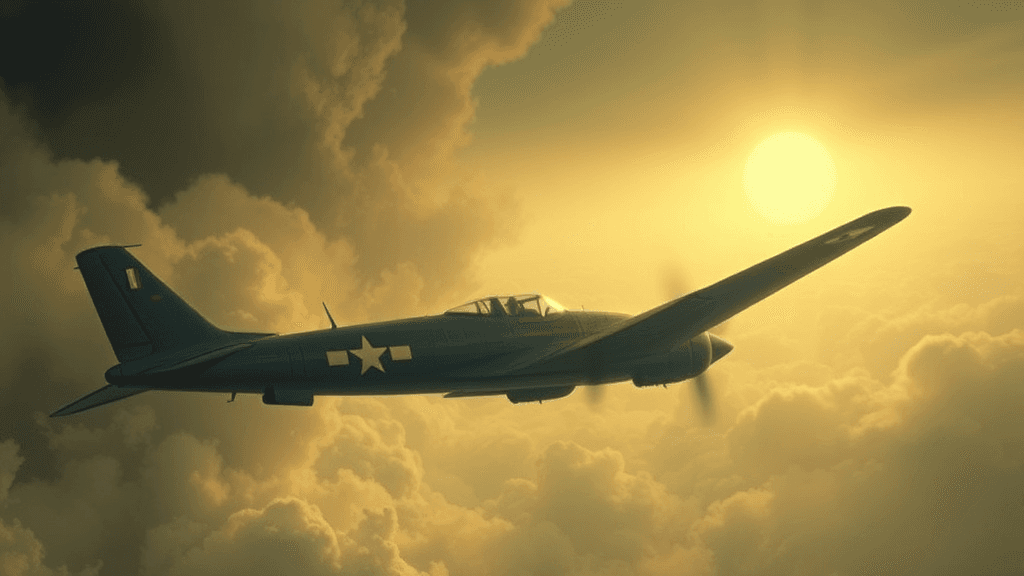
George F. Gorman was twenty-five years old, a veteran World War II fighter pilot who had served with distinction and returned home to manage a construction company in Fargo. He also held a commission as a second lieutenant in the North Dakota Air National Guard, flying P-51 Mustangs — the same nimble, powerful fighters that had helped win air superiority over Europe. On the evening of October 1, 1948, Gorman joined a group of Guard pilots on a routine cross-country training flight. When the formation returned to Hector Airport in Fargo around 8:30 PM, the other pilots landed, but Gorman decided to stay aloft and log some additional night-flying time. The sky was clear and dark, the air smooth. He had no reason to expect anything unusual.
Events
At approximately 9:00 PM, Gorman contacted the Hector Airport control tower to request landing clearance. The tower informed him that the only other traffic in the area was a Piper Cub flying below him. Gorman could see the Cub clearly about 500 feet beneath his Mustang. Then, to the west, he spotted what appeared to be the taillight of another aircraft — a sharply defined, brilliantly white light moving fast against the dark sky.
Gorman radioed the tower to ask about additional traffic. The controllers — Lloyd D. Jensen and H.E. Johnson — confirmed they had no other aircraft on their scopes or in their logs. Gorman decided to close in and investigate. What followed was one of the most dramatic aerial encounters in UFO history.
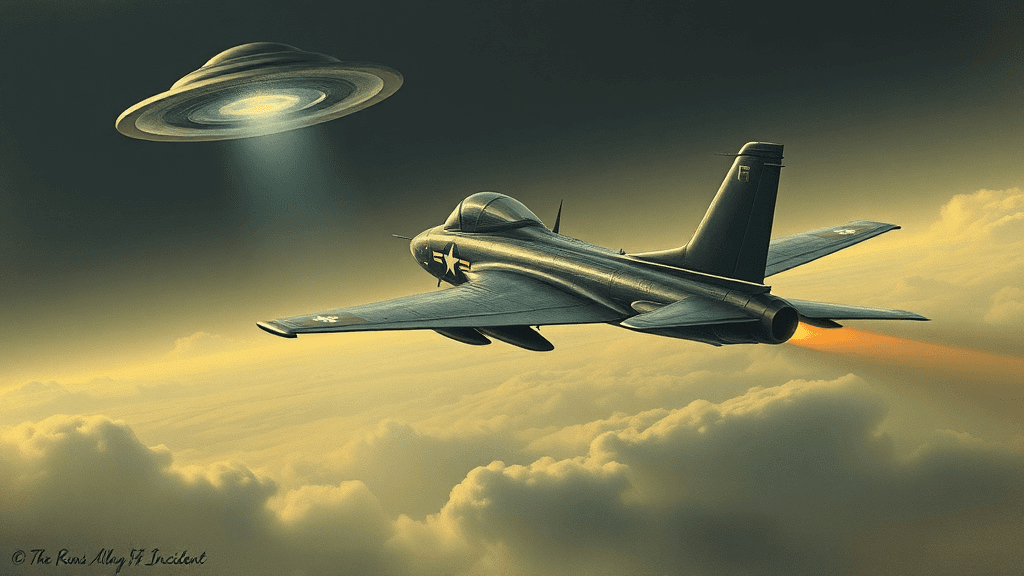
As Gorman turned his P-51 toward the light and pushed the throttle forward, the object accelerated away from him. He described it as a perfectly round ball of light, approximately six to eight inches in diameter, intensely white, with sharply defined edges and no visible trail, exhaust, or structural form — no wings, no fuselage, nothing resembling any aircraft he had ever seen. It was not a navigational light or a beacon. It was, as far as Gorman could tell, simply a sphere of controlled, purposeful luminescence.
For the next twenty-seven minutes, Gorman engaged in what can only be described as a dogfight. The light made a sharp turn and came directly toward his aircraft on what appeared to be a collision course. Gorman braced for impact, but at the last moment the object veered and passed over his canopy with only feet to spare. He banked hard and gave chase. The object climbed; Gorman climbed after it. The light reversed course; Gorman reversed. The two traced a series of tight, looping arcs across the sky above Fargo and then southwest of the city, covering a range of roughly twenty-five miles.
Gorman pushed his Mustang to its limits. At times he estimated his airspeed at over 400 miles per hour, yet the object pulled away effortlessly, accelerating to what he believed was 600 mph or more. When Gorman attempted tight turns to match the object's maneuvers, the G-forces caused him to momentarily black out. The object, whatever it was, appeared to execute instantaneous changes of direction with no visible arc, no deceleration, and no banking — movements that would have destroyed any known aircraft and killed any human pilot.
At one point, Gorman found himself at 14,000 feet, looking down at the object at approximately 11,000 feet. He rolled into a full-power dive, hoping to close the distance from above. The object responded with a sudden vertical climb that carried it effortlessly past Gorman's altitude and out of reach. He pulled up and tried to follow, but his P-51 stalled at approximately 14,000 feet while the object continued to ascend.
The chase ended at 9:27 PM when the light made a final steep climb and vanished from sight. Gorman, physically exhausted and shaken, turned back toward Hector Airport. His commanding officer, Major D.C. Jones, noted that Gorman had extreme difficulty landing — nearly crashing from what Jones described as nervous exhaustion. Gorman had flown fighters in wartime, but this encounter had rattled him in a way combat apparently had not.
Witnesses
Gorman was not the only observer. From the cockpit of the Piper Cub, Dr. A.E. Cannon — an optician — and his passenger, Einar Nielson, had watched the entire spectacle. Dr. Cannon described the light as moving "far faster than any aircraft" he had ever observed, with movements that suggested intelligent control. He confirmed the object was a distinct, self-luminous sphere, not a reflection or atmospheric phenomenon.
In the Hector Airport control tower, Lloyd D. Jensen and H.E. Johnson tracked the encounter through binoculars. Both men confirmed seeing the luminous object and the P-51 Mustang maneuvering in relation to it. They described the light as having sharply defined edges and a brilliant white intensity. Notably, the tower's radar showed no return from the object — a detail that both strengthened and complicated the case, depending on one's interpretive framework.
Investigation
Project Sign investigators arrived at Hector Airport within hours of the incident. They interviewed Gorman, Dr. Cannon, Nielson, the tower controllers, and Major Jones. They also examined Gorman's P-51 Mustang with Geiger counters. The results were startling: Gorman's aircraft registered significantly higher radioactivity than other P-51s in the Guard's inventory that had not flown recently. Some investigators took this as evidence that Gorman had flown in close proximity to an object powered by atomic energy — a hypothesis that was taken seriously within Project Sign's classified "Estimate of the Situation," a top-secret document that reportedly concluded UFOs were extraterrestrial in origin. The estimate was rejected and ordered destroyed by Air Force Chief of Staff General Hoyt Vandenberg.
On October 23, 1948, Gorman provided a sworn affidavit to investigators. His statement remains one of the most compelling pilot testimonies in UFO literature:
"I am convinced that there was definite thought behind its maneuvers. I am further convinced that the object was governed by the laws of inertia because its acceleration was rapid but not immediate and although it was able to turn fairly tight at considerable speed, it still followed a natural curve. When I attempted to turn with the object I blacked out temporarily due to excessive speed. I am in fairly good physical condition and I do not believe that there are many if any pilots who could withstand the turn and speed effected by the object, and remain conscious. The object was not only able to out turn and out speed my aircraft ... but was able to attain a far steeper climb and was able to maintain a constant rate of climb far in excess of my aircraft."
Gorman also reported that Air Materiel Command classified all information about the encounter as Secret, and that he was warned he could face court-martial if he discussed it publicly.
The case for
Several factors make the Gorman Dogfight a compelling case. First, the primary witness was a trained military aviator with combat experience — not a casual observer prone to misidentification. Gorman knew what aircraft looked like at night, understood aerial dynamics, and could estimate speed and altitude with professional accuracy. Second, multiple independent witnesses — from different vantage points on the ground and in the air — corroborated his account. Dr. Cannon, an educated professional with no obvious motive to fabricate, confirmed the object's extraordinary speed and apparent intelligent control. Third, the anomalous Geiger counter readings on Gorman's aircraft, while not conclusive, added a physical-evidence dimension that pure visual sightings lack.
The duration of the encounter — twenty-seven minutes of sustained observation and interaction — also distinguishes it from fleeting sightings. Gorman had ample time to study the object under controlled conditions, at varying distances and angles, while actively testing its capabilities against his own aircraft. His sworn testimony is measured and specific, noting that the object obeyed inertia (arguing against hallucination or optical illusion) while exceeding any known aircraft's performance.
Edward Ruppelt, who later directed Project Blue Book, designated the Gorman Dogfight as one of the three "classic" UFO cases of 1948 in his 1956 book The Report on Unidentified Flying Objects. Researchers Donald Keyhoe and James E. McDonald both regarded the case as genuinely unexplained and cited it as evidence of structured, intelligently controlled craft operating in American airspace.
The case against
The official explanation, settled upon by early 1949, was prosaic: a lighted weather balloon. The Air Weather Service confirmed that a lighted balloon had been launched from Fargo at 8:50 PM on October 1 — roughly ten minutes before Gorman first spotted the object. Project Sign investigators suggested that Gorman initially pursued the balloon, and that after it drifted out of visual range, he became disoriented and began chasing the planet Jupiter, which was visible low in the southwestern sky.
This explanation has significant problems. Weather balloons of the era drifted at wind speed — typically well under 50 mph — and could not accelerate, execute sharp turns, or climb vertically on command. The object Gorman described exceeded 600 mph and performed maneuvers that would have been impossible for any balloon. The Jupiter hypothesis, advanced by astronomer Donald Menzel in his debunking work Flying Saucers (1953), is also problematic: Jupiter was near the southwestern horizon during the encounter, and ground witnesses confirmed the object's rapid, purposeful movement — behavior inconsistent with a stationary celestial body.
The elevated Geiger counter readings were later attributed to normal cosmic radiation exposure at high altitude, a plausible explanation given that the comparison aircraft had not flown recently and would have had lower baseline readings. This remains the strongest element of the skeptical case.
Skeptics also note the lack of radar confirmation from the tower, suggesting the object may have been smaller and closer than Gorman believed — potentially a lit balloon at closer range, with its apparent speed exaggerated by Gorman's own high-velocity maneuvering. Pilot disorientation during night flying is a documented phenomenon, and the adrenaline of pursuit could have amplified perceptual errors.
Cultural impact
The Gorman Dogfight became one of the most widely reported UFO cases of the late 1940s. It received extensive coverage in newspapers across the country and was featured prominently in a landmark April 7, 1952 LIFE magazine article titled "Have We Visitors from Space?" — a piece that helped legitimize serious discussion of UFOs in mainstream American culture. The article noted that the Air Force acknowledged many sightings "still defy explanation" and highlighted the Gorman case as particularly significant evidence.
The case also played an important role in the internal politics of the Air Force's UFO investigation programs. It was one of the cases that contributed to Project Sign's classified "Estimate of the Situation" — the document arguing for an extraterrestrial hypothesis that General Vandenberg rejected. The Gorman case thus sits at a pivotal moment in the history of official UFO secrecy: the point where the Air Force chose to move from genuine investigation toward the more dismissive stance of Project Grudge and, eventually, the often-criticized Project Blue Book.
Donald Keyhoe cited the Gorman Dogfight extensively in his influential 1950 book The Flying Saucers Are Real, one of the first books to argue that UFOs were extraterrestrial spacecraft and that the government was covering up the evidence. The case became a touchstone for the military-pilot-witness category of UFO reports — encounters that carried particular weight because the observers were trained aviation professionals whose credibility was difficult to dismiss.
Current status
The Gorman Dogfight remains officially classified as "explained" in Project Blue Book records — attributed to a weather balloon and Jupiter. Few serious researchers accept this explanation without reservation. The case continues to appear in UFO literature and documentaries as a foundational example of a military pilot encounter with an unknown aerial object.
George Gorman himself declined all public interviews about the incident for the rest of his life, including turning down LIFE magazine's request for a feature story. He retired from the Air National Guard as a lieutenant colonel in 1969 and died in 1982. Friends and family reported that he privately remained convinced the object he pursued that night was under intelligent control, and he never accepted the weather balloon explanation.
In the context of the modern UAP disclosure movement, the Gorman Dogfight resonates as an early precursor to cases like the USS Nimitz "Tic Tac" encounter of 2004 — another instance of a military pilot engaging an object that dramatically outperformed his aircraft. The pattern of official dismissal followed by persistent doubt is one that has repeated across seven decades of UFO history, and the Gorman case is where much of that pattern began to crystallize.
Witnesses
- George F. Gorman — Second Lieutenant, North Dakota Air National Guard; P-51 Mustang pilot and primary witness. WWII veteran fighter pilot, age 25 at the time.
- Dr. A.E. Cannon — Optician, piloting a Piper Cub over Fargo; observed the luminous object and confirmed its extraordinary speed and apparent intelligent control.
- Einar Nielson — Passenger aboard Dr. Cannon's Piper Cub; corroborated Cannon's observations.
- Lloyd D. Jensen — Hector Airport control tower operator; observed the object through binoculars.
- H.E. Johnson — Hector Airport control tower operator; also observed the object through binoculars.
- Major D.C. Jones — Gorman's commanding officer; witnessed Gorman's difficulty landing due to nervous exhaustion.
Evidence
- Pilot testimony under oath: Gorman provided a sworn affidavit on October 23, 1948, describing the object's maneuvers in precise aviation terminology.
- Multiple independent witnesses: Four additional observers from separate vantage points (Piper Cub cockpit and airport control tower) corroborated the sighting.
- Geiger counter readings: Gorman's P-51 Mustang registered elevated radioactivity compared to other aircraft that had not recently flown, though this was later attributed to cosmic radiation at altitude.
- No radar return: The Hector Airport control tower detected no radar signature from the object.
- Project Sign investigation files: Declassified Air Force records document the investigation and witness interviews.
- No physical debris or photographic evidence was recovered.
Filed under
Watch
The Gorman UFO Incident of 1948 - Forgotten History
Project Blue Book: Declassified - The Gorman Dogfight | History
Global Air Force UFO Encounters You've Probably Never Heard of
Where this entry came from
ProvenanceAgent indexedUpdated 6mo ago8 sources
Drafted by the archive's AI research agent from the sources below; corrections from readers are reviewed and folded in.
- First indexed
- 27 APR 26 // 18:23Z
- Last updated
- 27 APR 26 // 18:23Z
- Gorman dogfight, Wikipedia
- Gorman Dogfight, Prairie Public Broadcasting
- Gorman Dogfight, The UFO Database
- THE GORMAN DOGFIGHT: Did This Fighter Pilot Chase a UFO Over the Skies of Fargo?, Weird Darkness
- The Report on Unidentified Flying Objects, Edward J. Ruppelt, Internet Archive
- F-51s vs UFOs, Vintage Aviation News
- The Gorman Dogfight - Fargo, North Dakota, UFO Evidence
- Pilot dueled with unknown object over Fargo, Curt Eriksmoen, Bismarck Tribune
Notes
- Gorman dogfight, Wikipedia
- Gorman Dogfight, Prairie Public Broadcasting
- Gorman Dogfight, The UFO Database
- THE GORMAN DOGFIGHT: Did This Fighter Pilot Chase a UFO Over the Skies of Fargo?, Weird Darkness
- The Report on Unidentified Flying Objects, Edward J. Ruppelt, Internet Archive
- F-51s vs UFOs, Vintage Aviation News
- The Gorman Dogfight - Fargo, North Dakota, UFO Evidence
- Pilot dueled with unknown object over Fargo, Curt Eriksmoen, Bismarck Tribune
Also available
The Phenomenon
Comprehensive investigation of unidentified aerial phenomenon from World War II through recent times, featuring testimony from high-ranking government officials and NASA astronauts. Covers landmark cases including early post-war incidents.
Out of the Blue
Award-winning investigation into UFO phenomenon through interviews with military, government, and scientific witnesses. Examines whether some UFOs could be of extraterrestrial origin and explores government secrecy surrounding the issue.
UFOs: It Has Begun
Exploration of UFO sightings in America narrated by Rod Serling. Re-release of the 1974 documentary UFOs: Past, Present, and Future. Covers landmark post-war incidents including the 1948 Mantell case and early Cold War-era encounters.
Project Blue Book: Declassified
Series. History Channel docuseries examining declassified UFO cases investigated by the U.S. Air Force Project Blue Book program. Features episode on the 1948 Gorman Dogfight and other landmark incidents.
Buying through these links supports the library. We may earn a commission.