The UFO Library: Radar and visual
RB-47 Radar-Visual Encounter
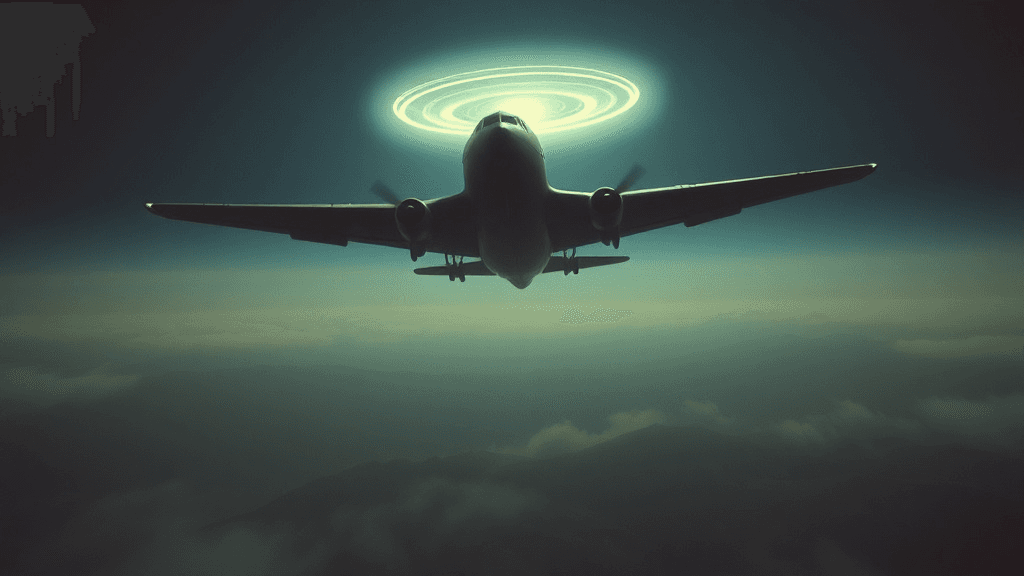
A USAF RB-47H electronic reconnaissance aircraft was tracked and paced by an unidentified luminous object for over 700 miles and 1.5 hours, with the object simultaneously detected visually, on airborne ECM equipment, and by ground radar.
Background
In the early morning hours of July 17, 1957, one of the most thoroughly documented radar-visual UFO encounters in history unfolded across the skies of the American South. The case is remarkable not merely because six trained military officers observed an anomalous object, but because the encounter was simultaneously registered on three physically independent detection systems: the human eye, sophisticated airborne electronic countermeasures (ECM) equipment, and ground-based radar. This convergence of evidence across multiple channels — and, crucially, the synchronous appearances and disappearances of the object on all three — has made the RB-47 case a touchstone in serious UFO research for nearly seven decades.
The aircraft at the center of the encounter was a Boeing RB-47H Stratojet, the electronic reconnaissance variant of the Air Force's first all-jet operational bomber. Powered by six General Electric J-47 turbojet engines and capable of speeds up to 600 mph, the RB-47H was the backbone of the Strategic Air Command's electronic intelligence (ELINT) fleet in the 1950s. These aircraft routinely flew missions along the borders of the Soviet Union, North Korea, and China, their crews trained to detect, identify, and analyze hostile radar emissions. The crew aboard the aircraft that morning was not a group of casual observers — they were specialists in electromagnetic signals.
The six officers were assigned to the 55th Strategic Reconnaissance Wing, based at Forbes Air Force Base in Topeka, Kansas. They were flying a training and test exercise that included gunnery drills over the Texas-Gulf area, navigation exercises over the open Gulf of Mexico, and ECM exercises on the return leg across the south-central United States. The crew was preparing for reassignment to Germany and was intimately familiar with their equipment and the electromagnetic environment of the American South.
The Crew
The six men aboard the RB-47H that morning were:
- Major Lewis D. Chase — Pilot, from Spokane, Washington. An experienced Strategic Air Command aviator, Chase would serve as the primary visual witness alongside McCoid.
- Captain James H. McCoid — Copilot, stationed at Offutt AFB. McCoid corroborated Chase's visual observations throughout the encounter.
- Captain Thomas H. Hanley — Navigator, from Vandenberg AFB. Hanley attempted to detect the object on the aircraft's K-system navigational radar but was unable to acquire a return, an observation that itself carried evidential significance.
- Captain John J. Provenzano — No. 1 ECM monitor, from Wichita, Kansas. Provenzano confirmed the anomalous signal on his APD-4 direction-finding system.
- Captain Frank B. McClure — No. 2 ECM monitor, stationed at Offutt AFB. McClure was the first to detect the anomalous electronic signal and tracked it throughout the encounter using the ALA-6 direction finder.
- Captain Walter A. Tuchscherer — No. 3 ECM monitor, from Topeka, Kansas. Tuchscherer's equipment operated on frequencies outside the range of the detected signal.
Events
The encounter unfolded in several distinct phases over a period of approximately ninety minutes and a distance exceeding 700 miles.
Phase 1: The Orbiting Signal (before 4:00 AM CST)
As the RB-47 flew near Gulfport, Mississippi, over the Gulf of Mexico, Captain McClure detected an anomalous airborne signal on his No. 2 ECM monitor at a frequency of approximately 2,800 megacycles. The signal appeared to originate from a point over the Gulf. McClure initially suspected a 180-degree error in his scope alignment — a common enough equipment glitch. But as he watched, the signal traced a complete circular path around the aircraft at a rate consistent with a source moving at roughly 500 mph. No ground-based radar could produce such a pattern; the signal was behaving as though it emanated from an object that was physically orbiting their aircraft.
Phase 2: Visual Contact Over Louisiana (~4:10 AM CST)
As the RB-47 crossed over Winnsboro, Louisiana, Major Chase spotted an intensely brilliant white light approaching rapidly from the left. The light crossed the aircraft's nose at extreme speed, moving from left to right, and blinked out as it reached a position to the right-front of the aircraft. Captain McCoid also observed the light. At this point, the crew had no reason to connect the visual sighting with the earlier electronic anomaly.
Phase 3: Three-Channel Correlation (~4:30 AM CST)
McClure, who had reset his No. 2 monitor to 3,000 megacycles, picked up a strong signal at precisely the bearing where Chase had observed the light. Captain Provenzano independently confirmed the signal on his No. 1 monitor using the wing-tip APD-4 direction-finding antennas. Both operators verified their equipment calibration against known ground radar stations. The signal maintained a constant position relative to the aircraft — a characteristic incompatible with any fixed ground source, since the RB-47 was moving at roughly 500 mph.
Phase 4: Duncanville Radar Confirmation (~4:39–4:48 AM CST)
As the RB-47 approached the Dallas-Fort Worth area at 34,500 feet, Chase spotted a massive luminous object approximately 5,000 feet below the aircraft. He reported visual contact and noted two signals at bearings of 40 and 70 degrees; both Chase and McCoid observed red lights at those positions. McClure confirmed dual signals at the same bearings.
Chase contacted Radar Station Utah, a Ground Controlled Intercept (GCI) facility located at Duncanville, Texas, near Dallas, and requested permission to abandon his flight plan to pursue the object. Permission was granted. At 4:48 AM, the Duncanville operators confirmed that their ground radar was detecting an object at precisely the location McClure had reported from his airborne ECM equipment. The object was registering as "skin paint" — a direct radar reflection from a physical object — not an IFF transponder return.
Phase 5: The Synchronized Vanishing (~4:52 AM CST)
What happened next constitutes the most scientifically significant aspect of the entire encounter. The object appeared to stop in mid-air. As the RB-47 closed the distance, it overshot the target. At that moment, the object blinked out — and it did so simultaneously on all three detection channels. It vanished from Chase and McCoid's direct visual observation, from McClure's ECM scope, and from the Duncanville ground radar, all at the same instant.
Chase threw the RB-47 into a port turn. Almost immediately, the object reappeared — again simultaneously on all three channels — at its original position. The crew began closing to within five miles.
Then the object executed a rapid descent to approximately 15,000 feet and vanished once more from all detection systems.
Phase 6: Final Contact and Departure (~4:55–5:00 AM CST)
At 4:55 AM, Chase radioed Duncanville that the RB-47 was running low on fuel and must abandon the pursuit. The aircraft returned to its scheduled flight plan. But at approximately 4:57 AM, McClure reacquired the signal, and Chase made visual contact again. The object was now trailing the RB-47 from the rear as the aircraft entered Oklahoma airspace. The signal gradually faded as they approached Oklahoma City, and contact was lost permanently.
Investigation
Project Blue Book
The case received minimal attention from Project Blue Book, the Air Force's official UFO investigation program. Blue Book's explanation attributed the sighting to civilian airliners, specifically American Airlines Flights 966 and 655. As investigators later pointed out, those flights were operating more than 1,000 kilometers from the RB-47's position. No evidence was found that a formal report on the event ever reached Project Blue Book through normal channels, likely because the crew was reassigned to Europe shortly after the incident.
The Condon Report (Case 5)
The encounter was included as Case 5 in the University of Colorado UFO Project, commonly known as the Condon Report, published in 1969. Gordon David Thayer, a physicist and radar specialist working on the project, conducted the analysis. Thayer explored the possibility of anomalous radar wave propagation and optical mirage effects but found these explanations inadequate. He suggested that the object at 30,000–35,000 feet "may have been a combined radio-optical mirage of another aircraft" and that the GCI radar returns might have been anomalous propagation echoes, but conceded that "there are many unexplained aspects to this sighting" and that such a solution, "although possible, does not seem highly probable." Thayer famously described the Blue Book airliner explanation as "literally ridiculous."
Critically, the Condon Report omitted the initial Gulfport orbiting incident, failed to emphasize the 700-mile pursuit duration, and did not clearly present the sequence of synchronized three-channel appearances and disappearances. Despite the case being classified as unexplained within the report's body, Dr. Edward Condon did not address it in his summary conclusions — an omission that drew sharp criticism from subsequent researchers.
James McDonald's Investigation
James E. McDonald, Professor of Atmospheric Sciences at the University of Arizona and one of the most rigorous scientific investigators of UFO reports, conducted his own independent examination of the case. McDonald personally interviewed all six crew members and presented his findings at a symposium of the American Association for the Advancement of Science in Boston in December 1969.
McDonald corrected a significant error in the historical record: the date had been misrecorded as September rather than July, which had prevented earlier investigators from locating the case file. He concluded that the RB-47 encounter represented "a well-reported, multi-channel, multiple-witness UFO report" in which "observer credibility and reliability were not in question." McDonald argued that the phenomena "appeared to defy explanation through either natural or technological phenomena" and that the case demanded "the most intensive scientific study." He published his detailed analysis in Flying Saucer Review in 1970 and presented a summary in the Aeronautics and Astronautics journal of the American Institute of Aeronautics and Astronautics.
The Case For
The RB-47 encounter possesses several characteristics that elevate it above the vast majority of UFO reports:
Multi-channel detection. The object was detected visually, on airborne ECM equipment, and by ground-based radar — three physically distinct detection methods operating on different principles. The probability of all three systems simultaneously producing false positives is extraordinarily low.
Synchronized behavior. The object appeared and disappeared simultaneously on all three channels on multiple occasions. This correlation is extremely difficult to explain through any combination of unrelated conventional phenomena (atmospheric effects, equipment malfunction, misidentified aircraft).
Witness credibility. The six officers were trained ELINT specialists whose professional duties required them to accurately identify and characterize electromagnetic signals. They were not prone to misidentifying radar emissions.
Duration and distance. The encounter lasted approximately ninety minutes and covered over 700 miles, ruling out brief atmospheric phenomena such as meteors, ball lightning, or temperature inversions.
Ground radar confirmation. The Duncanville GCI station independently detected the object as a physical "skin paint" return at the precise location reported by the airborne crew.
Signal anomalies. McClure noted that the 2,800-megacycle signal was so powerful that its source "would have had an antenna bigger than a bomber to put out that much signal." The signal had characteristics similar to a CPS-6B radar system (normal pulse repetition frequency and pulse width), yet its behavior — orbiting the aircraft, maintaining station relative to a moving platform — was incompatible with any known ground-based or airborne radar.
The Case Against
Skeptical analysts have offered several alternative explanations:
Philip Klass's composite theory. Aviation journalist and prominent UFO skeptic Philip Klass proposed that the encounter was a confluence of unrelated events: anomalous radar wave propagation for the electronic tracks, a bright meteor or fireball for the initial visual sighting, the star Vega for subsequent visual observations, and American Airlines aircraft for remaining sightings. Critics, notably aeronautics specialist Brad Sparks, challenged this interpretation point by point, arguing it was "based on the erroneous interpretation of the data and overall nonsensical."
The Keesler Air Force Base radar hypothesis. Klass also suggested that McClure's ECM equipment may have picked up signals from a training radar at Keesler Air Force Base in Biloxi, Mississippi. Researcher Tim Printy investigated military training schedules and found that Keesler was operating at "maximum training capacity in July, 1957" with classes scheduled between midnight and 6 AM — potentially supporting Klass's hypothesis for the initial signal detection near Gulfport. Printy also noted the suspicious coincidence that the detected signal operated on a frequency characteristic of U.S. Air Force radar.
Atmospheric propagation. Thayer's own cautious suggestion of anomalous propagation was offered as a possible but improbable explanation. Atmospheric ducting can cause radar signals to travel far beyond their normal range, but it cannot easily account for visual observations or for the precise synchronization of appearances and disappearances across multiple systems.
The navigator's non-detection. Captain Hanley's K-system navigational radar failed to detect the object, despite its capability to track a KC-97 tanker at four miles. This non-detection implied either that the object's radar cross-section was extremely small at the K-system's operating frequency, or that the visual and ECM targets were not a single solid object. Skeptics have cited this as evidence against a physical craft, while proponents argue it merely indicates the object had unusual electromagnetic properties.
Cultural Impact
The RB-47 case has occupied a distinctive position in UFO literature since McDonald brought it to wide attention in the late 1960s. It is frequently cited alongside the Tehran UFO incident of 1976 and the Belgian UFO wave as one of the strongest radar-visual cases on record. Its strength lies not in dramatic narrative — there were no close encounters, no alien beings, no physical traces — but in the austere convergence of instrumental data.
The case has appeared in virtually every serious survey of UFO evidence, including Richard Hall's The UFO Evidence, Volume II (2000), Jerome Clark's The UFO Encyclopedia (1998), and Leslie Kean's UFOs: Generals, Pilots, and Government Officials Go on the Record (2010). McDonald's investigation of the RB-47 case became a model for how rigorous scientific methodology could be applied to UFO reports — and his frustration with the Condon Committee's handling of it became emblematic of the broader conflict between serious investigators and the institutional dismissal of the UFO subject.
The case also played a role in the debate over the Condon Report itself. Critics pointed to Case 5 as a prime example of the report's internal contradictions: here was a case that the report's own analyst classified as unexplained, involving multiple forms of instrumental evidence, yet it was never addressed in Condon's dismissive summary. This disconnect fueled the argument — advanced by McDonald, J. Allen Hynek, and others — that the Condon Committee had been less a scientific investigation than a predetermined exercise in closure.
Current Status
The RB-47 encounter remains classified as unexplained by every official body that has examined it. No conventional explanation has satisfactorily accounted for the simultaneous, correlated detection of the object across visual, electronic, and ground-radar channels. The case file, including the original Blue Book documents, is available through the Black Vault and the National Archives.
In the context of the post-2017 UAP disclosure era, the RB-47 case has gained renewed relevance as a historical precedent for the kind of multi-sensor military encounters that have driven contemporary congressional interest. The emphasis placed by the All-domain Anomaly Resolution Office (AARO) on cases involving multiple sensor modalities directly echoes the evidential structure of the RB-47 encounter. If there is a gold standard for Cold War-era radar-visual UFO cases, this is it.
Witnesses
- Major Lewis D. Chase — Pilot. Observed the luminous object visually on multiple occasions; described it as "bigger than a house" and a "bright red glow." Directed pursuit and communicated with ground radar.
- Captain James H. McCoid — Copilot. Corroborated Chase's visual observations of both the white light over Louisiana and the red lights near Dallas.
- Captain Thomas H. Hanley — Navigator. Attempted to detect the object on K-system navigational radar but was unable to acquire a return.
- Captain John J. Provenzano — No. 1 ECM monitor. Independently confirmed the anomalous signal on his APD-4 direction-finding system.
- Captain Frank B. McClure — No. 2 ECM monitor. First to detect the 2,800 MHz signal; tracked it throughout the encounter on ALA-6 direction finder.
- Captain Walter A. Tuchscherer — No. 3 ECM monitor. His equipment operated on frequencies outside the signal's range.
- Duncanville GCI operators — Ground radar personnel at Radar Station Utah who independently confirmed the object's position as "skin paint."
Evidence
- Airborne ECM detection: The ALA-6 direction finder (No. 2 monitor) and APD-4 direction-finding system (No. 1 monitor) both independently tracked a powerful 2,800 MHz signal that maintained position relative to the moving aircraft — behavior incompatible with any ground-based source.
- Ground radar confirmation: The Duncanville, Texas GCI station (Radar Station Utah) detected the object as a physical "skin paint" return at precisely the position reported by the airborne crew.
- Synchronized appearances/disappearances: The object vanished and reappeared simultaneously on all three detection channels (visual, airborne ECM, ground radar) on multiple occasions — an extraordinarily unlikely coincidence if the detections were unrelated.
- Signal characteristics: The 2,800 MHz signal exhibited normal pulse repetition frequency and pulse width similar to CPS-6B radar systems but at abnormally high intensity, leading McClure to estimate the source would require "an antenna bigger than a bomber."
- Navigator's non-detection: The K-system navigational radar failed to acquire the target, suggesting unusual electromagnetic properties at its operating frequency.
- Project Blue Book file: Original case documents preserved in National Archives and available via the Black Vault.
- Condon Report (Case 5): Classified as unexplained by the University of Colorado UFO Project.
Filed under
Watch
Secret UFO Signal Detected! : The Rb-47 UFO
Best Evidence - RB47 case
Cynthia Witthoft - Visitors from Outer Space
Fall Asleep to UFO & Alien Stories: Episode 11 — The Evidence That Changed UFO History
Where this entry came from
ProvenanceAgent indexedUpdated 6mo ago8 sources
Drafted by the archive's AI research agent from the sources below; corrections from readers are reviewed and folded in.
- First indexed
- 27 APR 26 // 12:22Z
- Last updated
- 27 APR 26 // 12:22Z
- Condon Report, Case 5: B-47 Crew, Radar/Visual Sighting, Gordon David Thayer, University of Colorado UFO Project (Condon Report)
- The 1957 Gulf Coast RB-47 Incident, James E. McDonald, Flying Saucer Review
- Project Blue Book — RB-47, July 17, 1957, U.S. Air Force, The Black Vault / National Archives
- Science in Default: Twenty-Two Years of Inadequate UFO Investigations, James E. McDonald, Aeronautics and Astronautics (AIAA)
- RB-47 Radar Visual Multiple Witnesses Case, July 17, 1957, Patrick Gross, UFOs at Close Sight
- The RB-47 Incident: Mystery at 2800 Megacycles, Micah Hanks, The Debrief
- The RB-47 Encounter of 1957 — UFOlogy's Best Evidence?, Robert Sheaffer, Bad UFOs
- The RB-47 Radar-Electronic Intelligence (ECM) UFO Incident (1957), James E. McDonald, Academia.edu
Notes
- Condon Report, Case 5: B-47 Crew, Radar/Visual Sighting, Gordon David Thayer, University of Colorado UFO Project (Condon Report)
- The 1957 Gulf Coast RB-47 Incident, James E. McDonald, Flying Saucer Review
- Project Blue Book — RB-47, July 17, 1957, U.S. Air Force, The Black Vault / National Archives
- Science in Default: Twenty-Two Years of Inadequate UFO Investigations, James E. McDonald, Aeronautics and Astronautics (AIAA)
- RB-47 Radar Visual Multiple Witnesses Case, July 17, 1957, Patrick Gross, UFOs at Close Sight
- The RB-47 Incident: Mystery at 2800 Megacycles, Micah Hanks, The Debrief
- The RB-47 Encounter of 1957 — UFOlogy's Best Evidence?, Robert Sheaffer, Bad UFOs
- The RB-47 Radar-Electronic Intelligence (ECM) UFO Incident (1957), James E. McDonald, Academia.edu
Also available

Out of the Blue
Award-winning documentary narrated by Peter Coyote examining UFO sightings through interviews with high-ranking military and government officials. Investigates the RB-47 case among other historic incidents, arguing that some UFOs may be of extraterrestrial origin.

The Phenomenon
Documentary exploring the history of UFO sightings since World War II, featuring testimony from government, military, NASA officials and declassified Pentagon footage. Examines multiple high-credibility incidents and makes the case for greater scientific study of the UFO phenomenon.

Best Evidence: Top 10 UFO Sightings
Documentary presenting ten of the most credible and well-documented UFO cases selected by UFO experts. Features the RB-47 case as its primary incident, alongside cases like Rendlesham Forest and Shag Harbour, with analysis from researchers including Stanton Friedman.

Unidentified: Inside America's UFO Investigation
Series exploring the U.S. government's secret program to investigate UFOs, featuring former Pentagon official Luis Elizondo and other key figures. Episodes examine declassified cases and feature testimony from military pilots and government insiders about unexplained aerial phenomena.
Buying through these links supports the library. We may earn a commission.