The UFO Library: Radar and visual
Lakenheath-Bentwaters Incident
A six-hour sequence of radar contacts, visual sightings, and jet intercepts over two RAF bases in Suffolk that the Condon Committee conceded was most likely a genuine UFO.
Background
In the summer of 1956, eastern England was thick with Cold War military infrastructure. RAF Bentwaters, located about six miles east of Ipswich near the Suffolk coast, and RAF Lakenheath, some forty miles inland and twenty miles northeast of Cambridge, were both operated by the United States Air Force under NATO agreements. The bases hosted tactical fighter wings and were equipped with ground-controlled approach (GCA) radar and air-traffic control surveillance radar — equipment manned around the clock by experienced American technicians. A third facility, the RAF's own Ground Controlled Interception (GCI) station at Neatishead in Norfolk, provided high-altitude air-defence radar coverage across the region.
On the night of August 13–14, the annual Perseid meteor shower was active, a detail that would later figure in skeptical explanations. Weather conditions were generally clear with good visibility. Into this routine summer evening, beginning at approximately 2130 Zulu (9:30 p.m. local time), a cascade of anomalous radar contacts and visual sightings would unfold over roughly six hours — producing what many researchers consider the single best-documented radar-visual UFO case on record.
Events
Phase One: Bentwaters Radar Contacts (2130Z–2200Z)
The first sign of something unusual came at the Bentwaters GCA unit, where Airman 2nd Class John Vaccare was monitoring the radar scope. At approximately 2130Z, a target appeared 25 to 30 miles to the east-southeast, moving westward at extraordinary speed. Depending on the method of calculation, estimates ranged from 4,000 to as high as 9,000 miles per hour — far beyond any aircraft capability of the era. The blip traversed the scope and disappeared to the west.
Minutes later, a second anomaly appeared: a group of twelve to fifteen discrete targets, initially moving at 80 to 125 mph in a loose formation, which gradually converged into a single echo "several times larger than that of a B-36" bomber — an aircraft with a 230-foot wingspan. This merged return remained stationary for ten to fifteen minutes before resuming its northeastward movement and fading from the scope.
A third contact then crossed the scope at speeds calculated at approximately 12,000 mph — a target that appeared, traversed roughly 55 miles in 16 seconds, and vanished. T/Sergeant L. Whenry, the watch supervisor, confirmed the readings.
Phase Two: The 2255Z Contact — Radar Meets Eyes
At 2255Z, a fourth target arrived from the east at an estimated 2,000 to 4,000 mph. As it passed directly over Bentwaters, the radar return faded — but simultaneously, ground personnel in the control tower observed a bright, blurred white light streak overhead from east to west. At that same moment, the pilot of a C-47 transport aircraft flying at 4,000 feet directly above Bentwaters reported that a brilliant white light had passed beneath his aircraft at tremendous speed.
This was the critical juncture: three independent channels — ground radar, ground visual, and airborne visual — had registered the same object at the same moment. Bentwaters immediately telephoned Lakenheath to alert them.
Phase Three: Lakenheath Ground Observations and Radar (2255Z onward)
At Lakenheath, ground observers quickly reported their own sightings. Two white lights were seen arriving from the northeast at low altitude — roughly 2,000 to 2,500 feet — executing a sharp directional change, and appearing to merge before departing in formation. Other luminous objects were seen performing dead stops and instantaneous course reversals. Observers explicitly noted an "unusual amount of shooting stars" that night but distinguished the anomalous objects from Perseid meteors, citing the absence of typical meteor trails and the objects' controlled, non-ballistic behavior.
Meanwhile, two separate radar systems at Lakenheath were tracking the unknowns. The CPN-4 surveillance radar in the GCA unit and the CPS-5 search radar in the Radar Air Traffic Control Centre (RATCC) operated on different wavelengths, pulse repetition frequencies, and scan rates — making simultaneous equipment malfunction an extremely unlikely explanation. Technical Sergeant Forrest Perkins, the RATCC Watch Supervisor, noted that a stationary target appeared on the scopes approximately 20 to 25 miles southwest of the base. This was unusual because targets below 40 to 45 knots should have been eliminated by the radar's Moving Target Indication (MTI) filter. After hovering motionlessly for three to six minutes, the target would suddenly accelerate to 400–600 mph without any gradual buildup, maintain constant velocity for 8 to 20 miles, then stop dead again. This pattern repeated multiple times.
Phase Four: The Venom Intercept (~0000Z)
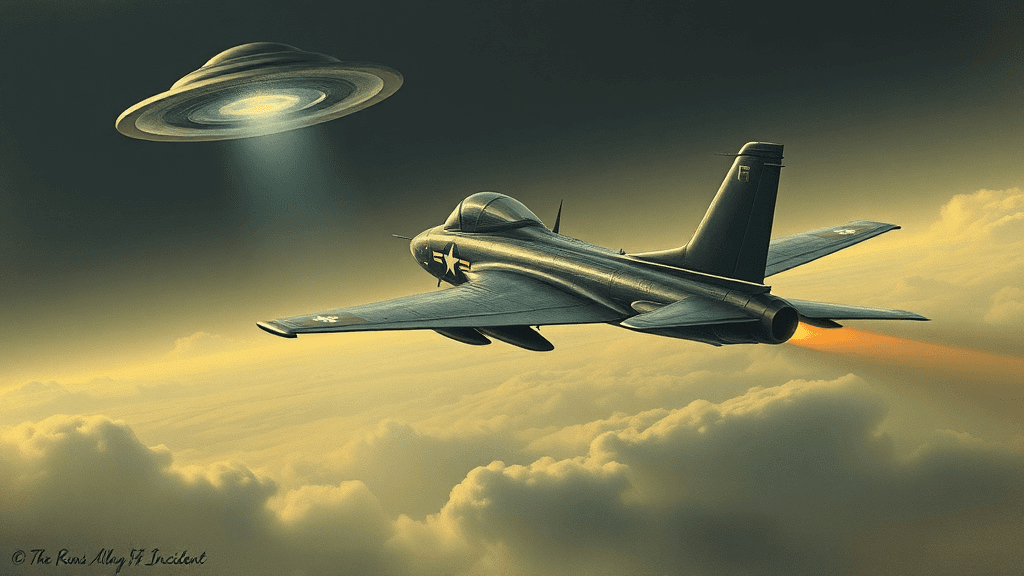
With the situation clearly anomalous, Lakenheath contacted the RAF's Neatishead GCI station and requested a fighter intercept. Around midnight, a de Havilland Venom night-fighter was scrambled from RAF Waterbeach, near Cambridge. The Venom was a single-seat jet equipped with nose-mounted AI (air-intercept) radar — giving it the ability to track targets independently of ground control.
The pilot was vectored toward one of the stationary targets. As he closed in, he reported a "bright white light" visually and achieved radar lock-on, calling it "the clearest target I have ever seen on radar." For a brief moment, all three detection channels — ground radar, airborne radar, and pilot visual — were simultaneously tracking the same object. Then, at approximately thirteen miles from the target, both the radar return and the visual light vanished.
Ground controllers vectored the Venom toward a second target roughly ten miles to the east. The pilot approached and again achieved contact. But then something unprecedented happened: the object executed a sudden maneuver and repositioned itself directly behind the Venom.
Perkins later described the moment to the Condon Committee: "The pilot of the interceptor told me he lost contact and the target was behind him and he requested assistance." Ground radar clearly displayed two distinct blips — the fighter and, close behind it, the pursuer — confirming the pilot's report. The Venom pilot attempted evasive maneuvers for approximately ten minutes: climbing, diving, circling, executing sharp turns. The object matched every move, maintaining a fixed distance behind the aircraft "as if glued" to it. At no point did the two blips merge on the ground radar display.
When the Venom's fuel ran low, the pilot broke off and headed back to Waterbeach. The object followed for a short distance, then stopped and hovered. A second Venom was scrambled but suffered an equipment malfunction and had to return to base before making contact. The original target eventually moved northward and faded from the scopes.
Investigation
Project Blue Book
The incident was reported through standard USAF channels under Air Force Regulation 200-2 and assigned to Project Blue Book. The initial evaluation attributed the sightings to "anomalous propagation" — a weather-related phenomenon that can produce false radar returns. However, this explanation struggled to account for the simultaneous visual sightings, the airborne radar contacts, the MTI anomalies, and above all, the fighter-chase sequence.
J. Allen Hynek, Blue Book's scientific consultant, initially concurred with the anomalous propagation explanation but later reversed his position, acknowledging the case as genuinely unexplained.
The Condon Committee
The case might have remained buried in Blue Book files had Technical Sergeant Forrest Perkins not written a detailed letter to the Condon Committee at the University of Colorado on February 13, 1968. Perkins' letter was the first public disclosure of the incident; months later, the twelve-year-old intelligence documents were recovered from USAF files and found to support his testimony in every substantial respect.
Gordon D. Thayer, an optical physicist from the National Oceanic and Atmospheric Administration (NOAA), was assigned to analyze the case for the Condon Report. His conclusion was remarkable — and stood in stark contrast to the Committee's overall dismissive tone. Thayer wrote: "This is the most puzzling and unusual case in the radar-visual files. The apparently rational, intelligent behavior of the UFO suggests a mechanical device of unknown origin as the most probable explanation of this sighting."
The Condon Report's final assessment read: "In conclusion, although conventional or natural explanations certainly cannot be ruled out, the probability of such seems low in this case and the probability that at least one genuine UFO was involved appears to be fairly high." This was Case 2 in the Report and remains one of only a handful of cases the Committee conceded as unexplained.
James McDonald and the AIAA
Atmospheric physicist James E. McDonald of the University of Arizona conducted his own independent investigation, publishing "UFOs over Lakenheath in 1956" in Flying Saucer Review in 1970. McDonald systematically dismantled the anomalous propagation hypothesis, noting that AP could not account for the merging and separation of targets, stationary hovering despite active MTI filtering, instantaneous acceleration from zero to 600 mph, or targets visible at radically different ranges simultaneously.
The case's significance was further recognized when the UFO Subcommittee of the American Institute of Aeronautics and Astronautics (AIAA) selected it as a sample case for publication. Thayer expanded his Condon Report analysis into a full paper for the AIAA Journal of Astronautics and Aeronautics in September 1971, titled "UFO Encounter II." The AIAA selected the case specifically because of its "multiplicity of observations" — the convergence of ground radar, airborne radar, ground visual, and airborne visual evidence.
Freddie Wimbledon's Corroboration
In 1978, a Sunday Times article about the incident caught the eye of retired RAF Flight Lieutenant Freddie Wimbledon, who had been the Chief Fighter Controller at Neatishead on the night in question. Wimbledon wrote a letter correcting certain details but crucially corroborated the core narrative: it had been his team that directed the two Venoms to the interception, the radar return was solid and tracked on three ground sets plus the interceptor's airborne radar, and the pursuit of the Venom by the unknown object was exactly as Perkins had described. Wimbledon's independent confirmation, coming from the RAF side of the operation, significantly strengthened the case.
The Case For
The Lakenheath-Bentwaters incident stands out among UFO cases for the sheer redundancy of its evidence:
- Multiple radar systems: Two ground radars at Lakenheath (CPN-4 and CPS-5) operating on different technical parameters, plus the Bentwaters GCA radar and the Neatishead GCI radar, all tracked anomalous targets. The different wavelengths and configurations make simultaneous equipment malfunction or interference essentially impossible.
- Airborne radar confirmation: The Venom's nose-mounted AI radar independently locked onto the same target that ground radars were tracking — a correlation that eliminates ground-based anomalous propagation as an explanation.
- Multiple visual witnesses: Ground observers at both bases, the C-47 pilot, and the Venom pilot all reported luminous objects consistent with the radar tracks.
- Intelligent behavior: The object's pursuit of the Venom, maintaining precise station-keeping behind an aircraft executing violent evasive maneuvers, suggests controlled, purposeful movement rather than any natural phenomenon.
- Performance characteristics: Speeds ranging from stationary hover to thousands of miles per hour, instantaneous acceleration and deceleration, and sharp directional changes far exceeded any known 1956 technology — or, indeed, any publicly known technology today.
- Independent corroboration: Perkins (USAF) and Wimbledon (RAF) provided consistent accounts from different sides of the operation, years apart and without coordination.
The Case Against
Skeptical explanations have been offered, though none has achieved broad acceptance:
- Anomalous propagation: The initial Blue Book explanation. While temperature inversions can produce false radar returns, AP cannot explain the simultaneous visual sightings, the airborne radar contacts, or the fighter-chase sequence. Thayer himself, a radar propagation specialist, rejected AP as insufficient.
- Perseid meteors: Philip Klass, the noted aviation journalist and UFO skeptic, argued that the high-speed Bentwaters returns could have been Perseid meteors appearing on radar, with visual sightings being misidentified shooting stars. However, ground observers explicitly distinguished the anomalous objects from the night's meteor activity, and meteors cannot hover, reverse direction, or pursue aircraft. Wimbledon directly disputed Klass's analysis.
- Combined explanations: Some skeptics have suggested that different phases of the incident may have different explanations — the initial high-speed Bentwaters returns could be meteors or anomalous propagation, while the Lakenheath contacts might involve misidentified conventional aircraft. However, this piecemeal approach struggles with the fighter-chase sequence, for which no conventional explanation has been proposed that satisfies the available evidence.
Cultural Impact
The Lakenheath-Bentwaters incident has occupied a singular position in UFO research. Unlike more famous cases such as Roswell or the Kenneth Arnold sighting, which rely heavily on witness testimony, Lakenheath offers instrumental data from multiple independent radar systems corroborated by visual observations from trained military personnel on the ground and in the air. This evidential depth has made it a touchstone for researchers arguing that at least some UFO reports represent genuinely anomalous phenomena.
James McDonald used the case as a centerpiece of his argument before the U.S. House Committee on Science and Astronautics in 1968, contending that UFO reports warranted serious scientific investigation. The AIAA's decision to feature it as a sample case lent it a degree of institutional respectability rare in UFO literature. Martin Shough, a British researcher, later conducted an exhaustive multi-year reinvestigation, subjecting every element of the case to detailed technical analysis and largely confirming its anomalous nature.
The case also illustrates the tensions inherent in Cold War UFO reporting. American and British personnel were operating under different chains of command and reporting requirements, yet their independent accounts align remarkably well — a fact that strengthens the case but also highlights how bureaucratic silos could prevent proper investigation of anomalous incidents.
Current Status
The Lakenheath-Bentwaters incident remains classified as unexplained by every major investigation that has examined it. Neither Project Blue Book's initial dismissal (later effectively retracted), nor the Condon Committee's unusual concession, nor subsequent skeptical analyses have produced a conventional explanation that accounts for the full range of observations.
The case continues to be cited in academic and policy discussions about unidentified aerial phenomena. In the current disclosure era, where the U.S. government has acknowledged that military personnel regularly encounter objects exhibiting flight characteristics beyond known technology, Lakenheath-Bentwaters stands as a historical precedent — a 1956 case that already demonstrated, with instrumental data, exactly the kind of anomalous performance that modern military encounters continue to report. Its treatment by the Condon Committee — where even a study designed to close the book on UFOs could not explain it away — remains one of the most significant admissions in the institutional history of UFO research.
Witnesses
- T/Sgt Forrest Perkins — USAF Watch Supervisor, Lakenheath RATCC; wrote the key letter to the Condon Committee in 1968
- A2C John Vaccare — USAF radar operator at Bentwaters GCA who detected the initial high-speed targets
- T/Sgt L. Whenry — Bentwaters watch supervisor who confirmed the anomalous radar returns
- Flt Lt Freddie Wimbledon — RAF Chief Fighter Controller at Neatishead GCI; directed the Venom intercepts; corroborated events in 1978
- Unnamed Venom pilot — RAF pilot from Waterbeach who achieved radar lock and was pursued by the object
- C-47 pilot — USAF transport pilot at 4,000 feet over Bentwaters who observed a bright light pass beneath his aircraft
- Multiple ground observers — Personnel at both Bentwaters and Lakenheath who visually observed luminous objects
Evidence
- Multiple ground radar tracks: CPN-4 (GCA) and CPS-5 (RATCC) at Lakenheath, plus Bentwaters GCA and Neatishead GCI radar — four independent radar systems on different wavelengths and parameters
- Airborne radar lock-on: Venom interceptor's AI radar achieved lock on the target, calling it "the clearest target I have ever seen on radar"
- Ground visual observations: Personnel at both bases observed luminous objects performing maneuvers consistent with radar tracks
- Airborne visual observations: Both the C-47 pilot and the Venom pilot visually observed anomalous lights
- Blue Book intelligence reports: Original USAF reporting documents recovered in 1968, corroborating Perkins' account
- Condon Report Case 2: Gordon Thayer's detailed technical analysis concluded the case was unexplained
- AIAA publication: Selected as a sample case by the UFO Subcommittee of the American Institute of Aeronautics and Astronautics
Filed under
Watch
Video captures flying objects that officials can't explain (2020)
Rendlesham Forest UFO sighting: Eyewitness Colonel Charles Halt
Ancient Aliens: Most Famous UFO Sighting in England (Season 12) | History
TRUE STORY: When The US Airforce Encountered UFO's | Our Life
Lakenheath/ Bentwaters UFO Incident 1956 - Dr. David Clarke
Where this entry came from
ProvenanceAgent indexedUpdated 6mo ago8 sources
Drafted by the archive's AI research agent from the sources below; corrections from readers are reviewed and folded in.
- First indexed
- 28 APR 26 // 01:25Z
- Last updated
- 28 APR 26 // 01:25Z
- The Bentwaters 1956 Radar, Ground, Air, and Visual Case — Study by James E. McDonald, James E. McDonald, UFOlogie.net (reprint of McDonald's FSR paper)
- The Lakenheath England, Radar-Visual UFO Case — Gordon Thayer's Condon Report Analysis, Gordon D. Thayer, UFOlogie.net (reprint of Condon Report Case 2)
- UFO Encounter II — Sample Case Selected by the UFO Subcommittee of the AIAA, Gordon D. Thayer, CIA FOIA Reading Room (reprint of AIAA Astronautics & Aeronautics, Sept. 1971)
- UFOs over Lakenheath in 1956, James E. McDonald, Flying Saucer Review, Vol. 16, No. 2
- Lakenheath-Bentwaters Incident: The UK's Roswell, Sky History
- Lakenheath 1956: A UK Radar-Visual UFO Classic, UFO Evidence
- Lakenheath and Bentwaters RAF/USAF Radar/Visual Case, 1956, UFO Evidence
- The Lakenheath England, Radar-Visual UFO Case, August 13–14, 1956, Gordon D. Thayer, Academia.edu (reprint of Thayer's AIAA paper)
Notes
- The Bentwaters 1956 Radar, Ground, Air, and Visual Case — Study by James E. McDonald, James E. McDonald, UFOlogie.net (reprint of McDonald's FSR paper)
- The Lakenheath England, Radar-Visual UFO Case — Gordon Thayer's Condon Report Analysis, Gordon D. Thayer, UFOlogie.net (reprint of Condon Report Case 2)
- UFO Encounter II — Sample Case Selected by the UFO Subcommittee of the AIAA, Gordon D. Thayer, CIA FOIA Reading Room (reprint of AIAA Astronautics & Aeronautics, Sept. 1971)
- UFOs over Lakenheath in 1956, James E. McDonald, Flying Saucer Review, Vol. 16, No. 2
- Lakenheath-Bentwaters Incident: The UK's Roswell, Sky History
- Lakenheath 1956: A UK Radar-Visual UFO Classic, UFO Evidence
- Lakenheath and Bentwaters RAF/USAF Radar/Visual Case, 1956, UFO Evidence
- The Lakenheath England, Radar-Visual UFO Case, August 13–14, 1956, Gordon D. Thayer, Academia.edu (reprint of Thayer's AIAA paper)
Also available

Unsolved Mysteries
Classic 1991 episode featuring the Bentwaters UFO incident. Ground and radar operators at RAF Bentwaters and Lakenheath report simultaneous visual and radar contacts with multiple unidentified objects during the night of August 13-14, 1956. Includes interviews with Robert Stack and eyewitnesses including Bob Ball, Jamie Boylan, and John F. Burroughs.

Ancient Aliens
Ongoing docuseries exploring UFO phenomena across history. Episodes cover the Lakenheath-Bentwaters incident, featuring host Giorgio A. Tsoukalos visiting RAF bases with former MOD UFO Investigator Nick Pope. Examines radar-visual evidence and classified files related to the 1956 incident.

The Phenomenon
Comprehensive documentary examining decades of UFO incidents and government cover-ups. Features testimony from high-ranking government and military officials, NASA astronauts, and classified evidence. Covers pivotal cases including radar-visual incidents from the 1950s era.

Encounters
Netflix docuseries featuring mass UFO sightings from the last 50 years with eyewitness accounts and expert interviews. Explores significant incidents and patterns in UFO activity, including historical cases from the 1950s-60s era that parallel the Lakenheath-Bentwaters incident.

Top Secret UFO Projects: Declassified
Documentary series examining declassified UFO incidents and U.S. government secrecy surrounding aerial phenomena. Covers historical cases including 1950s radar-visual incidents and explores the government's historical handling of UFO evidence.
Buying through these links supports the library. We may earn a commission.