The UFO Library: Photograph or film
McMinnville UFO Photographs
Farmer Paul Trent photographed a silver, disc-shaped UFO over his farm in Oregon; the images became among the most famous and credible UFO photographs ever taken.
The Sighting
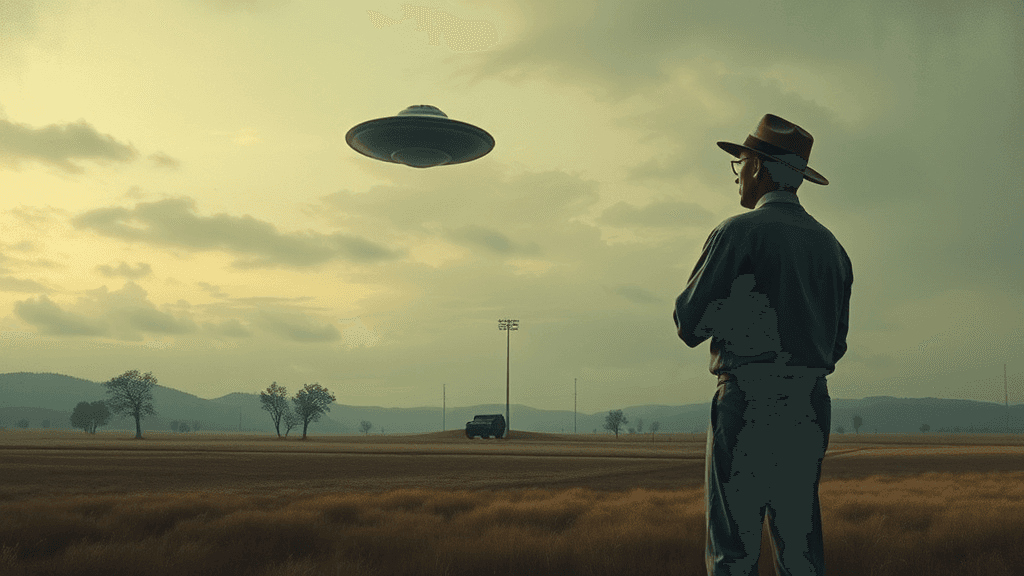
On the evening of May 11, 1950, around 7:00 PM, Evelyn Trent was tending to caged rabbits on her family farm in McMinnville, Oregon, when she observed an unusual aerial object approaching from the northeast. The craft was described as silver and disc-shaped, approximately 1,500 feet away and moving silently. She immediately called for her husband, Paul Trent, who was inside the house.
Paul emerged with a Kodak camera and took two black-and-white photographs of the object as it descended closer to the farmstead, coming within 50–100 yards of the witnesses before tilting and rapidly departing eastward. The photographs captured a bright metallic disc with a distinctive raised center and a dark spot at its apex. The object produced no audible sound and left no visible exhaust or propulsion mechanism.
Publication and Impact
The Trents initially reported the sighting to the local press. The photographs were published in the McMinnville Telephone Register in June 1950 and subsequently reprinted in Life magazine on June 26, 1950. From there the images spread rapidly across national and international media, becoming among the most iconic UFO photographs in history.
The timing — so soon after Kenneth Arnold's 1947 sighting had triggered the modern UFO phenomenon — made the McMinnville case an instant focus of public and scientific attention. Unlike many UFO photographs that were either ambiguous or quickly debunked, the Trent images showed a clear, unambiguous object and came with a detailed, credible eyewitness account from two respectable farmers with no apparent motive to fabricate.
Investigation and Scientific Analysis
FBI and Military Response
The Federal Bureau of Investigation and the U.S. Air Force examined the photographs and the negatives shortly after their publication. Neither agency found evidence that the images were fabricated, tampered with, or created through any known photographic technique.
The Condon Committee Analysis (1967)
In 1967, the University of Colorado's Condon Report — a comprehensive government-funded study of UFO reports — assigned optical physicist Dr. William K. Hartmann to investigate the McMinnville case. Hartmann employed sophisticated photometric analysis (measuring brightness properties) and photogrammetry (measuring depth and spatial relationships) on the original negatives. He also interviewed the Trents directly and examined the geographic site where the photographs were taken.
Hartmann's conclusion was notable: "This is one of the few UFO reports in which all factors investigated, geometric, psychological, and physical appear to be consistent with the assertion that an extraordinary flying object, silvery, metallic, disc-shaped, tens of meters in diameter, and evidently artificial, flew within sight of two witnesses."
Maccabee's Authentication (1975)
Optical physicist Dr. Bruce Maccabee obtained the original photographic negatives in 1975 and conducted extensive technical analysis. His tests confirmed that the negatives showed no signs of tampering, double-exposure, or other fakery techniques. Maccabee found the photographic evidence consistent with the Trents' account.
Credibility Factors
Several aspects of the McMinnville case have lent it unusual credibility within UFO research:
- Witness Stability: The Trents maintained an identical, detailed account of their sighting for decades without embellishment or revision, despite intense media pressure and public scrutiny.
- No Financial Motive: The Trents did not capitalize on their photographs, write books, or pursue lecture circuits with the same commercial energy as other UFO witnesses.
- Photographic Evidence: The negatives themselves showed no evidence of darkroom manipulation, double-exposure, or other fabrication methods available in 1950.
- Proactive Reporting: The Trents reported what they saw to local authorities without seeking sensationalism, a hallmark of credible witnesses.
- Geometric Consistency: When experts measured the angles, distances, and lighting in the photographs against the known geography of the site, all values aligned.
Skeptical Counter-Arguments
While the overwhelming consensus among photographic analysts favors authenticity, skeptics and debunkers have proposed alternative explanations:
- Hoax Hypothesis: Some have claimed the photographs depict a physical model or a deliberately constructed fake.
- Misidentification: A few researchers have suggested the object might have been a terrestrial aircraft photographed at an unusual angle.
- Optical Illusion: Some have proposed atmospheric optical effects or lenticular phenomena. n However, over 65 years after the photographs were taken, no researcher has successfully demonstrated how a hoax would have been executed, nor has anyone recovered evidence (a model, confessions, documentation) proving the Trents fabricated the images. The negatives themselves remain consistent with all technical analyses performed on them.
Cultural and Historical Significance
The McMinnville photographs occupy a unique position in UFO history. They arrived at a moment when the cultural zeitgeist was primed to receive them — the atomic age, the early Cold War, and the fresh memory of Kenneth Arnold's 1947 sighting had established flying saucers as a real possibility in the public mind. Yet unlike many early UFO photographs, the McMinnville images have not been conclusively debunked or forgotten. They remain cited by mainstream historians of the UFO phenomenon as among the strongest pieces of photographic evidence ever submitted.
The case represents a watershed moment: a sighting that was simultaneous ly ordinary (rural Oregon farmers with a camera) and extraordinary (unexplained aerial craft), credible and mysterious, widely circulated and never fully explained. In that ambiguity lies much of the case's enduring power.
Witnesses
Paul Trent (photographer, farm owner) and Evelyn Trent (initial observer)
Evidence
- Two original black-and-white photographs (35mm film negatives)
- Witness testimony consistent across decades
- No evidence of photographic tampering or double-exposure
- Photometric and photogrammetry analysis (Hartmann, 1967)
- Film authentication (Maccabee, 1975)
- Geographic site verification consistent with photo geometry
Filed under
Watch
McMinnville UFO photographs
Where this entry came from
ProvenanceAgent indexedUpdated 3mo ago4 sources
Drafted by the archive's AI research agent from the sources below; corrections from readers are reviewed and folded in.
- First indexed
- 29 JUL 26 // 02:20Z
- Last updated
- 29 JUL 26 // 02:20Z
- McMinnville UFO photographs, Community editors, Wikipedia
- The History of the 1950 Trent UFO Sighting in McMinnville, Oregon, McMenamins Blog
- The Trent UFO Photos — 'Best' of All Time — Finally Busted?, Skeptical Inquirer
- 1950: The Trent Photographs, UFO Casebook
Notes
- McMinnville UFO photographs, Community editors, Wikipedia
- The History of the 1950 Trent UFO Sighting in McMinnville, Oregon, McMenamins Blog
- The Trent UFO Photos — 'Best' of All Time — Finally Busted?, Skeptical Inquirer
- 1950: The Trent Photographs, UFO Casebook
Also available

The Phenomenon
A sweeping documentary revisiting UFO sightings from World War II to the present, including the iconic 1950 McMinnville Trent photographs. Covers the Pentagon UFO videos, Roswell, Socorro, and other benchmark cases in UFOlogy history.
UFO
A four-part docuseries produced by J.J. Abrams' Bad Robot examining UFO phenomena across American history. Each episode investigates clandestine government influence and military involvement in concealing evidence of extraterrestrial objects, including the McMinnville incident.
Unidentified: Inside America's UFO Investigation
A History Channel series starring former Defense Intelligence Agency official Lue Elizondo, who directed the classified Advanced Aerospace Threat Identification Program. The series exposes secret government UFO investigations and features testimony from military personnel at sensitive U.S. installations, covering historical incidents including McMinnville.
Close Encounters: Proof of Alien Contact
A documentary investigating UFO authenticity by examining over 250 amateur video clips and recent revelations about Roswell, including coverage of the McMinnville Trent photographs and other historical UFO evidence.
Buying through these links supports the library. We may earn a commission.