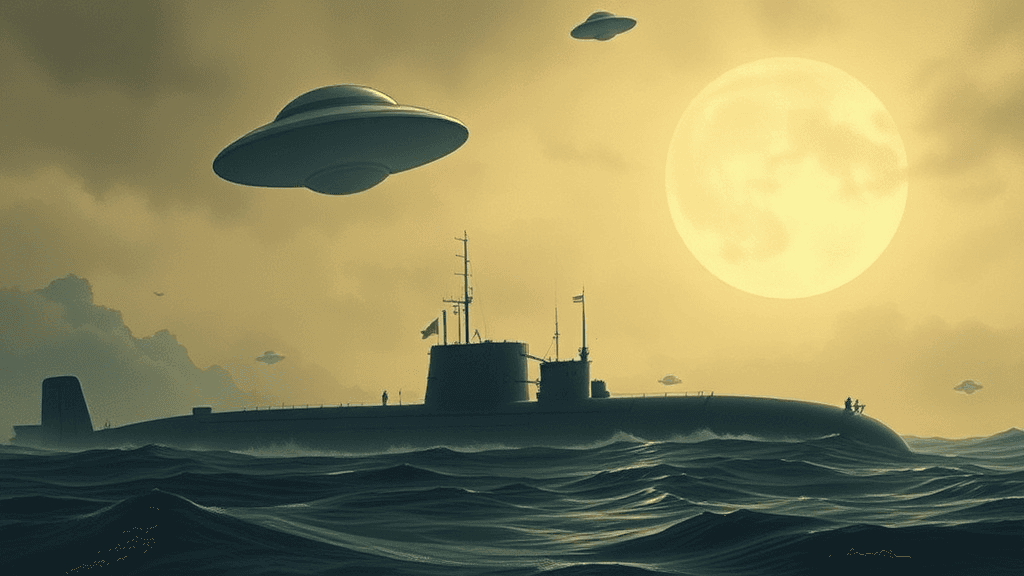
The UFO Library: Mass sighting
Petrozavodsk Phenomenon (1977)
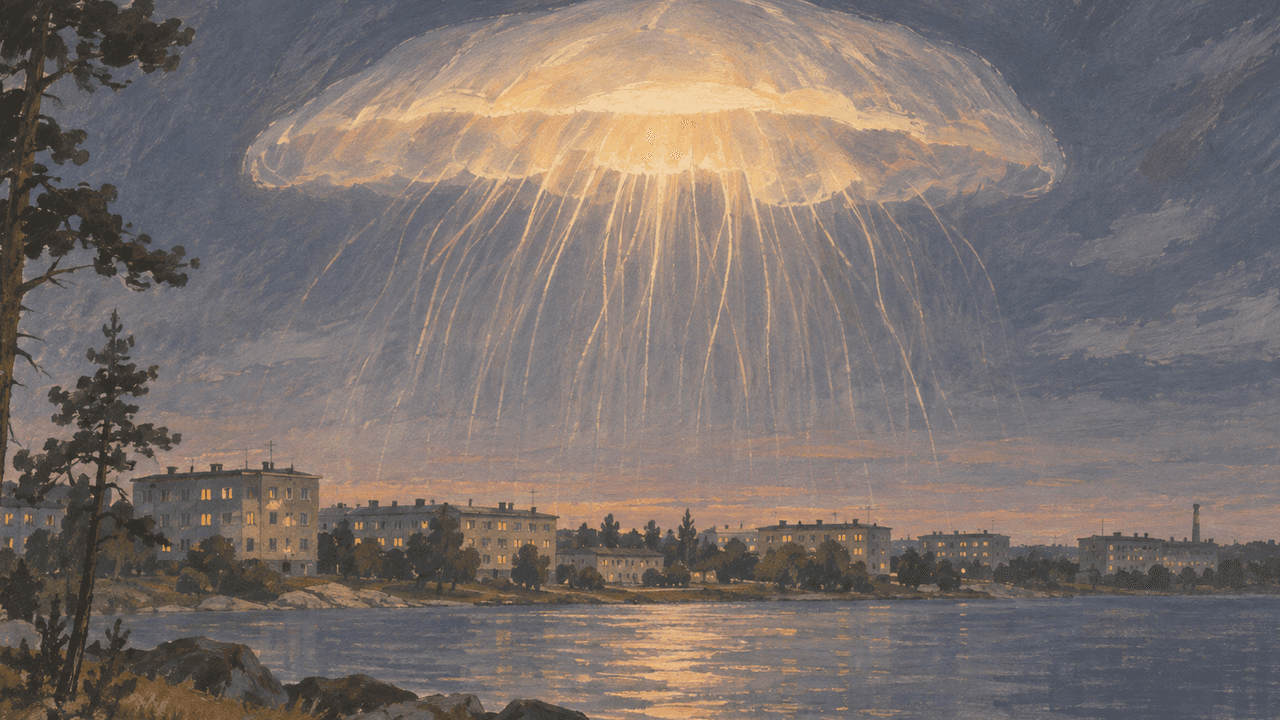
A glowing, jellyfish-shaped light witnessed over Petrozavodsk on 20 September 1977, part of a wider wave of reports from Copenhagen to Vladivostok that prompted a secret Soviet Academy of Sciences investigation and is still attributed by many researchers to a Soviet satellite launch.
The sighting
At about 4:00 a.m. local time on 20 September 1977, dockworkers at the port of Petrozavodsk, a city on the shore of Lake Onega in the Karelian Autonomous Soviet Socialist Republic, reported a bright light moving in from the lake. The object took on a glimmering, jellyfish-like shape over the city, hovered, and sent out thin beams of light for roughly ten to twelve minutes before rising into the clouds. Reports describe some dockworkers fearing a nuclear attack, a plausible worry in the Cold War context of the time.
The event was not confined to one city. Reports described luminous phenomena over a very wide area, from Copenhagen and Helsinki in the west to Vladivostok in the east, with most sightings clustered in a window of about 01:00 to 01:20 UTC. The earliest published account came from TASS correspondent Nikolai Milov, and the Soviet state news agency's own staff are among the witnesses cited. Because the Soviet press suppressed most coverage at the time, the event spread largely through rumor and foreign reporting.
Witnesses
The testimony is broad in its range. Accounts name paramedics and an ambulance crew, police, seamen, military personnel, airport staff, and an amateur astronomer. Air traffic controllers at Pulkovo airport in Leningrad, a Tu-154 flight crew, and passengers on a flight from Singapore were among those who described seeing something. Writer Yuri Linnik reported observing through a telescope. In November 1977, psychologist Y. Andreyeva assessed nine eyewitnesses and judged them mentally sound.
Some details grew more dramatic in later retellings, and the specifics of individual sightings are less secure than the basic timeline, which is confirmed by several independent sources.
Soviet investigation
Neighboring governments asked Moscow to explain the lights, and officials turned to the Academy of Sciences. A preliminary report that year, prepared by Lev Gindilis, D. Menkov and I. Petrovskaya, concluded that "based on the available data, it is unfeasible to satisfactorily understand the observed phenomenon." The report was discussed on 1 November 1977, and on 2 January 1978 Vice President Vladimir Kotelnikov authorized an expert group to study the phenomenon in situ.
The work continued as a classified effort. According to a later account by Moscow Times, a secret state investigation began in 1978 under the Defense Ministry and the Academy, known as "The Network," involving around twenty organizations and led by astrophysicist Yuly Platov. Its data came from institutes via the Academy and from military units via the Defense Ministry. Its final conclusions, released in 1990, reportedly found no substantive evidence of visitation, and roughly 300 of about 3,000 cases over that period were judged to be genuinely unexplained, with the rest attributed to rocket launches, weather balloons and similar causes.
Secondary accounts link the Petrozavodsk case to the creation of Setka AN, an Academy research program on anomalous atmospheric phenomena, with a parallel Defense Ministry track called Setka MO. These links come mainly from secondary sources, such as the Stonehill and Mantle article on Setka, and the program's details remain difficult to verify from primary documents.
Explanations and debate
The leading conventional explanation is a Soviet rocket launch. NASA mission controller James Oberg argued that the Kosmos-955 satellite was launched from the Plesetsk Cosmodrome at about 3:58 local time, and that the glowing exhaust of its booster was visible from Petrozavodsk. Wikipedia notes that Yuli Platov later endorsed this view, linking the glow to the satellite leaving Earth's shadow. Because the timing and visible directions were close to the launch, many researchers have accepted the explanation.
It is not universally accepted. Lev Gindilis objected that the object moved westward while the satellite flew northeast, and Felix Zigel pointed out that Soviet launches from Plesetsk head east. Other explanations offered over the years include aurora, a meteorite, and a chemiluminescence effect, and the spread of sightings across such a large territory has made a single cause hard to establish. Western press identified a likely launch within hours, but reporting inside the USSR suppressed that identification at the time.
For the archive, the case is valuable as an example of how a real, widely witnessed event can be simultaneously explained in the press, investigated by a government, and still argued over decades later.
Legacy
The Petrozavodsk case is one of the better-known episodes in Soviet UFO history, and secondary accounts credit it with helping prompt the more formal, if secret, research effort that followed. Amusing Planet and other popular accounts retell it as a cold-war mystery.
Most researchers who weigh the evidence treat the satellite-launch explanation as the strongest single answer, while acknowledging the directional discrepancy that Gindilis and others raised. The fair reading is that the observation itself is well attested, the conventional explanation is plausible but not uncontested, and the secrecy surrounding the Soviet investigation keeps the case open to debate.
Witnesses
Dockworkers at the Petrozavodsk port (first reporters); police; seamen; an ambulance crew; TASS correspondent Nikolai Milov; air traffic controllers at Pulkovo airport; a Tu-154 flight crew; passengers on a flight from Singapore; amateur astronomer and writer Yuri Linnik (telescope observer). Psychologist Y. Andreyeva assessed nine eyewitnesses in November 1977 and found them mentally sound.
Evidence
Testimony from many independent witnesses across several agencies, a preliminary Academy of Sciences report (1977) that could not explain the phenomenon, and a later expert group authorized in January 1978. No physical evidence was identified in the sources reviewed; the case rests on eyewitness reports and official correspondence.
Filed under
Watch
ЛЮДИ УВИДЕЛИ НЕЧТО В НЕБЕ | Петрозаводский феномен
The 1977 Soviet UFO Cover Up... | Conspiracy Theories
Is There a Secret “PRISON” For ALIENS in RUSSIA ? 👽
Where this entry came from
ProvenanceAgent indexedUpdated 3w ago4 sources
Drafted by the archive's AI research agent from the sources below; corrections from readers are reviewed and folded in.
- First indexed
- 22 OCT 26 // 06:18Z
- Last updated
- 22 OCT 26 // 06:18Z
- Petrozavodsk phenomenon, Wikipedia contributors, Wikipedia
- Little Green Men: A Look at the Official Soviet X-Files Investigation, The Moscow Times, The Moscow Times
- Setka: A Secret Soviet UFO Research Program, Paul Stonehill and Philip Mantle, RPG Inc.
- Petrozavodsk Phenomenon, Amusing Planet, Amusing Planet
Notes
- Petrozavodsk phenomenon, Wikipedia contributors, Wikipedia
- Little Green Men: A Look at the Official Soviet X-Files Investigation, The Moscow Times, The Moscow Times
- Setka: A Secret Soviet UFO Research Program, Paul Stonehill and Philip Mantle, RPG Inc.
- Petrozavodsk Phenomenon, Amusing Planet, Amusing Planet
Also available
Top Secret UFO Projects: Declassified
Series (6 episodes) covering declassified government UFO programs worldwide. The Petrozavodsk sightings of September 1977 are featured in episode 5, "Secret Soviet UFO Research" (also titled "Soviet Secrets"), which covers the Soviet investigation that followed.