The UFO Library: Humanoid encounter
Voronezh UFO Landing
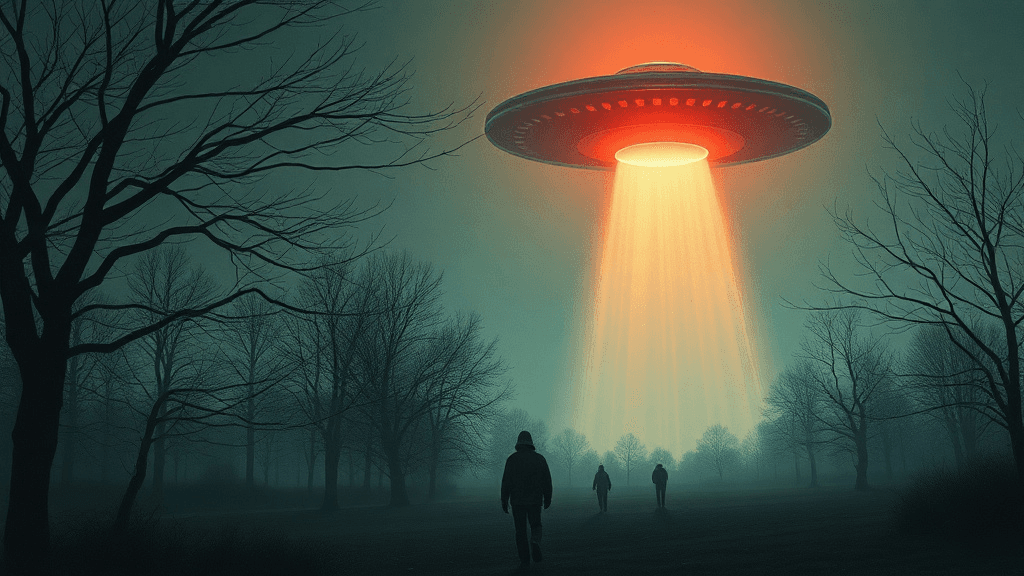
Soviet state news agency TASS reported that children and adults in Voronezh witnessed a glowing red sphere land in a public park, discharging nine-foot-tall, three-eyed beings and a robot — one of the most dramatic close-encounter claims of the Cold War era.
Background
In the autumn of 1989, the Soviet Union was in the throes of transformation. Mikhail Gorbachev's policies of glasnost (openness) and perestroika (restructuring) had loosened the iron grip on Soviet media. For the first time in decades, newspapers and wire services were experimenting with what they could publish. Taboo subjects — religion, paranormal phenomena, government corruption — began appearing in outlets that had previously confined themselves to Party-approved content. The Berlin Wall would fall just weeks later, in November. Against this backdrop of seismic political change, the official Soviet news agency TASS would publish one of the most remarkable UFO stories ever to appear in state-controlled media.
Voronezh, a city of roughly one million people located approximately 300 miles (480 km) south of Moscow, was an unremarkable provincial capital — home to universities, aviation factories, and a thriving agricultural sector. It had no prior reputation for unusual phenomena. Yet beginning in late September 1989, residents began reporting strange lights and objects in the sky. These initial sightings were part of a broader wave of UFO reports across the Soviet Union that year, with incidents logged in Cherepovetsk in April, the Vologda region in June, and a mass sighting involving some 500 witnesses earlier in September. The Voronezh events, however, would eclipse them all.
Events
The Primary Encounter — September 27, 1989
At approximately 6:30 PM on September 27, a group of children were playing football in Yuzhny Park (South Park), a public green space in a residential district of Voronezh. The evening was mild and visibility was clear. According to the children's later testimony, a pink luminescence appeared in the sky, gradually coalescing into a deep red, pulsating sphere estimated at roughly 30 feet (10 meters) in diameter. The sphere circled silently overhead, vanished, then reappeared moments later at low altitude.
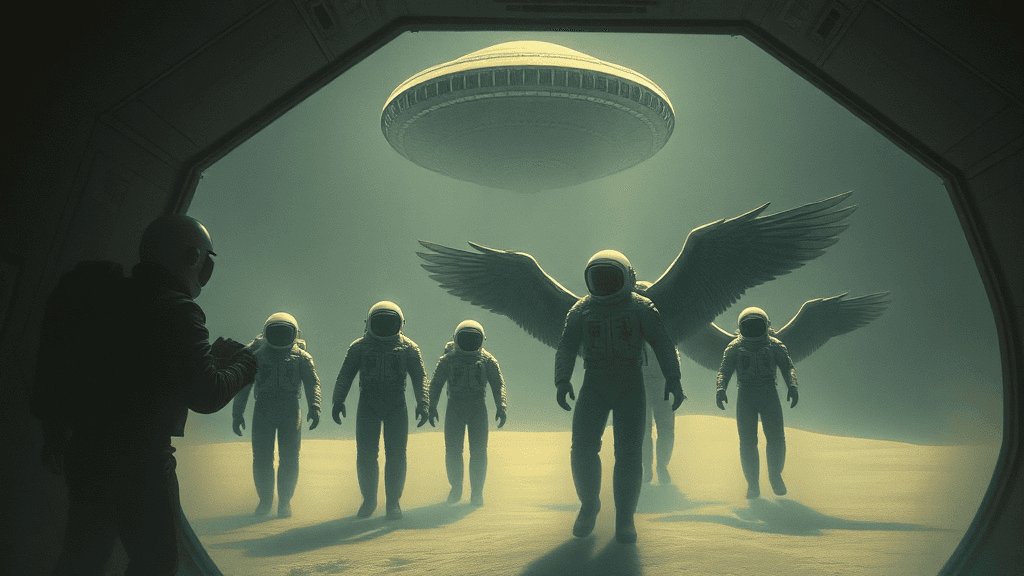
The craft descended and appeared to land in the park. A hatch opened in the lower section. From it emerged a towering humanoid figure. The children — later identified by Soviet investigators as Vasya Surin, Julia Sholokhova, Lena Sarokina, Alyosha Nikonov, and Vova Startsev, among others — described the being in remarkably consistent detail across separate interviews:
- Height: Approximately 9 to 14 feet (3 to 4 meters) tall
- Head: Small and knob-like, set on extremely broad shoulders with no visible neck
- Eyes: Three in total — two large, whitish outer eyes and one central red eye that reportedly "swiveled independently, like a radar"
- Clothing: Silvery overalls or a jumpsuit, with bronze-colored boots
- Chest device: A round metallic disk that emitted light and projected geometric shapes
- Gait: Heavy, mechanical; the being made guttural sounds
Two or three additional beings reportedly exited the craft, accompanied by a robot-like entity described as box-shaped with visible controls or buttons on its front panel. The beings appeared to examine the ground and collect soil samples.
The most dramatic claim involved a 16-year-old boy standing near the landing site. According to multiple child witnesses, the lead being fixed its gaze on the boy, who became paralyzed with fear. The craft then vanished instantaneously, only to reappear approximately five minutes later. At this point, one of the beings reportedly produced a tube-shaped device and aimed it at the boy, who — according to the children — vanished entirely. He reappeared unharmed only after the craft departed for the final time.
Adults were present as well. Between 30 and 40 people at a nearby bus stop reportedly observed the glowing sphere in the sky, though their accounts of the beings were less detailed than the children's. Lieutenant Sergei A. Matveyev of the Voronezh district police later told investigators that he too had seen the UFO, describing it as a luminous object unlike anything in his experience.
Subsequent Sightings
The September 27 encounter was not an isolated event. Over the following days and weeks, additional sightings of luminous objects were reported over Voronezh by multiple witnesses. The clustering of reports suggested either a genuine anomalous presence, heightened public attention primed by the initial event, or some combination of the two. The broader 1989 Soviet UFO wave provided context: Russia was experiencing an unprecedented surge in reported sightings, possibly amplified by the newly liberated press.
Investigation
The TASS Report — October 9, 1989
Twelve days after the primary event, on October 9, 1989, TASS transmitted a dispatch that astonished the world: "Scientists have confirmed that an unidentified flying object recently landed in a park in the Russian city of Voronezh. They have also identified the landing site and found traces of aliens who made a short promenade about the park." The report stated that a TASS correspondent had spoken to 10 or 12 young witnesses, and quoted Genrikh Silanov, head of the Voronezh Geophysical Laboratory, as the scientific authority behind the claims.
According to the TASS dispatch, investigators found a 20-yard depression at the alleged landing site with four deep dents arranged in a rhombus pattern, each 4 to 5 centimeters deep — consistent, they suggested, with landing gear. Two pieces of rock were recovered that TASS initially described as composed of material "that cannot be found on Earth." Silanov reportedly confirmed the landing location using "biolocation" — a technique involving dowsing rods, which skeptic Paul Kurtz would later characterize as "a form of ESP dowsing" with no scientific standing.
International Media Reaction
The TASS report detonated across the global press. The New York Times, The Washington Post, The Guardian, and the Associated Press all covered the story. The American television program A Current Affair dispatched a crew to Voronezh. NASA noted dryly that the Soviets had not contacted them. The story's extraordinary nature — state media in a nuclear superpower reporting an alien landing as confirmed fact — guaranteed saturation coverage, though much of it was tinged with bemused skepticism.
Soviet evening news correspondent Vladimir Posner sent his own film crew to Voronezh but reported that they "could find no other witnesses except the children." This detail — the reliance on child testimony — would become the case's most persistent vulnerability.
Scientific Analysis
Multiple teams examined the alleged landing site. Initial claims of anomalous soil composition and unusual rocks were dramatic but did not survive scrutiny. The "alien rocks" were later identified as hematite (iron oxide), a mineral common throughout the Soviet Union. Elevated phosphorus levels were noted but not conclusively anomalous. Cesium-137 radioactivity detected at the site was attributed to residual fallout from the 1986 Chernobyl disaster, not to any extraterrestrial source.
A comprehensive battery of tests followed: 16 radiometric analyses, 19 ground checks, 9 tests for microorganisms, and 20 spectro-chemical measurements. The conclusion was unambiguous: no anomaly was found "either in the earth or surrounding vegetation."
Psychologists from local universities interviewed the child witnesses to assess the possibility of suggestion, shared hallucination, or confabulation. Their findings were inconclusive — the children appeared sincere, consistent, and genuinely frightened, but the psychological evaluation could neither confirm nor rule out collective fantasy.
Silanov's Retraction
Perhaps the most damaging development for the case's credibility came from Genrikh Silanov himself. The scientist upon whose authority TASS had built its report later distanced himself sharply from the coverage, stating: "Don't believe all you hear from Tass. We never gave them part of what they published." He denied making several of the specific claims attributed to him. Whether this represented a genuine correction or a scientist retreating under political pressure remains debated.
Jacques Vallee's Involvement
The renowned French-American UFO researcher Jacques Vallee was invited by the Soviet press agency Novosti to visit the USSR in the wake of the Voronezh reports. However, Vallee was unable to travel to Voronezh itself or interview witnesses directly. Instead, investigators from the "Voronezh Collective" — an independent UFO research group that included a professor of material physics at the University of Voronezh — were brought to Moscow to brief him.
Vallee came away from the meetings believing that the witnesses were "obviously sincere and shocked and had obviously seen something," and that the pattern of observations matched reports from other parts of the world. He noted, however, that Soviet researchers were "not prepared to do an investigation all of a sudden of something of that magnitude." The case features in his 1992 book UFO Chronicles of the Soviet Union, where he treats it as genuinely anomalous while acknowledging the investigative limitations.
The Case For
Several elements lend the Voronezh incident a degree of credibility unusual for humanoid-encounter cases:
- Consistency of child testimony. The named child witnesses, interviewed separately by both Soviet investigators and later by visiting researchers, provided remarkably consistent descriptions of the craft, the beings, and the sequence of events. The specific detail of the three eyes — with the central red one described as independently mobile — appeared across multiple accounts.
- Multiple independent observers. While the detailed humanoid descriptions came primarily from children, 30 to 40 adults at a bus stop independently reported seeing the luminous sphere, as did police Lieutenant Matveyev.
- State media endorsement. The TASS report, whatever its journalistic failings, represented an unprecedented acknowledgment by a superpower's official news apparatus. The Soviet government had no obvious motive to fabricate an alien-landing story during a period of intense diplomatic engagement with the West.
- Physical traces. The rhombus-pattern depressions at the alleged landing site were documented by multiple investigators, even if their cause could not be conclusively attributed to a craft.
- Broader wave context. The Voronezh events occurred within a documented wave of Soviet UFO sightings in 1989, suggesting the witnesses were not operating in an informational vacuum that would encourage fabrication for attention.
The Case Against
The skeptical case is formidable:
- Child witnesses. The most extraordinary claims — the humanoid beings, the ray gun, the disappearing boy — rest almost entirely on the testimony of children, a demographic vulnerable to fantasy, peer influence, and narrative elaboration. Vladimir Posner's crew found no adults who could corroborate the close-encounter details.
- Scientific null results. Every controlled scientific test of the landing site returned normal results. The "alien rocks" were ordinary hematite. The "biolocation" method used to identify the landing zone has no scientific credibility.
- Silanov's retraction. The key scientific authority cited by TASS repudiated significant portions of the report attributed to him, undermining the story's factual foundation.
- Glasnost sensationalism. The newly liberated Soviet press was experimenting with tabloid-style content. As one Soviet citizen told TIME: "They've been feeding us rubbish about the dream of Communism for years, and we now see they were lying. At least this gives us something new to dream about." The TASS report may have been an exercise in audience-building rather than journalism.
- Science fiction parallels. Critics noted that the described beings — tall, three-eyed, silver-suited, accompanied by robots — bore strong resemblance to figures from Western science fiction, particularly pulp magazines of the era. The question of cultural contamination in witness accounts cannot be dismissed.
- No photographic evidence. Despite occurring in a public park in a city of one million, during daylight hours with multiple alleged witnesses, no photographs or film footage of the encounter have ever surfaced.
Cultural Impact
The Voronezh incident became one of the defining UFO stories of the late Cold War era. Its significance lies less in the strength of the evidence than in the extraordinary context of its reporting. For the first time, a superpower's state news agency had broadcast an alien-encounter story to the world as confirmed fact. This intersection of ufology and geopolitics — the crumbling Soviet empire, the intoxicating new freedoms of glasnost, a population yearning for wonder amid disillusionment — gives the case a sociological richness that transcends the usual sighting report.
The incident contributed to a broader surge of public interest in the paranormal across the late Soviet Union and post-Soviet Russia. UFO groups proliferated. Television programs devoted to unexplained phenomena attracted massive audiences. The Voronezh story became a touchstone for this cultural moment — proof, for believers, that the phenomenon was global and undeniable, and proof, for skeptics, that media freedom without journalistic discipline produces sensationalism.
In the West, the story was received with a mixture of fascination and condescension. American and British media frequently framed it as evidence of Soviet credulity rather than engaging with the case on its own terms. This East-West dynamic — the tendency to treat Soviet UFO reports as inherently less credible than Western ones — has been criticized by researchers including Vallee, who argued that the pattern of Soviet sightings deserved the same analytical rigor applied to cases from the United States or Western Europe.
Current Status
The Voronezh landing remains classified as contested within ufological literature. No new evidence has emerged to substantiate the humanoid-encounter claims, and the comprehensive scientific testing of the landing site yielded nothing anomalous. The retraction by Silanov — the case's primary scientific voice — effectively removed its evidential foundation.
However, the case retains interest for several reasons. The consistency of child testimony across separate interviews remains unexplained by simple hoax or mass hysteria models. The broader 1989 Soviet UFO wave, of which Voronezh was the most dramatic episode, has never been satisfactorily explained. And the case's unique position at the intersection of ufology, Cold War politics, and media history ensures its continued relevance to scholars studying how extraordinary claims propagate through societies in transition.
Yuzhny Park remains a public green space in Voronezh. No official marker commemorates the alleged encounter, though the site is known to UFO enthusiasts who occasionally visit. The city itself treats the incident with a mixture of local pride and embarrassed amusement — much like Roswell, New Mexico, a comparison Voronezh residents would likely find both flattering and uncomfortable.
Witnesses
Child witnesses: Vasya Surin, Julia Sholokhova, Lena Sarokina, Alyosha Nikonov, Vova Startsev, Roma Torshin, Genya Blinov, and approximately 5-7 additional children playing in Yuzhny Park.
Adult witnesses: 30-40 unnamed adults at a nearby bus stop observed the luminous sphere. Lieutenant Sergei A. Matveyev of the Voronezh district police confirmed seeing the UFO. No adults provided detailed corroboration of the humanoid-encounter claims.
Evidence
Ground traces: A roughly 20-yard depression with four dents arranged in a rhombus pattern (4-5 cm deep) was documented at the alleged landing site.
Rock samples: Two pieces initially described as unearthly material were later identified as ordinary hematite (iron oxide).
Scientific testing: 16 radiometric analyses, 19 ground checks, 9 microorganism tests, and 20 spectro-chemical measurements found no anomalies in the soil or vegetation.
Biolocation: Genrikh Silanov used dowsing-based "biolocation" to identify the landing zone — a pseudoscientific method with no established validity.
No photographic or film evidence exists despite the public setting and multiple alleged witnesses.
Filed under
Watch
Voronezh Incident – When Aliens Landed in the Soviet Union
The Voronezh UFO Landing, 1989
The Terrifying Voronezh UFO Incident: Strange Otherworldly Beings Invaded The USSR - Lights Out #123
The Voronezh Incident: When Soviet Officials Confirmed an Alien Landing
The Most Violent Alien Encounter of the Soviet Union | Voronezh UFO landing
Where this entry came from
ProvenanceAgent indexedUpdated 6mo ago8 sources
Drafted by the archive's AI research agent from the sources below; corrections from readers are reviewed and folded in.
- First indexed
- 28 APR 26 // 06:23Z
- Last updated
- 28 APR 26 // 06:23Z
- Aliens Landed in Russia, According to Official Soviet Media. Here's the Backstory, Lily Rothman, TIME
- Back in the UFO, The Washington Post
- The Voronezh UFO Incident: Russia's Alien Landing, Hangar 1 Publishing
- The 1989 Voronezh UFO Incident: How Children Became Key Witnesses to an Alien Encounter, TVI
- Voronezh, Russia UFO Incident Analysis & Details, Viral UFOs
- Ummo and Voronej, Patrick Gross, UFOlogie.net
- UFO Chronicles of the Soviet Union — Book Review, Kirkus Reviews
- Voronezh, Russia UFO Landing and Aliens, John Greenewald Jr., The Black Vault
Notes
- Aliens Landed in Russia, According to Official Soviet Media. Here's the Backstory, Lily Rothman, TIME
- Back in the UFO, The Washington Post
- The Voronezh UFO Incident: Russia's Alien Landing, Hangar 1 Publishing
- The 1989 Voronezh UFO Incident: How Children Became Key Witnesses to an Alien Encounter, TVI
- Voronezh, Russia UFO Incident Analysis & Details, Viral UFOs
- Ummo and Voronej, Patrick Gross, UFOlogie.net
- UFO Chronicles of the Soviet Union — Book Review, Kirkus Reviews
- Voronezh, Russia UFO Landing and Aliens, John Greenewald Jr., The Black Vault
Also available

Aliens in USSR
Documentary examining three unsolved Soviet-era UFO mysteries: the Dyatlov Pass incident, the Petrozavodsk phenomenon, and the 1989 Voronezh landing where children reported seeing a three-eyed humanoid and robot-like entity in a park.

The Secret KGB UFO Files
Hosted by Roger Moore, this investigation documents the KGB's 13-year secret UFO program and declassified Soviet files revealing encounters and official investigations into unexplained aerial phenomena, including the Voronezh incident.
Soviet UFO Secrets Revealed
A documentary TV movie investigating the most significant UFO sightings in Soviet history, with focus on declassified government records and the clandestine investigation of unexplained phenomena including the Voronezh encounter.
Buying through these links supports the library. We may earn a commission.