The UFO Library: Physical trace
Socorro / Lonnie Zamora Incident
Socorro police officer Lonnie Zamora observed an egg-shaped craft with two small occupants, which departed in a roar of blue flame — leaving behind burned vegetation, landing-gear impressions, and fused sand that no investigation has satisfactorily explained.
Background
By the spring of 1964 the United States Air Force had been collecting and cataloguing UFO reports for seventeen years through Project Blue Book, and the programme's leadership had grown comfortable dismissing most of them. The vast majority of cases were filed as misidentified aircraft, weather balloons, or Venus at the horizon. What the programme needed — and what its scientific consultant, astronomer J. Allen Hynek, privately wished for — was a case so tightly documented, with so credible a witness and so tangible a body of physical evidence, that bureaucratic hand-waving would fail to contain it. On the evening of April 24, 1964, in the dusty New Mexico town of Socorro, a soft-spoken police officer named Lonnie Zamora delivered exactly that.
Socorro sits along the Rio Grande in central New Mexico, roughly seventy-five miles south of Albuquerque. In 1964 it was a quiet community of about six thousand people, home to the New Mexico Institute of Mining and Technology (New Mexico Tech) and within commuting distance of White Sands Missile Range, the sprawling military testing ground where some of the nation's most secret aerospace work took place. The proximity of White Sands would later fuel speculation about what Zamora saw — but also made the case harder to dismiss, since military investigators understood the local flight-test environment intimately and could not match it to any known programme.
April 1964 was, in retrospect, an unusually active month for UFO reports across the American Southwest. On April 10, NORAD tracked six to twelve anomalous objects at altitudes between 60,000 and 90,000 feet over Merced, California; F-106 interceptors failed to close on the targets. On April 18, radar operators at Fallon Air Force Base in Nevada tracked two objects in stacked formation for over an hour. Whatever was happening in the skies over the western United States that spring, the Socorro incident would become its most famous chapter.
Events
The chase abandoned
At approximately 5:45 p.m. on Friday, April 24, 1964, Officer Lonnie Zamora — a five-year veteran of the Socorro Police Department — was driving south along Old Highway 85 near the Socorro courthouse. He spotted a black Chevrolet speeding ahead of him, apparently headed toward the town's rodeo grounds, and gave pursuit. Moments later, a tremendous roar broke through the desert air, accompanied by a bright bluish-orange flame descending in the sky to the southwest, roughly half a mile to a mile away. Zamora knew a dynamite shack sat somewhere in that direction; fearing an explosion, he broke off the chase and turned his patrol car west onto a rough gravel road to investigate.
First sight of the object
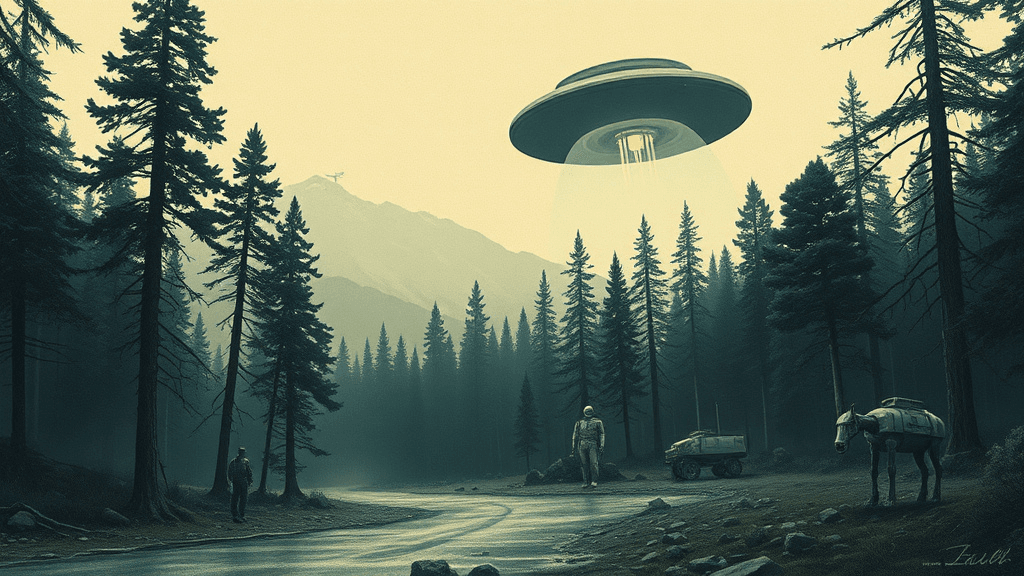
The road climbed a steep mesa. Zamora's car struggled on the loose surface, requiring three attempts to crest the rise. When he reached the top and looked south, roughly 150 to 200 yards away in a shallow gully, he saw what he initially took to be an overturned automobile — a white, shiny object "like aluminum" standing against the brown mesa background. Near it he glimpsed two figures in white coveralls. They appeared to be "normal in shape — but possibly small adults or large kids," as he would later tell investigators. One of the figures seemed to turn and look toward him, apparently startled. Zamora radioed the dispatcher, Nep Lopez, to report his location.
The roar and departure
Zamora drove closer and parked about 100 feet from the object. Stepping out of his car, he could now see that the craft was egg-shaped, smooth and whitish, and stood on four metallic legs. On its side he noticed a red insignia — an inverted V or arrow shape pointing upward from a horizontal bar, topped by a half-circle or arc. He would later sketch this symbol repeatedly for investigators.
As he approached on foot, the object suddenly emitted a deafening roar — "not like a jet," he said, but a low-frequency rumble that rose in pitch. A cone of blue and orange flame erupted from beneath the craft. Zamora, terrified, turned and ran. He stumbled, losing his glasses, and dove behind his patrol car for cover. Peeking over the hood, he watched the egg-shaped craft rise vertically to roughly twenty feet, the roar ceasing as the flame disappeared. The object then hovered silently for a moment before accelerating horizontally to the southwest, clearing Six Mile Canyon Mountain and vanishing from sight in seconds. Zamora frantically radioed Lopez to look out his window for the departing object.
Sergeant Chavez arrives
Within minutes, Socorro Police Sergeant Sam Chavez arrived at the scene in response to Zamora's radio calls. He found his colleague visibly shaken — "white as a plate," Chavez later said. The two officers walked to the spot where the object had stood. The greasewood brush was smoldering. Four distinct rectangular impressions, each roughly one to two inches deep, marked the hard-packed desert soil in a pattern that formed a quadrilateral whose diagonals intersected at exactly ninety degrees — consistent with the four legs Zamora had described. Between and around the impressions, the earth was scorched and still warm. No tire tracks or footprints other than Zamora's led to or from the site.
Investigation
The first responders
News of the sighting spread fast. By the next morning, Army Captain Richard T. Holder from White Sands Missile Range and FBI agent Arthur Byrnes had arrived to examine the site. They documented the four landing-gear impressions, the burned and still-smoldering brush, and four additional smaller, round indentations nearby. The FBI report noted "four irregularly shaped smoldering areas" and the absence of any conventional explanation. Holder later recalled making his report over a secure telephone line to a high-ranking colonel associated with the Joint Chiefs of Staff — not in writing — and being struck by the extraordinary level of interest from Washington. "Why in the world were they so interested?" he later wondered.
Opal Grinder, who managed the Whitting Brothers gas station near the landing site, told investigators that shortly after the incident a car carrying two men — later identified as Larry Kratzer and Paul Kies from Dubuque, Iowa — had stopped at his station. The driver was agitated, saying that something had flown unusually low, nearly taking the roof off their car. Multiple Socorro residents also reported hearing the loud roar at approximately the time Zamora described.
Hynek's arrival
Project Blue Book director Major Hector Quintanilla alerted Dr. J. Allen Hynek, who flew to New Mexico on April 28, four days after the incident. Hynek found the landing-site evidence still intact and spent hours interviewing Zamora and Chavez. Initially, Hynek entertained the idea that the episode might be an elaborate hoax, but Zamora's demeanour and the physical evidence persuaded him otherwise. Hynek found Zamora reticent and modest — a man who clearly wished the attention would go away. "There's never been a strong case with so unimpeachable a witness," Hynek later wrote. He would call Socorro "the Rosetta Stone" of UFO cases.
Hynek returned to Socorro later that year for follow-up interviews and further analysis. According to atmospheric physicist James E. McDonald, who also investigated the case, laboratory analysis of soil samples from the landing site revealed "fused sand" — glassy material formed by intense, localised heat — beneath the burn area. This material was reportedly collected by military personnel during their initial visit, and its chain of custody remains unclear.
Project Blue Book's verdict
By 1965, Project Blue Book officially classified the Socorro incident as "UNIDENTIFIED" — one of only 701 cases out of 12,618 to receive that designation over the programme's two-decade life. The Air Force prepared two reports. The public version stated that "no conclusion" could be drawn. But a classified report authored by Major Quintanilla himself, not released until the early 2000s through Freedom of Information requests, was far more candid. Quintanilla wrote that there was "no question" about Zamora's reliability, "no doubt" he witnessed something extraordinary, and that the case was "the best-documented case on record." He confessed that the Air Force was equally baffled.
Zamora passed a polygraph test without difficulty. No known military aircraft, balloon, or experimental vehicle matched the object's described appearance or behaviour — particularly its ability to rise vertically, hover, and then accelerate horizontally at high speed against the prevailing wind.
The case for
The Socorro incident ranks among the most credible UFO reports for several reinforcing reasons:
- Witness reliability. Zamora was a serving police officer with no history of attention-seeking, no interest in UFOs, and no financial motive. He was so uncomfortable with the publicity that he left the police force within two years, taking a quieter job as Socorro's landfill supervisor. He rarely spoke about the incident for the rest of his life.
- Physical trace evidence. The quadrilateral landing impressions, each consistent in depth and shape; the burned and smoldering vegetation; and the reports of fused sand are among the strongest physical-trace evidence in UFO history. No satisfactory conventional explanation has been offered for the combination of marks.
- Corroborating testimony. Multiple independent witnesses reported hearing the roar. The two Iowa tourists described a low-flying object in the same area at the same time. Sergeant Chavez observed the still-hot landing site within minutes.
- Official bafflement. The case was investigated by local police, the FBI, the U.S. Army, and Project Blue Book. None could identify the object. The classified Quintanilla report's candour is particularly striking, since Blue Book's institutional bias heavily favoured prosaic explanations.
- Quadrilateral geometry. Ray Stanford, a researcher who wrote the book Socorro 'Saucer' in a Pentagon Pantry (1976), noted that the four landing impressions formed a precise geometric figure with perpendicular diagonals — a pattern difficult to fabricate with hand tools in hard-packed desert soil without leaving additional marks.
The case against
Several sceptical hypotheses have been advanced, though none has achieved consensus:
- Student hoax. The most persistent theory holds that students at New Mexico Tech engineered a prank. Stirling Colgate, a distinguished astrophysicist who became president of New Mexico Tech in 1965, told Nobel laureate Linus Pauling in a private letter that the incident was "a hoax, a joke, a prank" and suggested the object was "a candle in a balloon." However, Colgate never provided specifics — no names of participants, no description of the mechanism, no explanation for the landing impressions or fused sand. Hynek and other investigators found no evidence of student involvement, and Socorro residents who knew the local student body dismissed the idea as implausible.
- Lunar lander test. Because White Sands tested early Lunar Module descent engines, some have suggested Zamora witnessed a test vehicle. However, no test was scheduled for that date, the Lunar Module's appearance and engine characteristics do not match Zamora's description, and the testing area was not in the vicinity of the sighting.
- Mirage. Scottish UFO sceptic Steuart Campbell proposed that Zamora saw a mirage of the star Canopus, with the roar produced by a coincidental atmospheric event. This theory has found virtually no support among optical physicists or other researchers, as mirages do not produce physical ground traces.
- Philip Klass's tourism-fraud theory. Sceptic Philip Klass alleged that Zamora and Socorro mayor Holm Bursum Jr. invented the story to attract tourists. Klass claimed Bursum owned the landing-site property, but this was factually incorrect — the land belonged to someone else. No tourism venture ever materialised, and Zamora's well-documented reluctance to discuss the event is inconsistent with a publicity scheme.
None of these explanations accounts for the full body of evidence: a credible witness, corroborating testimony, landing impressions in a precise geometric pattern, burned vegetation, possible fused sand, and the object's observed flight characteristics.
Cultural impact
The Socorro incident occupies a pivotal position in UFO history for several reasons. It was the case that began to transform J. Allen Hynek from a loyal Air Force debunker into the field's most respected scientific advocate. By the time he published The UFO Experience: A Scientific Inquiry in 1972, Hynek had developed his famous Close Encounter classification system — and Socorro, as a case involving a craft, physical traces, and possible occupants, served as a paradigm for what he called a "Close Encounter of the Third Kind." Without Socorro's influence on Hynek's thinking, the trajectory of UFO research in the 1970s might have been very different.
The case also became a touchstone for the physical-trace school of UFO investigation, which argues that ground markings, soil changes, and radiation readings provide harder evidence than eyewitness testimony alone. Researcher Ted Phillips compiled a catalogue of over 4,000 physical-trace cases worldwide, and Socorro consistently appears near the top of his credibility rankings.
In Socorro itself, the landing site became a quiet local landmark. A modest marker was placed there, and in 2012 the city erected a public art installation — a stylised representation of the craft — on the site. The city's tourism website acknowledges the incident as part of Socorro's identity, though the town has never become a UFO-tourism destination on the scale of Roswell.
Ray Stanford's 1976 book Socorro 'Saucer' in a Pentagon Pantry remains the most detailed single-volume treatment of the case, drawing on hundreds of pages of previously classified documents obtained through FOIA requests. Stanford argued that Pentagon interest in the case was far greater than publicly acknowledged, citing the secure-line call from Captain Holder to the Joint Chiefs and the rapid confiscation of soil samples.
Current status
Lonnie Zamora died of heart failure on November 2, 2009, at the age of seventy-six. He had rarely discussed the incident publicly in his later years, though he never recanted any part of his account. Those who knew him described a quiet, deeply religious man who found the experience unsettling rather than exciting and wanted nothing more than to be believed — and then left alone.
The case remains officially unidentified. The declassified Project Blue Book files, now available through the National Archives and repositories like The Black Vault, contain hundreds of pages on Socorro, including Hynek's field notes, the Quintanilla report, FBI memoranda, and Zamora's own signed statements. Modern UAP researchers continue to cite Socorro as one of the strongest historical cases, and it featured prominently in the wave of renewed interest following the 2017 New York Times revelations about the Advanced Aerospace Threat Identification Program.
The student-hoax theory experienced a brief revival in 2009 when researcher Anthony Bragalia published correspondence in which Colgate reiterated his claim, but Colgate again declined to name participants or explain the mechanism, and the theory remains unsubstantiated. No student has ever come forward, despite the passage of over sixty years and the considerable fame (and potential profit) that such a confession would bring.
Socorro endures as one of those rare UFO cases that resists both easy belief and easy dismissal. The witness was credible. The evidence was physical. The investigators were baffled. And the desert, as always, keeps its secrets.
Witnesses
- Lonnie Zamora — Socorro Police officer, primary witness. Observed egg-shaped craft with two small figures in white coveralls; watched craft depart with roar and blue-orange flame.
- Sgt. Sam Chavez — Socorro Police sergeant. Arrived within minutes; observed Zamora visibly shaken and confirmed smoldering brush, landing impressions, and lack of other tracks.
- Larry Kratzer & Paul Kies — Tourists from Dubuque, Iowa. Reported a low-flying object nearly striking their car in the same area at approximately the same time.
- Opal Grinder — Manager of Whitting Brothers gas station near the landing site. Spoke with the Iowa tourists immediately after the incident.
- Multiple Socorro residents — Reported hearing the loud roar at approximately 5:45 p.m.
Evidence
- Four rectangular landing-gear impressions — each 1–2 inches deep in hard-packed soil, forming a quadrilateral with perpendicular diagonals.
- Four smaller round impressions — possibly from secondary landing apparatus or instrument pods.
- Burned and smoldering vegetation — greasewood brush scorched across four irregularly shaped areas, confirmed by FBI and Air Force investigators.
- Fused sand / glassy material — reported by atmospheric physicist James E. McDonald beneath the burn area, consistent with intense localised heat; samples allegedly collected by military personnel.
- Zamora's radio transmissions — logged by dispatcher Nep Lopez, establishing a real-time timeline.
- No extraneous tracks — no tire marks, footprints, or trails other than Zamora's own approach.
- Zamora's polygraph — passed without difficulty.
- Corroborating auditory testimony — multiple independent witnesses heard the roar at the reported time.
Filed under
Watch
The Best Documented UFO Case: Lonnie Zamora | blameitonjorge
Mysterious UFO Blasts Away From Terrified Police Officer I Close Encounters
Lonnie Zamora UFO Incident (Socorro, New Mexico; Aliens?) - Jimmy Akin's Mysterious World
The Socorro UFO landing mystery, the full story of Lonnie Zamora's sighting TLBE HD
Policeman Lonnie Zamora in 3 interviews (1964, ‘74 & '96) talks witnessing a landed UFO in Soccoro
Where this entry came from
ProvenanceAgent indexedUpdated 6mo ago9 sources
Drafted by the archive's AI research agent from the sources below; corrections from readers are reviewed and folded in.
- First indexed
- 27 APR 26 // 00:23Z
- Last updated
- 27 APR 26 // 00:23Z
- The Vault Files: The Socorro UFO Landing Incident, April 24, 1964, John Greenewald Jr., The Black Vault
- From the Desks of Project Blue Book: Socorro, New Mexico UFO Landing, John Greenewald Jr., The Black Vault
- The Zamora Incident – UFO Landing At Socorro, UFO Insight
- Socorro / Zamora UFO Incident, UFO Evidence
- The 1964 Socorro UFO Encounter, HowStuffWorks
- Socorro UAP Incident (Lonnie Zamora Incident), Enigma Labs
- Official FBI Files on the Socorro UFO Landing, April 24, 1964, John Greenewald Jr., The Black Vault
- Dionicio Eduardo 'Lonnie' Zamora (1933–2009), Find a Grave
- Lonnie Zamora (1933–2009): Eulogy to a Man of His Word, Frank Warren, The UFO Chronicles
Notes
- The Vault Files: The Socorro UFO Landing Incident, April 24, 1964, John Greenewald Jr., The Black Vault
- From the Desks of Project Blue Book: Socorro, New Mexico UFO Landing, John Greenewald Jr., The Black Vault
- The Zamora Incident – UFO Landing At Socorro, UFO Insight
- Socorro / Zamora UFO Incident, UFO Evidence
- The 1964 Socorro UFO Encounter, HowStuffWorks
- Socorro UAP Incident (Lonnie Zamora Incident), Enigma Labs
- Official FBI Files on the Socorro UFO Landing, April 24, 1964, John Greenewald Jr., The Black Vault
- Dionicio Eduardo 'Lonnie' Zamora (1933–2009), Find a Grave
- Lonnie Zamora (1933–2009): Eulogy to a Man of His Word, Frank Warren, The UFO Chronicles
Also available
The Phenomenon
Investigates decades of UFO cover-ups with testimony from government officials and NASA astronauts. Features the Socorro incident as a central case involving police officer Lonnie Zamora's 1964 encounter with an egg-shaped craft and humanoid figures.
UFO
Series. Four-part documentary series from J.J. Abrams' Bad Robot exploring unexplained aerial phenomena and alleged government cover-ups. Covers historical UFO cases including Socorro where Zamora reported witnessing a craft landing with occupants.
Expedition X: UFOs Over New Mexico
Season 3, Episode 3. Investigation team led by Josh Gates visits Socorro, New Mexico to examine the infamous 1964 Landing Incident witnessed by police officer Lonnie Zamora. Uses advanced technology and new witness testimony.
Unsolved Mysteries: Socorro Close Encounter
Classic episode from the original Unsolved Mysteries series featuring the Socorro UFO case. Police officer Lonnie Zamora recounts his 1964 encounter with an unidentified object that exhibited characteristics defying conventional explanation.
Buying through these links supports the library. We may earn a commission.