The UFO Library: Military encounter
1976 Tehran UFO Incident
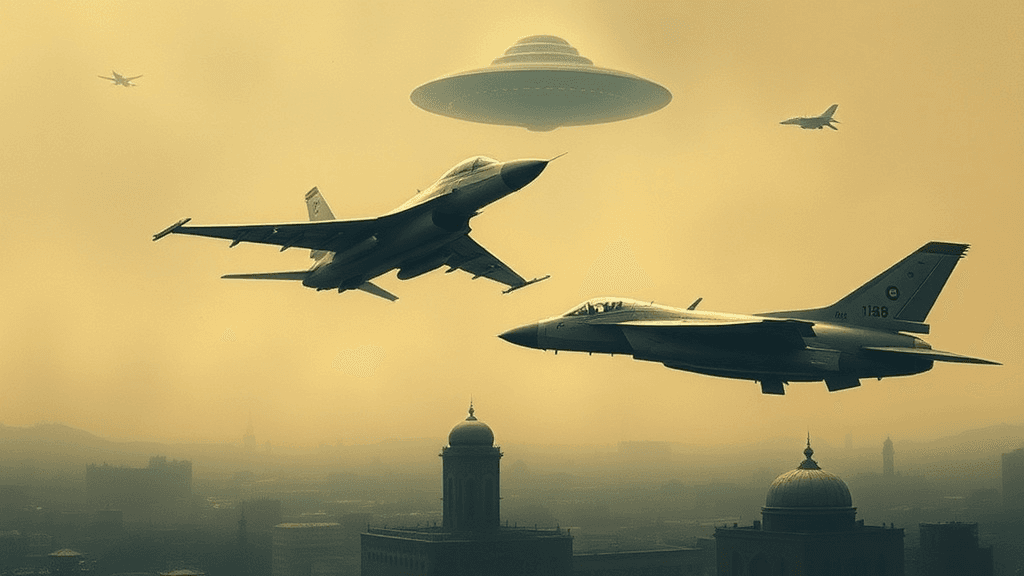
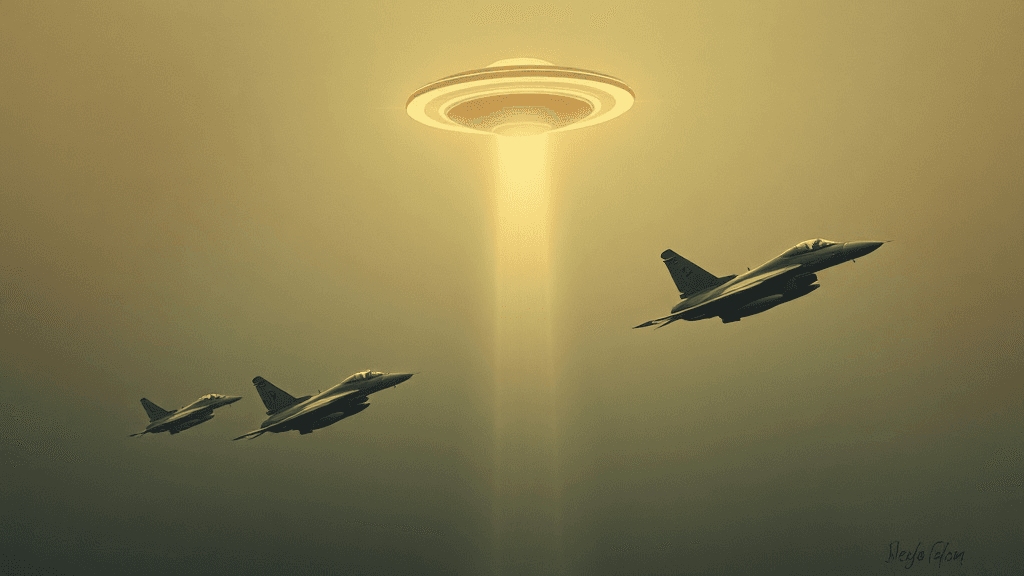
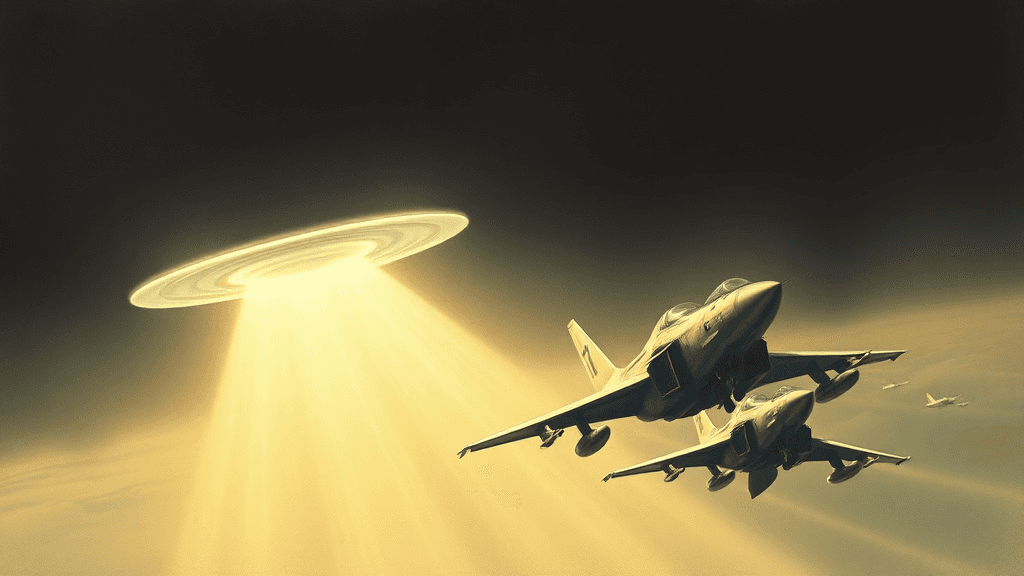
Two Iranian Air Force F-4 Phantoms intercepted a radar-confirmed UFO over Tehran; both jets experienced simultaneous electromagnetic interference and weapons system failure.
The Encounter
In the early morning hours of September 19, 1976, multiple reports of an unusual aerial phenomenon flooded the Iranian air defense command. Residents across Tehran observed a bright, luminous object unlike any known aircraft. Air traffic control at Mehrabad International Airport confirmed radar contact and visual sightings from the control tower.
The object was described as highly luminous with a variable brightness that fluctuated intensely. Its flight characteristics defied conventional aviation: it appeared to hover motionless, then accelerate to impossible speeds, and most remarkably, it seemed to "jump" instantaneously across vast distances—at one point covering over 43 kilometers (27 miles) in what witnesses calculated as a single instant.
The Military Response
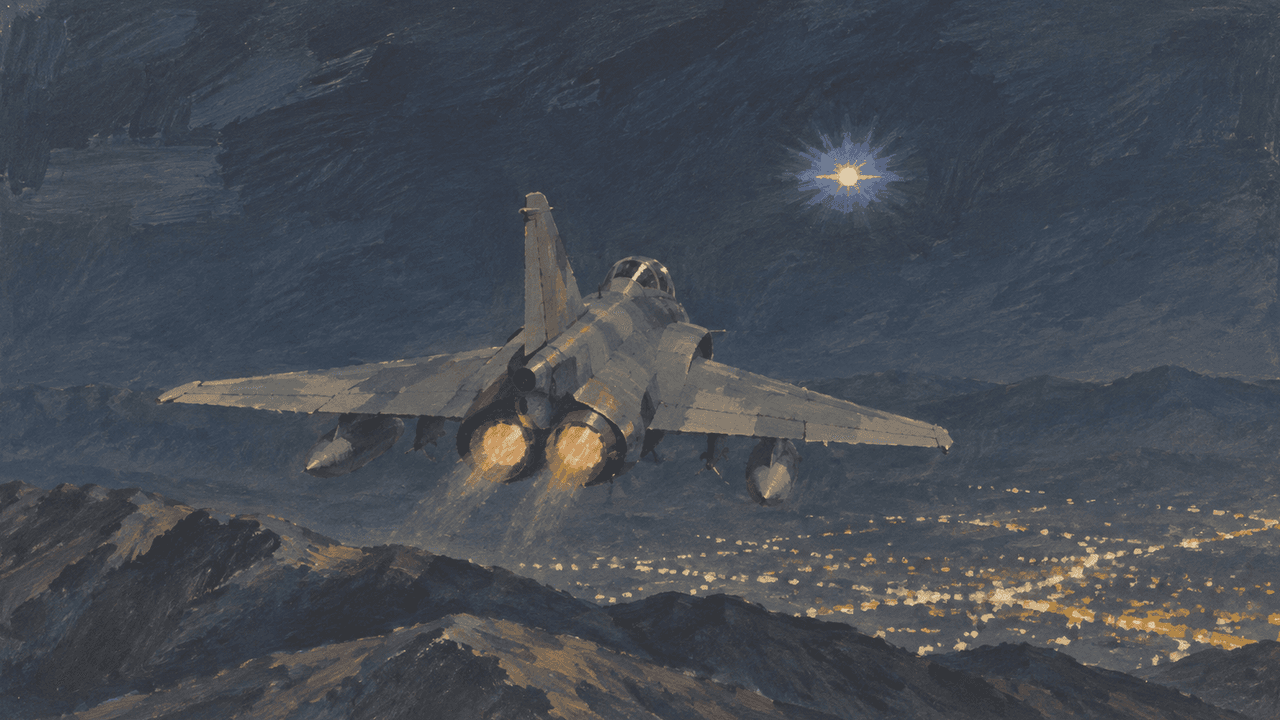
At approximately 0130 local time, the Iranian Air Force scrambled the first F-4 Phantom II jet interceptor piloted by Lieutenant Rahim Azarmehr. Upon approach, the pilot reported a massive object on visual observation and attempted to close to identification range. However, as the jet reached a point roughly 46 kilometers from the target, the aircraft's instrumentation failed catastrophically. All communications were lost. The alarmed pilot broke off the pursuit, and remarkably, the aircraft's systems came back online immediately upon withdrawal.
A second F-4 Phantom was launched at approximately 0145, piloted by Major Parviz Jafari, a decorated squadron commander and combat veteran, with weapons officer First Lieutenant Jalal Damirian. Major Jafari's crew achieved radar lock on the object, which appeared on radar scope with a size equivalent to a Boeing 707—a massive aerial platform. The radar tracking indicated that every time the F-4 closed to within 46 kilometers, the object would either speed away or simply vanish and reappear elsewhere, sometimes maintaining distance through apparent velocity that exceeded the Phantom's maximum speed.
Major Jafari conducted a detailed visual observation. He described the object as rotating and changing shape, composed of four brilliant strobe lights arranged in a rectangular pattern—blue, green, red, and orange—flashing so rapidly that all colors appeared simultaneously. At the center was a deep red light with a yellow glow.
The Electromagnetic Effects
At one point during the encounter, a smaller luminous sphere separated from the main object and moved directly toward Jafari's aircraft. In response, Jafari prepared to launch an AIM-9 Sidewinder heat-seeking missile. However, at the moment of weapon engagement, all of Jafari's weapons control systems failed. His communications system simultaneously went offline. The radar operator lost all electronic contact with the target.
In a pattern identical to the first F-4's experience, the instant Major Jafari withdrew from the engagement zone and began increasing distance from the object, every electronic system aboard his aircraft restored to full operational status. The weapons officer confirmed that all ordnance remained safely armed and ready—the disabling was purely of the control and firing mechanism.
Documentation and Assessment
The incident was meticulously documented by Iranian military officials and subsequently reported to U.S. intelligence through multiple channels. The Defense Intelligence Agency (DIA) produced an analysis of the encounter classified at the highest levels, with distribution to the White House, the Secretary of State, the Joint Chiefs of Staff, the National Security Agency, and the Central Intelligence Agency.
The DIA assessment was remarkably forthright for a classified government document. The report characterized the incident as an "outstanding report" with "high credibility." Intelligence analysts noted that the simultaneous failure of sophisticated avionics systems in two independent aircraft, in conjunction with multiple independent visual and radar confirmations, made conventional explanations—optical illusions, misidentifications, or foreign aircraft—highly improbable. The professionalism and training of the witness pilots, combined with the precision of radar data, elevated the incident's credibility to a level unusual in UFO case evaluation.
What made the 1976 Tehran incident exceptional was not merely the sighting itself, but rather the constellation of factors that rendered it extraordinarily difficult to dismiss: military credibility, technological corroboration, electromagnetic effects on advanced weaponry, detailed official documentation, and a government assessment that took the phenomenon seriously rather than relegating it to the realm of curiosity.
Legacy
The case remains one of the most widely-cited examples in discussion of credible military UFO encounters, referenced by defense analysts, former military officials, and international defense observers as demonstrating the operational reality of encounters with phenomena that current aerospace technology cannot explain. Over four decades later, the incident has never been satisfactorily explained by conventional aircraft, atmospheric phenomena, or deliberate deception.
Witnesses
- Major Parviz Jafari — Imperial Iranian Air Force squadron commander, pilot of second F-4 Phantom; multiple military commendations and combat experience
- First Lieutenant Jalal Damirian — Weapons officer on second F-4 Phantom
- Lieutenant Rahim Azarmehr — Pilot of first F-4 Phantom
- Air Traffic Controllers — Mehrabad International Airport Tehran; multiple personnel confirmed visual and radar observations
- Civilian Observers — Multiple residents of Tehran and surrounding areas reported the luminous phenomenon
- Tower Personnel — Control tower staff documented object on radar and visual observation
Evidence
- Dual Radar Confirmation — Ground radar at Mehrabad International Airport and airborne radar in both F-4 Phantom interceptors independently tracked the object
- Visual Documentation — Detailed descriptions by trained military observers and civilian witnesses of specific luminous characteristics, color patterns, and shape changes
- Electromagnetic Interference — Two F-4 Phantom II aircraft (advanced NATO-standard fighter jets) independently experienced simultaneous loss of communications, instrumentation, and weapons systems control during approaches
- Declassified Government Analysis — Defense Intelligence Agency report noting high credibility of the incident; distribution to highest levels of U.S. government
- Precision Observations — Radar size estimates (Boeing 707-equivalent), calculated distances (46 km standoff distance), speed calculations (43 km instantaneous jumps)
Filed under
Watch
Iran Military Intercepts Alien UFO
Tehran UFO Incident, 1976: Iranian Fighter Jets Chase a UFO
Extraordinary 1976 UFO incident in Tehran, Iran: Mother Ship sighting, object chased by fighter jets
The Mysterious Tehran UFO Incident with Multiple Jet Fighters in 1976 - FindingUFO
UNIDENTIFIED Objects Over Tehran, Iran | Declassified INTERCEPT | Mini Docs | Short Documentary
Where this entry came from
ProvenanceAgent indexedUpdated 3mo ago4 sources
Drafted by the archive's AI research agent from the sources below; corrections from readers are reviewed and folded in.
- First indexed
- 24 APR 26 // 22:45Z
- Last updated
- 10 AUG 26 // 16:19Z
- 1976 Tehran UFO Incident, Wikipedia
- The Vault Files: 1976 Iran Incident, The Black Vault
- Tehran Incident, Enigma Labs
- The 1976 Tehran UFO Incident: A Military Encounter With the Unknown, New Space Economy
Notes
- 1976 Tehran UFO Incident, Wikipedia
- The Vault Files: 1976 Iran Incident, The Black Vault
- Tehran Incident, Enigma Labs
- The 1976 Tehran UFO Incident: A Military Encounter With the Unknown, New Space Economy
Also available

I Know What I Saw
Acclaimed documentary featuring interviews with credible UFO witnesses worldwide, prominently including Iranian Air Force pilot Parviz Jafari's account of the 1976 Tehran F-4 fighter jet encounter. The film presents military and government testimonies about close encounters.

The Phenomenon
Comprehensive documentary tracing UFO sightings from WWII to the present, featuring declassified Pentagon videos and government testimonies. Includes coverage of the 1976 Tehran incident as a pivotal credible military case in UFO history.

U.F.O. Confrontation: Iran
Television documentary episode from the Sightings series examining the 1976 Tehran UFO incident and whether the U.S. government was involved in a cover-up. Features interviews with military witnesses from the event.
Buying through these links supports the library. We may earn a commission.