The UFO Library: Military encounter
Wonsan–Sunchon UFO Incident (1952)
On the night of 29 January 1952, two B-29 bomber crews during the Korean War reported a glowing orange sphere flying alongside their aircraft over Wonsan and Sunchon; the Air Force investigated but never issued a conclusive explanation.
The sightings
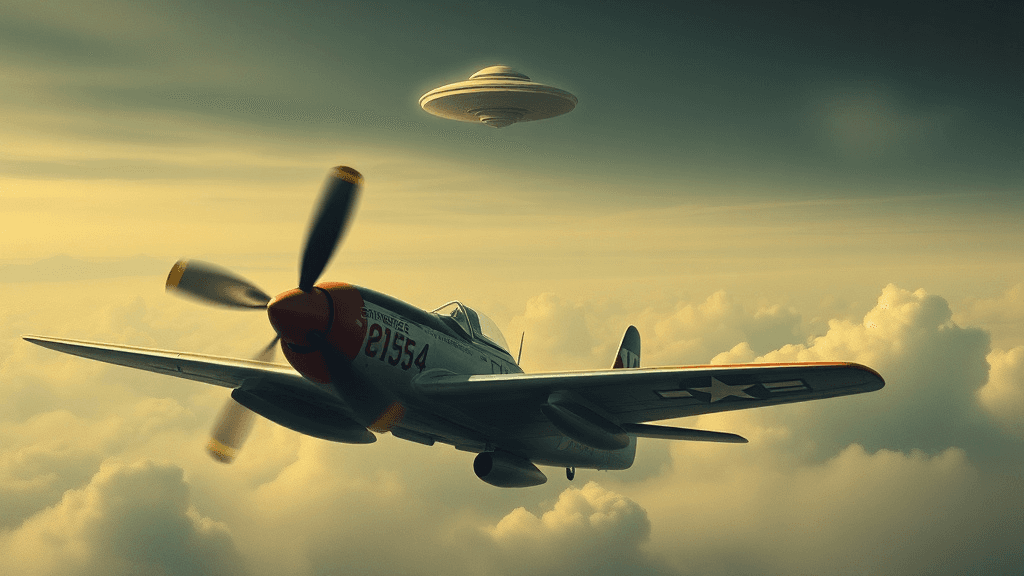
On the night of 29 January 1952, during the stalemate of the Korean War, crews from two U.S. Air Force B-29 Superfortresses reported an unusual object over northern Korea. The first sighting was over the port city of Wonsan, where a bomber was flying at roughly 20,000 feet and about 200 mph. The tail gunner and a fire-control gunner saw a round, orange light about three feet across that revolved, pulsated and trailed a bluish flame halo, according to the account later published in LIFE. The object stayed near the aircraft for about five minutes before pulling away at a sharp angle. About 24 minutes later, and roughly 60 miles to the northeast, a second B-29 from a different squadron based at Sunchon reported a similar sphere that shadowed it for about a minute. The two crews had not compared notes, and both were combat veterans. Accounts vary on the exact distances and on which gunners were positioned where, as the Wikipedia article and Project 1947's newspaper compilation note.
Air Force response
The Air Force Technical Intelligence Center (ATIC), the body that handled such reports before Project Blue Book was formalized in 1952, asked the Far East Air Forces for coordinates, altitudes, speeds and photographs on 1 February. Its staff listed candidate explanations on 4 February, among them jet exhaust, a vortex, a ramjet-powered helicopter, air-to-air weapons, natural fireballs and trailed bombs, and judged most of them weak. The Propulsion Branch concluded the objects were self-propelled but probably not powered by any conventional jet, pulsejet or rocket engine, giving slight credence to a ramjet helicopter. A memo from Gen. Twining to the Secretary of the Air Force on 5 March offered two tentative explanations: exhaust from a Soviet La-9 or La-11 fighter, or an airborne searchlight. Publicly, the Far East commander, Gen. Otto Weyland, said on 22 February that the sightings could not be dismissed but needed more data, and he doubted a jet could produce such a glow, remarking that one would have to look "right up the tail pipe" to see it.
Publicity and legacy
The story broke in the Washington Daily News on 19 February 1952 through a United Press report, then spread through syndicated columns and wire copy; Senator Richard Russell requested an evaluation from the Air Force. The incident drew more attention than most 1950s reports, and the historian Curtis Peebles argued in 1994 that it was the first large-scale UFO publicity in years and helped fuel the Washington, D.C., flap later that summer. Edward Ruppelt, the former Blue Book chief, mentioned the case in his 1956 book The Report on Unidentified Flying Objects but noted it did not produce a flood of reports like Kenneth Arnold's 1947 sighting. No final official conclusion has been published, and the case is generally cited as an unresolved military observation rather than as proof of anything beyond the crews' sincere reports.
Assessment
The case is well documented in the sense that the crew statements, the ATIC inquiries and the press coverage all exist in the record, and it is notable for the Air Force's unusually open tone at the time. Explanations remain speculative. Skeptics point to the difficulty of judging distance and size from the air at night, the possibility of reflections or flares, and the lack of photographs or instrument data. Supporters point to the consistent descriptions from two independent crews and the official unwillingness to rule the objects out. The primary documents are the best place to check specifics; secondary summaries disagree on details.
Witnesses
Two B-29 crews: gunners aboard a Wonsan-area bomber (tail gunner and fire-control/waist gunner) and gunners aboard a Sunchon-based bomber of a different squadron. Both crews were described as combat veterans.
Evidence
No photographs or instrument data are known to survive. The evidence consists of crew interrogation reports, ATIC and Propulsion Branch memoranda, FEAF statements and contemporaneous newspaper and LIFE coverage.
Filed under
Watch
Unraveling the Wonsan-Sunchon UFO Mystery
5 Most Convincing UFO Sightings I've Ever Heard of...
Where this entry came from
ProvenanceAgent indexedUpdated 2w ago4 sources
Drafted by the archive's AI research agent from the sources below; corrections from readers are reviewed and folded in.
- First indexed
- 22 OCT 26 // 17:20Z
- Last updated
- 22 OCT 26 // 17:20Z
- Wonsan-Sunchon UFO incident, Wikipedia contributors, Wikipedia
- UFO Documents - 1952 - Korea, Project 1947, Project 1947
- January 29, 1952 - Korea B-29 sightings (press compilation), Patrick Gross, Patrick Gross Ufology Archive
- January 29, 1952 — Wonsan and Sunchon, North Korea — B-29 Crew Followed By UFO, UAP Discovery, UAP Discovery
Notes
- Wonsan-Sunchon UFO incident, Wikipedia contributors, Wikipedia
- UFO Documents - 1952 - Korea, Project 1947, Project 1947
- January 29, 1952 - Korea B-29 sightings (press compilation), Patrick Gross, Patrick Gross Ufology Archive
- January 29, 1952 — Wonsan and Sunchon, North Korea — B-29 Crew Followed By UFO, UAP Discovery, UAP Discovery