The UFO Library: Crash and retrieval
Aurora Airship Crash
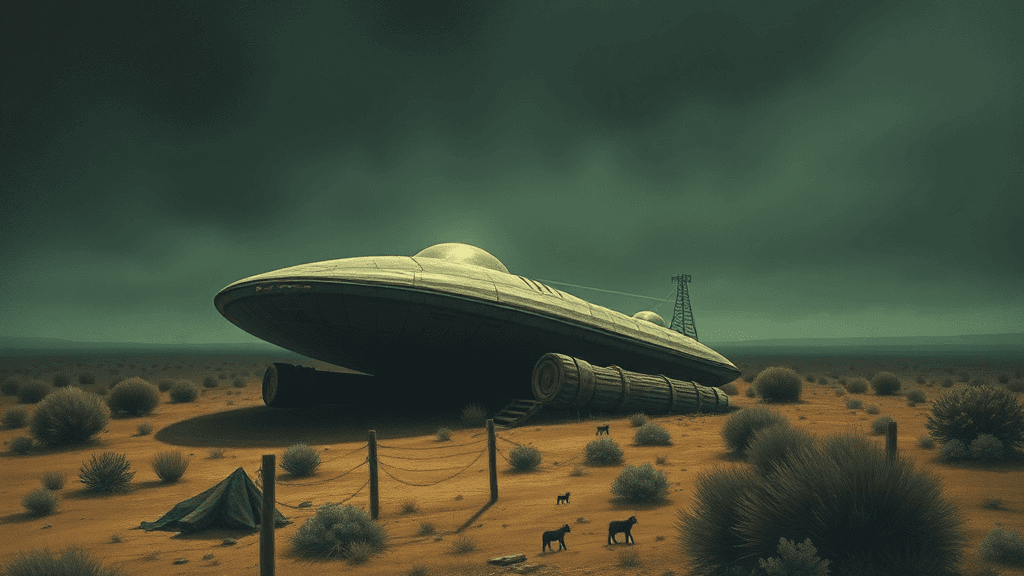
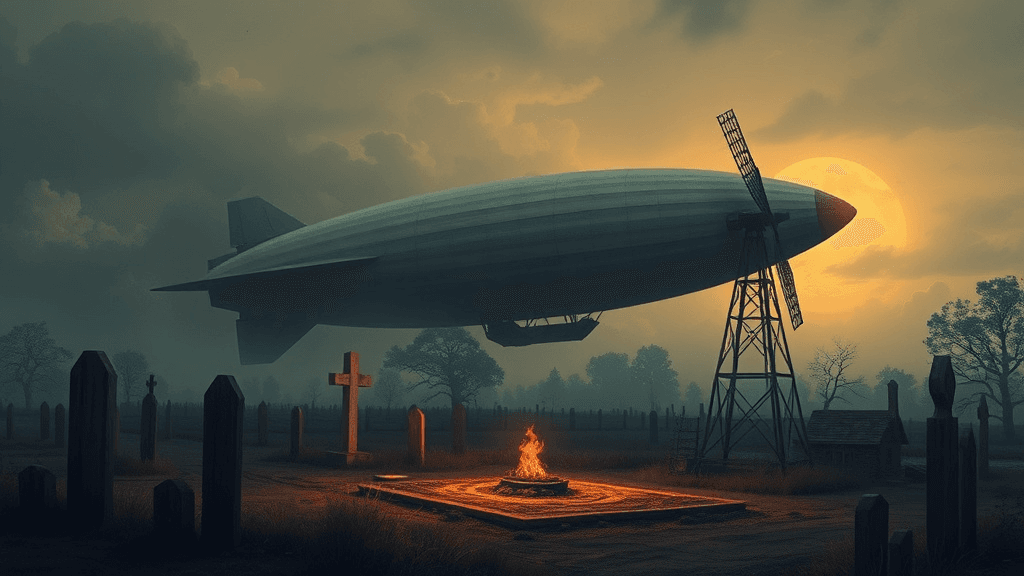
During the Great Airship Wave of 1896–1897, a cigar-shaped craft allegedly crashed into a windmill in Aurora, Texas, and townspeople reportedly buried the non-human pilot in the local cemetery — a story that has been debated for over a century.
Background
In the closing years of the nineteenth century, long before the terms "flying saucer" or "UFO" entered the American lexicon, the United States experienced its first great wave of anomalous aerial sightings. Beginning in November 1896 over Sacramento, California, and spreading eastward through the spring of 1897, thousands of witnesses across more than a dozen states reported seeing mysterious "airships" traversing the night skies — luminous, cigar-shaped craft that moved with apparent purpose, often against the wind, and sometimes at speeds that seemed impossible for any technology of the day.
The Great Airship Wave occurred in a peculiar cultural moment. The dirigible was a concept the public understood in theory — Count Ferdinand von Zeppelin would not fly his first rigid airship until 1900 — but no inventor had yet demonstrated a practical, steerable, powered lighter-than-air craft in the United States. Newspapers of the era, locked in fierce circulation wars, printed airship reports with enthusiasm, and many were clearly hoaxes or tall tales. Telegraph operators, small-town correspondents, and pranksters all contributed to a heady atmosphere in which genuine sightings, misidentifications of planets and stars, and outright fabrications were thoroughly mingled.
It was into this feverish climate that the most dramatic claim of the entire wave emerged: a report that one of the mystery airships had not merely been sighted, but had crashed — destroying a windmill, killing its pilot, and scattering wreckage across a farm in the tiny north Texas town of Aurora, roughly forty miles northwest of Fort Worth in Wise County.
Aurora itself was a community in crisis. Founded in the late 1850s, the town had grown modestly through the 1870s and 1880s, at one point boasting a population of nearly 3,000. But a cascade of misfortunes had devastated it. In 1891, the Burlington Northern Railroad chose to route its line through the neighboring town of Rhome rather than Aurora, dealing a fatal blow to the community's economic prospects. A spotted fever epidemic beginning in 1888 killed dozens of residents and drove many others away. The boll weevil ravaged local cotton crops. A fire destroyed much of the town's commercial district. By 1897, Aurora's population had dwindled to perhaps a few hundred souls, and the town appeared to be dying.
Events
The Dallas Morning News account
On April 19, 1897 — Easter Monday — the Dallas Morning News published a brief article datelined Aurora, Texas, under the headline that would echo through the next century of anomalous claims. The author was S. E. Haydon, a local cotton broker who served as a part-time correspondent for the newspaper.
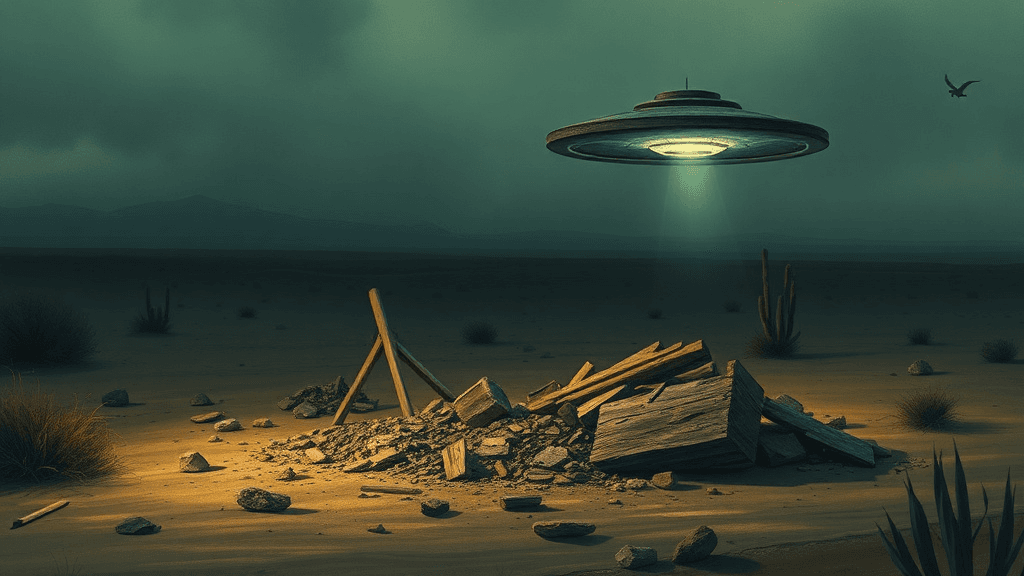
Haydon's account was vivid and matter-of-fact. He reported that "about 6 o'clock this morning the early risers of Aurora were astonished at the sudden appearance of the airship which has been sailing through the country." The craft, he wrote, was traveling northward at a speed of only ten to twelve miles per hour and appeared to be experiencing mechanical difficulty. It sailed over the town square before colliding with a windmill tower on the property of Judge J. S. Proctor, resulting in "a terrific explosion, scattering debris over several acres of ground."
The wreckage, Haydon continued, was "too badly wrecked to form any conclusion as to its construction or motive power." However, he noted that it was "built of an unknown metal, resembling somewhat a mixture of aluminum and silver, and it must have weighed several tons." Among the debris, papers covered in "strange hieroglyphics" were found, though no one could decipher them.
Most remarkably, Haydon reported that the body of the pilot was recovered from the wreckage, "badly disfigured" but sufficiently intact for T. J. Weems, identified as "a U.S. Signal Service officer and an authority on astronomy," to declare that the occupant was "not an inhabitant of this world" — a Martian, in Weems's judgment. The remains were given a proper burial in the Aurora cemetery, and the townspeople gathered to view the wreckage and collect specimens of the strange metal.
What didn't happen next
Remarkably, nothing happened. The story did not trigger a rush of journalists, scientists, or government officials to Aurora. No follow-up investigation was reported by the Dallas Morning News or any other newspaper. No specimens of the unknown metal were preserved for analysis — or if they were, none have ever surfaced. No photographs were taken. The story simply appeared, was read, and was forgotten, buried under the continuing flood of airship reports from across the country. Within weeks, the Great Airship Wave itself subsided, and the mystery airships vanished from American skies as suddenly as they had appeared.
Aurora continued its decline. The post office closed in 1901. The town nearly ceased to exist. It was only the construction of State Highway 114 through the area in 1939 that prevented Aurora from becoming a ghost town entirely. By the 1970s, Aurora had begun a modest recovery as a bedroom community for the expanding Fort Worth metropolitan area.
Investigation
The 1970s revival
The Aurora story lay dormant for over seven decades until the early 1970s, when a confluence of factors brought it back to public attention. The UFO phenomenon had become a mainstream cultural topic, and researchers were combing through historical newspaper archives for early reports. The Aurora article was rediscovered and immediately recognized as extraordinary — if true, it predated the Roswell crash by exactly fifty years.
In 1973, Bill Case, an aviation writer for the Dallas Times Herald and the Texas state director of MUFON (Mutual UFO Network), launched a formal investigation. Case brought a metal detector to the Aurora Cemetery and reported detecting "at least three large pieces of metal" beneath a small, crude grave marker — a half-broken rock headstone that appeared to bear a carved image resembling one end of a saucer-shaped craft, with small circles suggesting portholes. The grave was notably smaller than a standard adult burial, suggesting the occupant was either a child or a very small being.
Case also located two elderly witnesses who claimed memories of the event. MUFON requested permission from the Aurora Cemetery Association to exhume the suspect grave, but the request was firmly denied. Shortly after the investigation became public, the grave marker mysteriously vanished from the cemetery. When researchers returned, they found that a three-inch metal pipe had been driven into the ground at the suspected grave site, and metal detector readings that had previously registered strongly now showed nothing — suggesting that whatever metal had been buried there had been removed.
Also in 1973, journalist Jim Marrs — who would later become one of America's best-known conspiracy researchers — tracked down and interviewed Charlie C. Stephens, then eighty-three years old. Stephens was initially reluctant to talk but eventually told Marrs that as a ten-year-old boy on the morning of April 17, 1897, he had seen the airship trailing smoke as it headed north toward Aurora. Stephens said his father had gone to the crash site but would not let young Charlie accompany him.
Mary Evans, who was fifteen in 1897, told investigators that her parents had visited the crash site and described finding the body of the alien pilot among the wreckage.
Debunking efforts
The 1970s investigation also produced significant evidence against the story's authenticity. Reporter Frank Tolbert of the Dallas Morning News conducted his own research in the late 1960s and uncovered a pattern of fabricated airship stories generated by Iowa railroad telegraph operators during the 1897 wave. Tolbert also identified Joseph E. Scully, a Fort Worth railroad man, who had filed a false airship sighting report from Hawkins, Texas. Tolbert labeled the broader phenomenon "The Great Truthful Scully Hoax" and concluded the Aurora crash was "probably a non-event."
More damaging was the testimony of Etta Pegues, an Aurora town historian who had been ten years old in 1897. Pegues stated flatly that "Judge Proctor had never had a windmill on his property" — a claim that, if true, would demolish the entire foundation of Haydon's account. Pegues dismissed the story as "a hoax cooked up by Haydon and a bunch of men sitting around in the general store."
Further investigation by Bill Case revealed that T. J. Weems, identified in Haydon's article as a "U.S. Signal Service officer," was in fact the town blacksmith — not a government astronomer. And Oscar Lowery, who had been eleven years old in 1897 and was still living in Aurora in the 1970s, told Case he recalled no crash or explosion at all.
The well on Proctor's property
Brawley Oates, who purchased Judge Proctor's property around 1945, claimed to have developed severe arthritis that he attributed to contaminated water from the well on the property — the same well where Haydon's article said debris had been dumped. Oates sealed the well with a concrete slab in 1957. The well's existence and Oates's health complaints have been cited by both sides: believers see it as evidence of exotic material contamination, while skeptics note that arthritic well water is a common rural complaint with no necessary connection to alien wreckage.
The UFO Hunters investigation (2008)
In 2008, the History Channel program UFO Hunters brought a team to Aurora for a televised investigation. Researchers were permitted to unseal and examine the Proctor well. Water testing revealed nothing unusual except for "large amounts of aluminum" — an interesting but inconclusive finding, as aluminum can occur naturally in groundwater. The remains of a windmill base were located on the former Proctor property, confirming that a windmill had indeed existed there at some point — contradicting Etta Pegues's claim but not necessarily validating the crash story.
Ground-penetrating radar was used in the Aurora Cemetery and located an unmarked grave in the approximate area where the alien pilot was said to have been buried. However, the Aurora Cemetery Association once again refused exhumation, and the grave's contents remain unknown.
Former Mayor Barbara Brammer's assessment
Former Aurora Mayor Barbara Brammer conducted her own research into the town's history and concluded that Haydon's article was a fabrication — a "last-ditch attempt to keep Aurora alive" during its period of economic collapse. Brammer noted that Haydon was "known in the town to be a bit of a jokester" and that the story perfectly fit the pattern of tall tales that newspapers of the era published to boost circulation and attract attention to struggling communities.
The case for
Despite the substantial case for hoax, several elements continue to intrigue researchers:
- The windmill did exist. The 2008 investigation located structural remains on the Proctor property, contradicting Etta Pegues's denial and suggesting her memory may have been unreliable on this point.
- Witness testimony. Charlie Stephens and Mary Evans both offered accounts consistent with an unusual event, though neither claimed to have personally seen the crashed craft or its pilot.
- The vanishing grave marker. The mysterious disappearance of the marker after MUFON's investigation, the insertion of a metal pipe, and the absence of metal detector readings all suggest someone went to considerable trouble to remove evidence — behavior more consistent with a cover-up than a century-old prank.
- Metallic readings. Bill Case's initial metal detector readings and the elevated aluminum levels in the Proctor well represent physical anomalies that have never been fully explained.
- The Great Airship Wave itself. While many individual reports were certainly hoaxes, the sheer volume and geographic spread of the 1896–1897 sightings — thousands of witnesses across more than a dozen states — suggest that at least some observers were seeing something real, whether conventional or anomalous.
The case against
The evidence against the crash story is considerable:
- No physical evidence exists. Despite Haydon's claim that the "town is full of people to-day who are viewing the wreck and gathering specimens of the strange metal," not a single fragment, sample, or artifact has ever surfaced in over 125 years. No museum, private collection, or historical society possesses any piece of the alleged wreckage.
- No contemporaneous corroboration. No other newspaper sent a reporter to Aurora. No follow-up article appeared. No diary, letter, or personal record from any Aurora resident of the period mentions the crash. The entire story rests on a single newspaper article by a single author.
- The author's credibility. S. E. Haydon was a cotton broker, not a journalist. Multiple Aurora residents who knew him described him as a storyteller and prankster. The article appeared during a period when fabricated airship stories were epidemic in American newspapers.
- Key claims were false. T. J. Weems was the town blacksmith, not a Signal Service officer or astronomer. This deliberate misrepresentation of Weems's credentials undermines the article's credibility at a foundational level.
- Contradictory witness testimony. Oscar Lowery, who was the right age and location to have witnessed any such event, remembered nothing. Etta Pegues, the town historian, called it a hoax outright.
- Motivation. Aurora was desperate for attention. The railroad had bypassed it, disease had ravaged it, and its economy had collapsed. A sensational newspaper story was precisely the kind of publicity stunt a dying town might attempt.
- The timing. The article appeared on April 19, close enough to April Fools' Day traditions, and during the peak of the airship mania when editors were hungry for such stories.
Cultural impact
Regardless of its factual basis, the Aurora incident occupies a unique place in UFO history as the earliest alleged crash-retrieval case in America — predating Roswell by half a century. It demonstrates that the essential template of the UFO crash narrative — an exotic craft, a non-human pilot, wreckage of unknown composition, and burial of the evidence — existed in American culture long before the modern UFO era began in 1947.
The case has been featured in numerous television programs, including the History Channel's UFO Hunters (2008) and a 2002 documentary, Aurora: The UFO Crash of 1897, narrated by Jim Marrs. It appears in virtually every comprehensive history of the UFO phenomenon, from Jerome Clark's UFO Encyclopedia to Jim Marrs's Alien Agenda.
Aurora itself has embraced its strange heritage. The town's official website acknowledges the incident as part of its history. A Find a Grave memorial page exists for the alleged "Extraterrestrial Airship Pilot," listed with a death date of April 17, 1897. The story has become Aurora's primary claim to fame — an ironic fulfillment of what may have been S. E. Haydon's original intention, albeit more than a century late.
The case also serves as a cautionary tale for UFO researchers about the challenges of investigating historical claims. The complete absence of physical evidence, the reliance on a single documentary source, and the impossibility of interviewing long-dead witnesses all illustrate the fundamental epistemological problems that plague pre-modern UFO cases.
Current status
The Aurora airship crash remains one of the most discussed and debated pre-Roswell UFO cases. The balance of evidence tilts strongly toward hoax — the Texas State Historical Association flatly describes Haydon's article as "fictional" — but the case has never been definitively closed, largely because the one piece of evidence that could settle the matter, the contents of the alleged grave, has never been examined.
The Aurora Cemetery Association continues to refuse all requests for exhumation, citing respect for the dead and the physical fragility of the historic cemetery. Unless this position changes, the question of whether anything — or anyone — unusual lies beneath that unmarked plot of Texas earth will remain unanswered.
Meanwhile, the broader mystery of the 1896–1897 airship wave continues to fascinate historians and researchers. While the majority of individual reports are almost certainly misidentifications or fabrications, the wave as a whole — its geographic coherence, its timing in a period of rapid technological change, and the occasional report that defies easy explanation — ensures that the mystery airships, and Aurora's most famous alleged visitor, will continue to generate discussion for years to come.
Witnesses
- S. E. Haydon — Cotton broker and part-time Dallas Morning News correspondent; author of the original April 19, 1897 article; sole primary source for the crash account
- T. J. Weems — Described in Haydon's article as a "U.S. Signal Service officer"; later determined to be the town blacksmith; declared the pilot "not an inhabitant of this world"
- Charlie C. Stephens — Age 10 in 1897; interviewed by Jim Marrs in 1973 at age 83; claimed to have seen the airship trailing smoke heading toward Aurora; his father visited the crash site
- Mary Evans — Age 15 in 1897; told investigators her parents visited the crash site and found the alien body
- Etta Pegues — Town historian, age 10 in 1897; denied the event occurred and said Proctor never had a windmill; called it a hoax
- Oscar Lowery — Age 11 in 1897; recalled no crash or explosion
Evidence
- Dallas Morning News article (April 19, 1897): The sole contemporaneous document describing the crash, written by S. E. Haydon
- Metal detector readings (1973): Bill Case detected at least three large metallic objects beneath the suspected grave site; readings later vanished after the grave marker was stolen
- Vanishing grave marker: A crude headstone bearing a saucer-like carving disappeared from the Aurora Cemetery after MUFON's investigation; a metal pipe was inserted in its place
- Proctor well water analysis (2008): History Channel investigation found elevated aluminum levels in the sealed well
- Windmill base remains (2008): Structural remnants confirmed a windmill existed on the Proctor property, contradicting one debunker's claim
- Ground-penetrating radar (2008): Located an unmarked grave in the suspected area of the Aurora Cemetery; contents remain unexamined
- No physical wreckage: Despite claims that townspeople gathered specimens of unknown metal, not a single fragment has ever been produced
- No corroborating documents: No diaries, letters, receipts, or records from 1897 Aurora residents mention the crash or burial
Filed under
Watch
Aurora: The UFO Crash of 1897 (Documentary with Jim Marrs)
1897 UFO Incident in Aurora, Texas - Alien Mini-Documentary
Silly UFO Stories That Piss Me Off (Aurora Texas Alien Grave, Morristown UFO Hoax, Bermuda Wormhole)
The 1897 UFO crash in Aurora, Texas ~ "Martian pilot" was buried at the local cemetery
Aurora Texas UFO Crash Paranormal Alien Documentary
Where this entry came from
ProvenanceAgent indexedUpdated 6mo ago8 sources
Drafted by the archive's AI research agent from the sources below; corrections from readers are reviewed and folded in.
- First indexed
- 28 APR 26 // 14:21Z
- Last updated
- 28 APR 26 // 14:21Z
- The Mysterious Airship Crash in Aurora, Texas — A Historical Overview, TSHA Staff, Texas State Historical Association
- Aurora, TX Crash — 1897, MUFON Staff, MUFON
- The 1897 Aurora, Texas, UFO Crash & the 'Alien' Buried in the Cemetery, Texas Hill Country Staff, Texas Hill Country
- The Great Texas Airship Crash: Aurora, Texas April 17, 1897, Strange History Staff, Strange History
- Nearly 120 Years After Alleged UFO Crash, Small Texas Town Is All About Aliens, KERA Staff, KERA News
- Aurora, Texas, 'UFO' crash of 1897 still sparking debate, KVUE Staff, KVUE
- Extraterrestrial Airship Pilot 'Little Traveler' Alien (unknown–1897), Find a Grave Contributors, Find a Grave
- UFO Fever in America's Historical Newspapers: The Mysterious Airships of 1896–97, Readex Staff, Readex / NewsBank
Notes
- The Mysterious Airship Crash in Aurora, Texas — A Historical Overview, TSHA Staff, Texas State Historical Association
- Aurora, TX Crash — 1897, MUFON Staff, MUFON
- The 1897 Aurora, Texas, UFO Crash & the 'Alien' Buried in the Cemetery, Texas Hill Country Staff, Texas Hill Country
- The Great Texas Airship Crash: Aurora, Texas April 17, 1897, Strange History Staff, Strange History
- Nearly 120 Years After Alleged UFO Crash, Small Texas Town Is All About Aliens, KERA Staff, KERA News
- Aurora, Texas, 'UFO' crash of 1897 still sparking debate, KVUE Staff, KVUE
- Extraterrestrial Airship Pilot 'Little Traveler' Alien (unknown–1897), Find a Grave Contributors, Find a Grave
- UFO Fever in America's Historical Newspapers: The Mysterious Airships of 1896–97, Readex Staff, Readex / NewsBank
Also available
Aurora: The UFO Crash of 1897
Documentary examining the reported UFO crash in Aurora, Texas on April 17, 1897, when an unidentified flying object allegedly struck a windmill and exploded. Features investigation into eyewitness accounts and the alleged burial of an alien pilot in the local cemetery.
UFO Files: Texas' Roswell
Television documentary episode examining the mysterious 1897 airship crash in Aurora, Texas. Investigates eyewitness accounts and explores why this incident has baffled even skeptical UFO debunkers, establishing it as Texas' answer to the Roswell incident.
UFO Hunters: First Contact
Documentary episode investigating the Aurora, Texas UFO crash of April 1897. Includes forensic examination attempts, including testing water from a well for possible alien spacecraft debris.
Buying through these links supports the library. We may earn a commission.