The UFO Library: Crash and retrieval
Trinity Site Crash (1945)
Two boys allegedly discovered a crashed avocado-shaped craft and small humanoid occupants on a ranch near the Trinity nuclear test site, five weeks after the first atomic bomb detonation — a claim that remained untold for nearly six decades.
Background
On July 16, 1945, the United States detonated the world's first nuclear weapon at the Trinity test site in the Jornada del Muerto desert of south-central New Mexico. The explosion, codenamed "Trinity" and part of the Manhattan Project, yielded approximately 21 kilotons — a blast visible over 200 miles away and felt as far as El Paso, Texas. The surrounding area, already sparsely populated, was under heavy military security. The small village of San Antonio, New Mexico, sat roughly 20 miles northwest of ground zero.
According to a story that would not surface publicly until 2003, something else fell from the sky near San Antonio approximately five weeks after the nuclear test. If true, it would predate the famous Roswell incident by two full years, making it the earliest alleged UFO crash-retrieval event in modern American history. The claim centers on two childhood witnesses — Jose Padilla, then age 9, and Remigio "Reme" Baca, then age 7 — who said they encountered the wreckage of an unearthly craft and its non-human occupants on the Padilla family ranch.
The Claimed Events
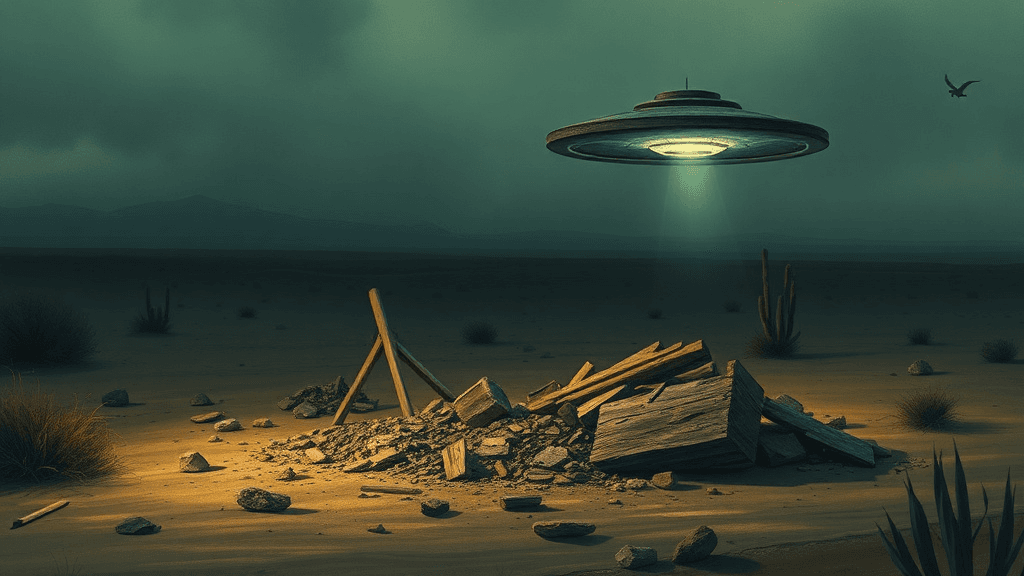
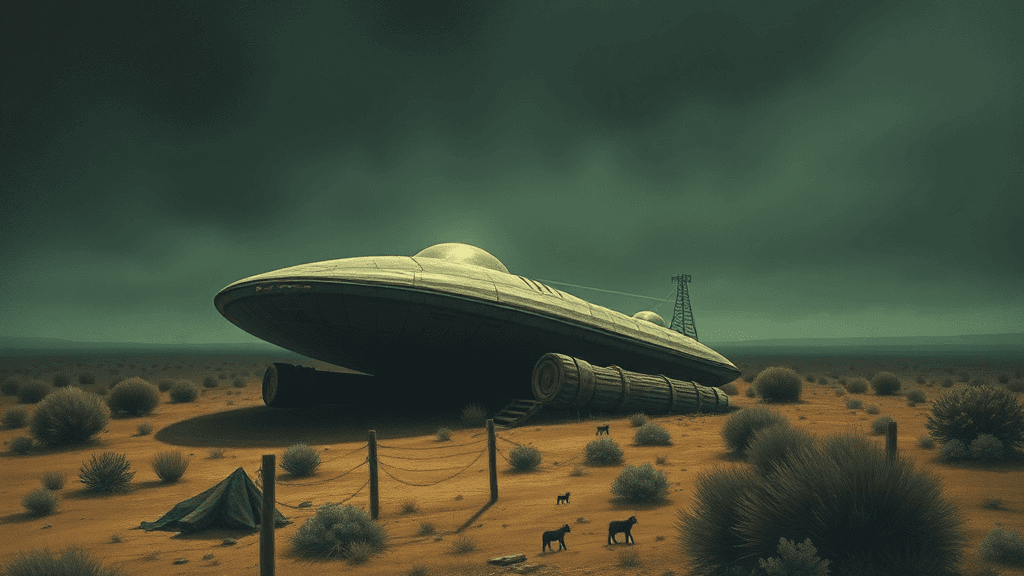
As the story was eventually told, on or around August 16, 1945, Padilla and Baca were riding horseback on the Padilla ranch west of San Antonio, searching for a missing cow. During a thunderstorm, they reportedly heard a tremendous crash and saw a bright flash. Following the disturbance, they came upon a large metallic object that had struck a communications tower, gouged a trench in the desert floor, and come to rest partially embedded in the earth.
The craft was described as roughly 30 feet long, avocado-shaped (a description that would become central to the narrative), and constructed of a dull metallic material. According to the witnesses, the hull was cracked open from the impact, allowing them to peer inside. They claimed to see small humanoid beings — variously described in different tellings as "ant-like creatures" or more conventionally humanoid figures — some apparently dead or injured.
Jose Padilla later stated that he was so young he did not initially understand what he was seeing. Both witnesses said they returned to the crash site multiple times in the days following the initial discovery. They claimed to observe thin, glowing filaments of "angel hair" material at the site and pieces of tin-foil-like metal that would spring back to its original shape when crumpled — a detail that echoes accounts from the later Roswell story.
A family friend, New Mexico State Police officer Eddie Apodaca, was said to have accompanied the boys to the crash site and entered the craft. The witnesses further claimed that within days, a U.S. Army detachment arrived with flatbed trucks and heavy equipment and removed the craft under a veil of secrecy. The military allegedly warned local ranchers to stay silent about what they had seen.
The Story Emerges
The Trinity crash narrative did not enter the public record until October 30, 2003, when journalist Ben Moffett published a two-part story in the Mountain Mail of Socorro, New Mexico. Moffett wrote the piece as a Halloween feature, documenting the recollections of Baca and Padilla, by then men in their mid-60s. Moffett would later distance himself from the story, telling researchers he was "never comfortable with many of Baca's assertions."
However, the story had a precursor. Investigative researcher Douglas Dean Johnson later discovered a recorded audio interview from late 2002 or early 2003 in which Reme Baca pitched a substantially different version of a childhood UFO encounter to Thomas J. Carey, a Roswell researcher. In this earlier version, the date was 1946 ("about a year since the bomb"), the boys arrived by pickup truck rather than horseback, the craft was disc-shaped rather than avocado-shaped, and the occupants were described as "ant-like creatures." Jacques Vallée would later concede this earlier version should be described as "fiction."
In 2011, Baca and Padilla self-published a memoir titled Born on the Edge of Ground Zero, which expanded their account. The book introduced a new figure: William "Billy" Brophy, who claimed his Air Force pilot father had witnessed the crash from the air and supervised the military recovery. Baca died in 2013; Padilla continued to tell the story at UFO conferences and in media appearances.
The story received its most significant boost in May 2021 when Jacques Vallée, one of the most respected figures in UFO research, and Italian journalist Paola Leopizzi Harris self-published Trinity: The Best-Kept Secret. Over several site surveys, Vallée and Harris reconstructed the witnesses' accounts and argued that the crash represented a deliberate symbolic response by non-human intelligence to humanity's development of nuclear weapons. Vallée framed the case provocatively: "What if their target was at a different level? At a symbolic level, about our relationship to life?"
The book gained mainstream attention when Vallée and Harris appeared on Fox News with Tucker Carlson to discuss their findings. The story subsequently influenced congressional action: Congressman Mike Gallagher inserted language into the 2023 National Defense Authorization Act requiring investigation of UAP incidents beginning January 1, 1945 — a date specifically chosen to encompass the Trinity claim.
Investigation and Criticism
The Trinity case drew intense scrutiny almost immediately after the Vallée-Harris book was published. The most systematic and damaging critique came from independent researcher Douglas Dean Johnson, who published a series of extensively documented articles beginning in May 2023 under the title "Crash Story: The Trinity UFO Crash Hoax."
Johnson's investigation uncovered what he characterized as fatal credibility problems with all three key witnesses:
Eddie Apodaca, the state trooper who allegedly accompanied the boys to the crash site, was documented by Johnson to have been serving with his Army unit in Europe in August 1945. Furthermore, Apodaca was not commissioned as a New Mexico State Police officer until January 1951 — six years after the alleged events. Johnson concluded that all quotes attributed to Apodaca in the crash narrative were "pure inventions."
Jose Padilla had claimed Korean War service and combat wounds, but the Korean War did not begin until June 1950, when Padilla would have been approximately 13 years old. No record of Padilla appeared in National Archives Korean War databases. Padilla also claimed extensive service with the California Highway Patrol, a claim Johnson found no evidence to support. At 5'3", Padilla would not have met the CHP's height requirements of the era. Vallée and Harris had cited Padilla's alleged law enforcement background six times in their book to bolster his credibility.
Reme Baca had falsely claimed to be a crucial political "kingmaker" for Washington Governor Dixy Lee Ray. Johnson documented that Baca had plagiarized passages nearly verbatim from writings by Louis Guzzo, an actual Ray associate. Baca also claimed to have accessed classified government files — another claim Johnson found unsupported.
Billy Brophy's account shifted dramatically over time. Prior to 2003, Brophy's letters placed his pilot father at a 1947 crash and never mentioned 1945. Only after the Baca-Padilla story was published did Brophy pivot to claiming his father witnessed the 1945 event. His father's role also expanded from modest cleanup participation to being an overhead witness who saw the crash in progress.
Regarding physical evidence, the witnesses produced a metallic bracket-like artifact they said was removed from the craft's interior. Multiple laboratory analyses identified it as conventional terrestrial aluminum manufactured to metric (non-U.S.) dimensions. Vallée speculated it may have originated in Mexico.
Brian Dunning of Skeptoid characterized the story bluntly as "a literal hoax, made up by people who knew they were making it up — not a distorted memory, not an honestly misinterpreted experience — but a straight-up hoax." Even UFO crash researcher Ryan Wood, who initially rated the story at "Medium-High" credibility (60–80%), later concluded after reviewing Johnson's findings that the account was "most likely a hoax."
Vallée's Defense
Jacques Vallée issued responses to the hoax allegations on May 15, 2023, and September 23, 2023. He challenged the characterization of the story as fabricated and suggested there might be a "deeper motive" in suppressing what he considered an important contribution to the congressional historical record on UFO phenomena. Two scientific papers summarizing physical analysis findings related to Trinity were drafted but withdrawn due to the controversy; Vallée indicated they might be resubmitted when "raucous accusations dissipate."
In his September 2023 declaration, Vallée made grudging concessions, including acknowledging that Eddie Apodaca could not have been present at the crash site as originally described. However, prominent associates who rallied to Vallée's defense did not publish substantive rebuttals to the specific factual findings Johnson had documented. Paola Harris acknowledged in September 2023 that "Reme Baca was pretty greedy," referencing Baca's documented demands of $250,000 for the artifact and another $250,000 for the story rights.
David Halperin, a professor emeritus of religious studies at the University of North Carolina who has written extensively on the psychology of UFO experiences, offered a middle-ground interpretation. He proposed that the witnesses' memories may have "took shape... as a fantasized doublet of their more or less accurate recollections" of the Trinity nuclear explosion itself, shaped partly by decades of exposure to the Roswell myth. This psychological explanation allowed for sincere (if unreliable) belief on the part of at least some witnesses, rather than pure fabrication.
The Case For
Proponents of the Trinity crash note several points in its favor:
- The proximity of the alleged crash to the first nuclear detonation fits a pattern observed in UFO reports worldwide, where nuclear facilities and test sites appear to attract disproportionate UAP activity.
- Jacques Vallée's involvement lent significant intellectual weight. As the model for the character of Claude Lacombe in Close Encounters of the Third Kind, Vallée is arguably the most credentialed researcher in UFO history, and his willingness to stake his reputation on the case gave many observers pause before dismissing it.
- Some details of the witnesses' descriptions — the memory-metal material, the small humanoid occupants — were consistent with other crash-retrieval narratives without being obviously derivative.
- The story influenced real legislative action, suggesting at least some members of Congress found it worthy of investigation.
The Case Against
The case against the Trinity crash is extensive and, in the view of most analysts, overwhelming:
- No contemporaneous documentation from 1945 has surfaced: no military records, no police reports, no local newspaper coverage, no aerial logs.
- The story was not told until 2003 — 58 years after the alleged event — by two men in their mid-60s.
- Multiple versions of the story exist with contradictory details (date, craft shape, mode of arrival, occupant descriptions).
- All three key witnesses had documented histories of fabricating biographical credentials.
- The physical artifact was identified as terrestrial aluminum.
- The original journalist distanced himself from the story.
- The February 2024 AARO Report on the Historical Record of U.S. Government Involvement with Unidentified Anomalous Phenomena found no evidence supporting any crash-retrieval claims, noting that such stories often result from "circular reporting from a group of individuals... despite the lack of any evidence."
Cultural Impact
Despite its severe credibility problems, the Trinity case has had outsized influence on the modern UFO discourse. Its most significant legacy may be legislative: the 2023 NDAA language requiring UAP investigations to cover events back to January 1, 1945, was directly inspired by the Trinity claim. This effectively expanded the temporal scope of official government UAP inquiry by two years.
The case also became a cautionary tale about the role of authority in UFO research. Vallée's prestige meant the Trinity story received far more attention and deference than its evidentiary basis warranted. Johnson's debunking demonstrated that basic background checks — verifying military service records, law enforcement employment, and biographical claims — had not been performed before publication. As Dunning noted, "any Congressional aide should have been able to determine [the problems] in an hour or two on the Internet."
For Vallée personally, the Trinity case represented an uncharacteristic stumble. A scientist who had built his reputation on methodological rigor and skepticism toward easy answers appeared to have been taken in by witnesses whose claims crumbled under scrutiny. The episode renewed debate about how even the most experienced researchers can fall prey to confirmation bias.
Current Status
As of 2024, the Trinity case is widely regarded as debunked among serious UFO researchers and skeptics alike. Jose Padilla continues to maintain the account is true. Reme Baca died in 2013. The AARO historical report effectively closed the door on any official government interest in the case, though the NDAA language it inspired remains on the books.
The Vallée-Harris book Trinity: The Best-Kept Secret remains in print, now in its second edition. Douglas Dean Johnson's investigative archive, freely available online, stands as the most thorough deconstruction of a modern UFO crash claim and is widely cited as a model of rigorous civilian investigation. The case serves as a reminder that in the field of UFO research, the reputation of the investigator is never a substitute for the quality of the evidence.
Witnesses
- Jose Padilla (b. ~1936) — claimed to be 9 years old at the time; primary witness who maintained the account into adulthood and continued appearing at conferences after Baca's death
- Remigio "Reme" Baca (b. ~1938, d. 2013) — claimed to be 7 years old; co-authored the 2011 memoir Born on the Edge of Ground Zero; first pitched the story to researchers around 2002–2003
- Eddie Apodaca — New Mexico State Police officer cited as a corroborating witness; later shown to have been serving in Europe with the U.S. Army in August 1945 and not commissioned as a state trooper until 1951
- William "Billy" Brophy — claimed his Air Force pilot father witnessed the crash and recovery from the air; his account shifted significantly after the Baca-Padilla story was published in 2003
Evidence
- Metallic artifact: A bracket-like object allegedly removed from the craft's interior. Multiple lab analyses identified it as conventional terrestrial aluminum manufactured to metric dimensions, possibly of Mexican origin.
- "Memory metal": Witnesses described tin-foil-like material that sprang back to its original shape when crumpled — a detail echoing Roswell accounts but never independently verified.
- "Angel hair": Glowing filament material reportedly observed at the site; no samples preserved.
- No contemporaneous documentation: No military records, police reports, newspaper accounts, or aerial logs from 1945 corroborate a crash or recovery operation in the area.
- Contradictory accounts: An earlier audio recording (late 2002/early 2003) preserves Baca telling a substantially different version of the story with different dates, craft shape, and mode of arrival.
- AARO finding (2024): The Department of Defense's historical review found no evidence supporting any alien crash-retrieval claims, attributing such stories to "circular reporting from a group of individuals."
People involved
Filed under
Watch
Radar confirms UFO swarm around Navy warship
W. Glenn Dennis Interview, 11/19/1990
Aliens are here, and they're not our friends, John Lear says -- Part 1
UFO Whistleblower Jason Sands Details Strange Alien Experience at Crash Site
The Proof Is Out There: UFO Crash Spotted in NASA Photo (Season 3) | History
Where this entry came from
ProvenanceAgent indexedUpdated 6mo ago9 sources
Drafted by the archive's AI research agent from the sources below; corrections from readers are reviewed and folded in.
- First indexed
- 24 APR 26 // 22:45Z
- Last updated
- 26 APR 26 // 12:20Z
- Crash Story: The Trinity UFO Crash Hoax, Douglas Dean Johnson, Douglas Dean Johnson's Substack
- The Trinity UFO Crash of 1945, Brian Dunning, Skeptoid
- Nuclear Test, UFO Crash – Vallee and Harris's 'Trinity' (Part 1), David Halperin, David Halperin
- Trinity UFO crash investigated by Jacques Vallée, Mystery Wire Staff, Mystery Wire
- Report on the Historical Record of U.S. Government Involvement with Unidentified Anomalous Phenomena — Volume 1, All-domain Anomaly Resolution Office, Department of Defense / AARO
- Trinity: The Best-Kept Secret, Jacques Vallée and Paola Leopizzi Harris, Amazon (self-published)
- Witness credibility implodes for Jacques Vallee's Trinity UFO crash tale, Douglas Dean Johnson, Douglas Dean Johnson's Substack
- The 1945 San Antonio UFO Crash — The Witness Interviews, Frank Warren, The UFO Chronicles
- Jacques Vallee Hits Back at Hoax Claims Over Trinity UFO Crash Book, Philip Mantle, Journo Jottings
Notes
- Crash Story: The Trinity UFO Crash Hoax, Douglas Dean Johnson, Douglas Dean Johnson's Substack
- The Trinity UFO Crash of 1945, Brian Dunning, Skeptoid
- Nuclear Test, UFO Crash – Vallee and Harris's 'Trinity' (Part 1), David Halperin, David Halperin
- Trinity UFO crash investigated by Jacques Vallée, Mystery Wire Staff, Mystery Wire
- Report on the Historical Record of U.S. Government Involvement with Unidentified Anomalous Phenomena — Volume 1, All-domain Anomaly Resolution Office, Department of Defense / AARO
- Trinity: The Best-Kept Secret, Jacques Vallée and Paola Leopizzi Harris, Amazon (self-published)
- Witness credibility implodes for Jacques Vallee's Trinity UFO crash tale, Douglas Dean Johnson, Douglas Dean Johnson's Substack
- The 1945 San Antonio UFO Crash — The Witness Interviews, Frank Warren, The UFO Chronicles
- Jacques Vallee Hits Back at Hoax Claims Over Trinity UFO Crash Book, Philip Mantle, Journo Jottings
Also available

The Day After Trinity
Academy Award-nominated documentary examining J. Robert Oppenheimer, the theoretical physicist who led the Manhattan Project to build the first atomic bomb tested at Trinity, New Mexico in July 1945, through interviews with scientists and declassified archival footage.

Trinity and Beyond: The Atomic Bomb Movie
Narrated by William Shatner, this documentary chronicles the development and testing of nuclear weapons from the Trinity test in 1945 through the first Chinese atomic bomb test in 1964, using restored archive footage and an original score by the Moscow Symphony Orchestra.
Trinity
Recent documentary exploring the devastating human impact of the world's first nuclear test in the New Mexico desert in July 1945, contrasting official histories with first-person testimony from Navajo Nation residents and others affected by radiation and fallout.
The Bomb
PBS documentary tracing the history of nuclear weapons from theoretical physics through the Trinity test in 1945, to the bombings of Hiroshima and Nagasaki, to the Cold War arms race and the global implications of atomic weapons in the modern world.
Buying through these links supports the library. We may earn a commission.