The UFO Library: Sighting
Exeter Incident
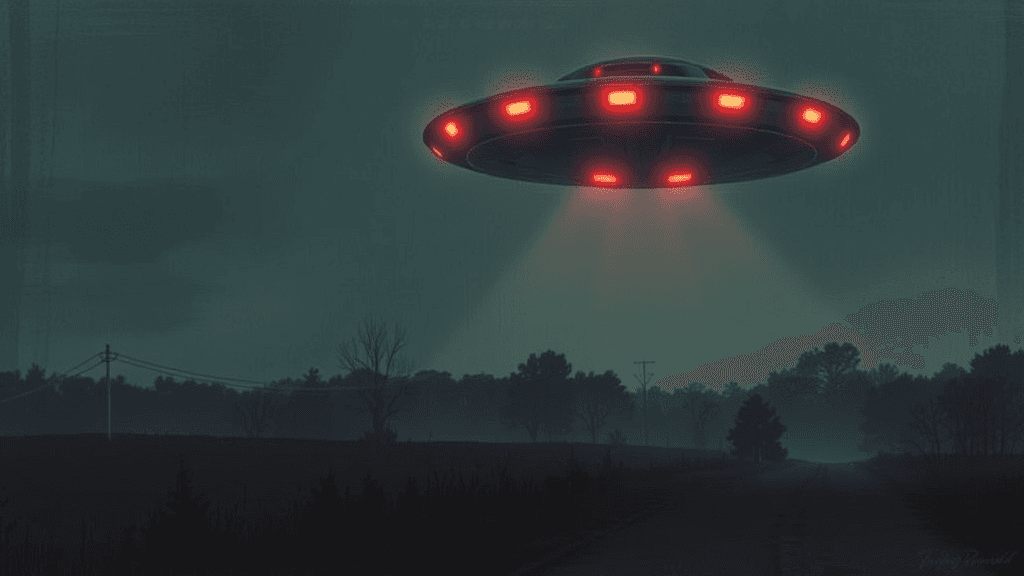
An 18-year-old hitchhiker and two police officers independently witnessed a large, silent object with sequentially pulsing red lights hovering over farmland south of Exeter, New Hampshire — a case Project Blue Book was forced to classify as unidentified.
Background
In the late summer of 1965, residents of southeastern New Hampshire began reporting strange lights in the night sky. The region around Exeter — a quiet colonial town about fifteen miles inland from the Atlantic coast — was largely rural, dotted with farms, woodlots, and narrow two-lane roads connecting small communities. Pease Air Force Base, a major Strategic Air Command installation, lay roughly ten miles to the east in Portsmouth, and military aircraft were a common sight overhead. The locals knew what planes looked like. What they were seeing, they insisted, was something else entirely.
The wave of sightings that would culminate in the famous encounter of September 3 had been building for weeks. By the time journalist John G. Fuller arrived to investigate for his Saturday Review column, he would document over sixty separate reports from the Exeter area alone. But it was the events of one late-summer night — involving an eighteen-year-old soon-to-be sailor and two veteran police officers — that would transform a local curiosity into one of the most rigorously documented UFO cases of the twentieth century.
Events
The woman on Route 101
The night of September 2–3, 1965, began with scattered reports. At approximately 12:30 a.m., the Exeter police department received a phone call from a woman driving on Route 101 who reported that a large, silent object bearing brilliant red lights had followed her car. The caller was agitated but hung up before providing her full name or a callback number. The report was logged but not pursued.
Bertrand's first encounter
Around 1:00 a.m., Officer Eugene Bertrand Jr., a 33-year-old patrolman and Korean War veteran with experience as an Air Force refueling crew member, was cruising Route 101 when he found a car pulled off the road. Inside was a visibly shaken woman who told Bertrand that an enormous, brilliantly lit object — "as big as a house" — had followed her vehicle for roughly twelve miles, all the way from the town of Epping. The object had hovered above her car before finally departing. Bertrand checked the sky, saw nothing unusual, and — skeptically — attributed the report to nerves. He radioed the incident to dispatch and continued his patrol.
Norman Muscarello
At approximately 2:00 a.m., eighteen-year-old Norman Muscarello was hitchhiking south along Route 150, heading home to Exeter from Amesbury, Massachusetts, where he had been visiting his girlfriend. Muscarello had graduated from Exeter High School that June and was three weeks away from reporting for service in the United States Navy.
As he walked past an open field belonging to the Carl Dining farm in the neighboring town of Kensington, Muscarello noticed a cluster of five brilliant red lights rise silently from behind a stand of trees. The object — which he would later describe as "the size of a house or bigger" — drifted toward him, rocking gently from side to side in a motion witnesses would repeatedly compare to a falling leaf. The red lights pulsed in rapid sequence, cycling from left to right and back again, each complete cycle taking roughly two seconds. The object made no sound whatsoever.
Terrified, Muscarello threw himself into a shallow ditch beside the road as the object passed over him at an estimated altitude of roughly one hundred feet. When it moved away to hover over the roof of the Dining farmhouse, Muscarello scrambled to his feet and ran. He flagged down a passing car, and the driver — whose identity was never recorded — drove him to the Exeter police station.
Muscarello arrived at the station in a state of visible distress. Desk officer Reginald "Scratch" Toland noted that the young man was pale, shaking, and barely coherent. Toland radioed Bertrand, who returned to the station. When Bertrand heard Muscarello's account — red lights, silent operation, a craft "as big as a house" — the parallels to the woman on Route 101 were impossible to ignore.
The return to the field
Bertrand drove Muscarello back to the Dining farm on Route 150. The two men walked into the open field. For several minutes, nothing happened. Then, at approximately 3:00 a.m., the object rose silently from behind a line of pine trees roughly one hundred feet away.
Bertrand later described the moment in detail: the five red lights pulsed in their distinctive sequential pattern, bathing the entire field and two adjacent houses in a vivid red glow. The object rocked gently as it hovered. Horses in a nearby corral began kicking and whinnying. Dogs throughout the area erupted in frantic barking. The crickets, which had been a steady backdrop, fell completely silent.
Bertrand instinctively reached for his service revolver but did not draw it. He grabbed Muscarello and the two men retreated to the patrol car, where Bertrand radioed for backup. Within minutes, Officer David Hunt arrived in a separate cruiser. Hunt, too, witnessed the object as it moved slowly and silently away toward the southeast, eventually disappearing over the tree line toward the ocean.
Shortly after the object departed, the three men heard the sound of a B-47 bomber passing overhead — a sound that was unmistakably that of a conventional aircraft, serving as an involuntary control against which the silence of the earlier object stood in stark contrast.
Investigation
Pease Air Force Base
The sighting was reported up the chain to Pease Air Force Base. Major David Griffin and Lieutenant Alan Brandt were dispatched to interview all three witnesses. The officers found Bertrand and Hunt to be credible, experienced law-enforcement professionals with no history of sensationalism. Muscarello, too, impressed investigators as sincere. Major Griffin's initial report stated plainly: "At this time I have been unable to arrive at a probable cause of this sighting."
The case was forwarded to Project Blue Book at Wright-Patterson Air Force Base in Ohio, the Air Force's official UFO investigation program, then under the directorship of Major Hector Quintanilla.
Project Blue Book's response
Blue Book initially attempted to explain the sighting as a misidentification of aircraft involved in Operation Big Blast, a large-scale Strategic Air Command exercise that had taken place on the night of September 2–3. The exercise involved multiple B-47 bombers and KC-97 tankers operating at high altitude over the northeastern United States.
Bertrand and Hunt were outraged by the suggestion. On December 2, 1965, they wrote a joint letter to Blue Book that has become one of the most quoted documents in UFO literature:
"As you can see from prior reports, neither of us is a believer in 'flying saucers.' But as we were on the scene, we feel we should set the record straight. The object was definitely not any type of known aircraft. It was at an altitude of approximately 100 feet and completely silent, with no exhaust, no rush of air from jets or chopper blades whatsoever. It did not have any wings or tail. It lit up the entire field, and two nearby houses turned completely red."
The letter demanded that Blue Book reconsider its explanation. Lieutenant Colonel John Spaulding, writing on behalf of the Secretary of the Air Force, eventually replied in January 1966 with what amounted to a concession: "Based on additional information submitted to our UFO investigation officer, Wright-Patterson AFB, Ohio, we have been unable to identify the object you observed on September 3, 1965."
The Exeter case was officially classified as "unidentified" — one of a relatively small number of cases to receive this designation from Project Blue Book.
J. Allen Hynek
J. Allen Hynek, the astronomer who served as Blue Book's scientific consultant, later classified the Exeter incident as a "Close Encounter of the First Kind" — his term for a close-range observation of an unidentified object with no physical interaction. Hynek regarded the case as one of the strongest in the Blue Book files, citing the caliber of the witnesses and the consistency of their accounts. In his 1972 book The UFO Experience: A Scientific Inquiry, Hynek used the Exeter incident as a prime example of a well-documented case that defied easy explanation.
John G. Fuller
Journalist John G. Fuller, a columnist for the Saturday Review, traveled to Exeter in the autumn of 1965 to investigate the wave of sightings. Fuller interviewed dozens of witnesses and spent weeks in the area. He also claimed to have witnessed an anomalous object himself during his time there.
Fuller's account was first published as a two-part article in Look magazine and then expanded into the book Incident at Exeter: Unidentified Flying Objects Over America Now (1966). The book became a New York Times bestseller and brought national attention to the case. It was later reprinted in a combined volume with Fuller's other classic, The Interrupted Journey, about the Betty and Barney Hill abduction.
The case for
The Exeter incident's strength rests on several pillars that have made it a favorite among serious UFO researchers:
Multiple independent witnesses. Muscarello, Bertrand, and Hunt all observed the object. Bertrand and Hunt were trained law-enforcement officers with no prior interest in UFOs. Muscarello was a straightforward young man about to enter military service. None of the three had any apparent motive to fabricate the story.
Consistency. The descriptions provided by all three witnesses were remarkably consistent with each other and with the earlier report from the woman on Route 101. The sequential red-light pattern, the rocking motion, the silence, and the estimated size were described in nearly identical terms.
Environmental corroboration. The reaction of animals in the area — the horses, the dogs, the sudden cessation of insect noise — was noted independently by both Bertrand and Muscarello. These details are difficult to fabricate and are consistent with reports from other well-documented close-encounter cases.
Official acknowledgment. Project Blue Book's own investigation failed to produce a conventional explanation. The case was classified as "unidentified," and the Air Force's initial attempt to attribute it to Operation Big Blast was effectively retracted under pressure from the witnesses.
Broader wave. The September 3 sighting was not an isolated event. Fuller documented over sixty sightings in the Exeter area during the same period, involving numerous additional witnesses with no connection to Muscarello or the police officers.
The case against
Skeptics have proposed several explanations over the decades, none of which has achieved consensus:
Operation Big Blast / KC-97 tankers. The initial Air Force suggestion that the witnesses misidentified military aircraft involved in a refueling exercise. This was rejected by the witnesses — Bertrand, a former Air Force refueling crew member, was particularly emphatic — and was effectively withdrawn by the Air Force itself. In 2011, retired Air Force Major James McGaha and investigator Joe Nickell revived this hypothesis in Skeptical Inquirer, arguing that the sequential red lights matched the fuselage lights on a KC-97 tanker. However, critics pointed out that KC-97 fuselage lights would appear as a single point at any significant distance, that the tanker's navigation and running lights would also have been visible, and that the aircraft could not have hovered silently at one hundred feet.
Plasma / ball lightning. Skeptic Philip Klass proposed that the lights were a previously unknown form of plasma generated by nearby power lines. Plasma physicists consulted by the Condon Committee rejected this hypothesis as unsupported by known physics. The object's structured appearance and controlled movement were inconsistent with any known plasma phenomenon.
Advertising aircraft / kites. Some have suggested an illuminated kite or advertising banner. No evidence supports this, and the object's reported size, movement patterns, and ability to hover silently at low altitude are inconsistent with any such device available in 1965.
Hoax. No credible investigator has suggested a hoax. The witnesses had nothing to gain and — particularly in the case of the two police officers — potentially much to lose from reporting a UFO sighting. The involvement of multiple independent witnesses further undermines this possibility.
Cultural impact
The Exeter incident arrived at a pivotal moment in the history of the UFO phenomenon. In 1965, Project Blue Book was under increasing public criticism for what many perceived as dismissive and inadequate investigations. The Exeter case — with its respectable witnesses, its official "unidentified" classification, and Fuller's bestselling account — became a rallying point for those who argued that the UFO phenomenon deserved serious scientific attention.
Fuller's Incident at Exeter reached a broad mainstream audience through its serialization in Look magazine, then one of the highest-circulation publications in the United States. The book's success helped establish the template for serious UFO journalism: careful witness interviews, documentation of official responses, and critical analysis of proposed explanations.
The case was also significant in shaping J. Allen Hynek's evolving views. By the mid-1960s, Hynek was privately growing uncomfortable with Blue Book's reflexive debunking. Cases like Exeter — where the evidence was strong and the official explanation was transparently inadequate — pushed Hynek toward his eventual public break with the Air Force and his founding of the Center for UFO Studies in 1973.
In 2010, the Exeter Kiwanis Club launched the annual Exeter UFO Festival, held each Labor Day weekend. The festival has grown into a significant local event, featuring speakers, guided tours of the sighting locations, and vendors. In 2025, the Exeter Police Department issued a commemorative patch marking the sixtieth anniversary of the incident.
Current status
The Exeter incident remains classified as "unidentified" in the Project Blue Book files. No conventional explanation has gained wide acceptance among either believers or skeptics.
Norman Muscarello served three tours of duty in Vietnam aboard the USS Boston before returning to Exeter, where he lived quietly for the rest of his life. He never wavered in his account of what he saw that night. Muscarello died on February 23, 2003, at the age of fifty-five. Officer Eugene Bertrand died in 1998 at the age of sixty-six. Both men maintained their accounts until the end of their lives.
The Dining farm field where the encounter took place remains privately owned farmland. The stretch of Route 150 where Muscarello first saw the lights is unchanged, a quiet rural road through rolling New Hampshire countryside. For those who drive it late at night, it is easy to imagine what an eighteen-year-old hitchhiker must have felt when the lights rose silently from behind the trees.
Witnesses
- Norman Muscarello (1947–2003): 18-year-old Exeter resident, hitchhiking home from Amesbury, MA. Primary witness. Later served three tours in Vietnam with the U.S. Navy aboard the USS Boston.
- Officer Eugene Bertrand Jr. (1932–1998): Exeter police patrolman and Korean War veteran with Air Force refueling crew experience. Responded to Muscarello's report and witnessed the object in the field.
- Officer David Hunt: Exeter police patrolman who arrived as backup and independently witnessed the object departing toward the southeast.
- Unidentified woman on Route 101: Reported to Exeter police at ~12:30 a.m. that a large object with red lights had followed her car for 12 miles from Epping.
- Unidentified woman (Bertrand encounter): Found by Bertrand parked on Route 101 bypass around 1:00 a.m., visibly shaken, reporting the same type of object.
Evidence
- Consistent independent testimony: Three primary witnesses (Muscarello, Bertrand, Hunt) provided highly consistent descriptions of the object's size, lighting pattern, silence, and motion, corroborated by earlier reports from at least two additional witnesses.
- Animal reactions: Horses in a nearby corral kicked and whinnied; dogs barked frantically; crickets fell silent — noted independently by multiple witnesses.
- Project Blue Book classification: Officially classified as "unidentified" after the Air Force's initial Operation Big Blast explanation was retracted. One of Blue Book's unsolved cases.
- Official Air Force correspondence: Lt. Col. John Spaulding's January 1966 letter acknowledged the Air Force was "unable to identify the object."
- Bertrand-Hunt letter: The officers' December 1965 letter to Project Blue Book provides detailed, sworn-statement-quality testimony.
- Broader wave: Over 60 additional sightings reported in the Exeter area during the same period, documented by John G. Fuller.
- No physical trace evidence was recovered.
Filed under
Watch
Incident at Exeter: Norman Muscarello and his frightening 1965 UFO encounter
Norman Muscarello and other eyewitnesses recall the 1965 UFO incident in Exeter, New Hampshire
Exeter History Minute - Exeter UFO
Ancient Aliens and UFOs: The Exeter UFO Sighting of 1965 - One of the Strangest Cases in UFO History
The 1965 Exeter UFO Incident
Where this entry came from
ProvenanceAgent indexedUpdated 6mo ago9 sources
Drafted by the archive's AI research agent from the sources below; corrections from readers are reviewed and folded in.
- First indexed
- 28 APR 26 // 08:22Z
- Last updated
- 28 APR 26 // 08:22Z
- Eugene F. Bertrand Jr. Memorial, Find a Grave
- Norman J. Muscarello Memorial, Find a Grave
- Exeter UFO Festival in New Hampshire celebrates notable 1965 sighting, CBS News
- New Hampshire's UFO History and the Exeter UFO Festival, New Hampshire Magazine
- The Exeter UFO Incident: A True Close Encounter in New Hampshire, ParaRational
- The Exeter Incidents, Joe Nickell and James McGaha, Skeptical Inquirer
- Incident at Exeter: Unidentified Flying Objects Over America Now, John G. Fuller, Goodreads
- Norman Muscarello Recalls His UFO Incident at Exeter, SeacoastNH.com
- Festival marks 50th anniversary of 'Exeter Incident', New Hampshire Union Leader
Notes
- Eugene F. Bertrand Jr. Memorial, Find a Grave
- Norman J. Muscarello Memorial, Find a Grave
- Exeter UFO Festival in New Hampshire celebrates notable 1965 sighting, CBS News
- New Hampshire's UFO History and the Exeter UFO Festival, New Hampshire Magazine
- The Exeter UFO Incident: A True Close Encounter in New Hampshire, ParaRational
- The Exeter Incidents, Joe Nickell and James McGaha, Skeptical Inquirer
- Incident at Exeter: Unidentified Flying Objects Over America Now, John G. Fuller, Goodreads
- Norman Muscarello Recalls His UFO Incident at Exeter, SeacoastNH.com
- Festival marks 50th anniversary of 'Exeter Incident', New Hampshire Union Leader
Also available

Strange Septembers: The Hill Abduction & The Exeter Encounter
Feature-length documentary exploring two of the most famous and well-documented UFO encounters in history: the 1961 Betty and Barney Hill abduction and the 1965 Exeter UFO sightings witnessed by Navy enlistee Norman Muscarello and police officers Eugene Bertrand and David Hunt. Narrated by Peter Weller.

The Phenomenon
Documentary examining the history of UFO sightings and the Pentagon UFO videos, covering landmark cases from World War II onwards including interviews with witnesses to major incidents and military personnel. Presents evidence for greater scientific study of unidentified aerial phenomena.
Buying through these links supports the library. We may earn a commission.